

Economy
How FG Suspended SEC DG for Insisting on Forensic Audit of Oando

By Modupe Gbadeyanka
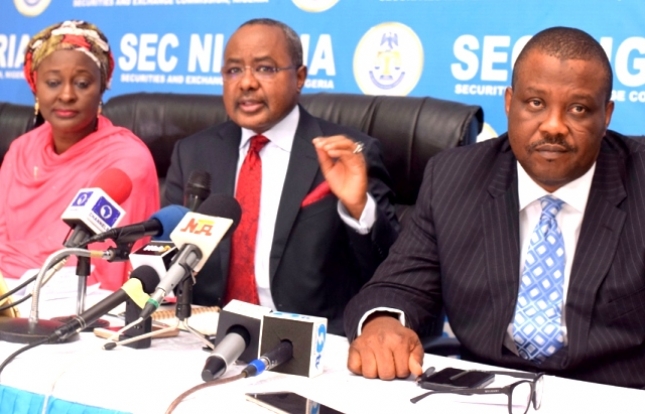
The suspension of Director-General of the Securities and Exchange Commission (SEC), Mr Mounir Gwarzo, yesterday by the Federal Government may not come as a surprise to some observers in the Nigerian capital market, but the reason behind this move may shock some.
An exclusive report by Premium Times suggested that the regulatory chief was suspended because he insisted on conducting a forensic audit on one of the biggest indigenous oil firms in the country, Oando Plc, headed by Mr Adewale Tinubu, to save the integrity of the capital market regulator.
Oando was accused of gross financial misconducts by two petitioners and SEC suspended trading of shares of the company on the Nigerian Stock Exchange (NSE).
After this action, there was an allegation against the SEC boss that after he was appointed as the DG, he paid himself N104 million as severance package as a former Executive Commissioner of SEC.
Below is Premium Times’ report:
Just before 5:00 p.m. on Wednesday evening, selected journalists got mails from the finance ministry of an impending ‘news break.’
“Kindly await a major news break from the Federal Ministry of Finance today at 6.30 p.m.,” Oluyinka Akintunde, the spokesperson of the Finance Minister, Kemi Adeosun, said; an indication that a decision to be announced to the public about 90 minutes later had already been made.
Less than an hour after Mr. Akintunde’s mail, the news was announced. Munir Gwarzo, the Director General of the Securities and Exchange Commission, SEC, had been suspended.
Suspended alongside Mr. Gwarzo were two officials of the regulatory commission, Abdulsalam Habu, Head of Media Division, and Anastasia Braimoh, Head of Legal Department.
The finance ministry in the statement signed by Patricia Deworitshe, Deputy Director, Press, announced that the officials were suspended based on corruption allegations against them.
“The Honourable Minister has set up an Administrative Panel of Inquiry (API) to investigate and determine the culpability of the Director-General”, Ms. Deworitshe announced.
Ms. Deworitshe did not announce the reason why it took the finance minister 10 months to acknowledge and act after the allegations were made to her office and anti-corruption agencies against Mr. Gwarzo and the two others.
However, ongoing investigation by PREMIUM TIMES reveals that while the allegations against the regulatory chief deserve to be investigated and suspects prosecuted if found guilty, the real reason for the suspension was the crisis rocking Nigeria’s supposed largest indigenous oil and gas firm, Oando.
In fact, sources told PREMIUM TIMES, the decision to suspend Mr. Gwarzo was taken at least 24 hours before Mr. Akintunde’s first mail to journalists on Wednesday at a meeting attended by three people.
THE MEETINGS
On Tuesday, the SEC chief met with the Permanent Secretary of the Ministry of Finance, Mohammed Dutse, two sources knowledgeable about the meeting told PREMIUM TIMES although both gave varying details of the meeting.
One source said the Tuesday meeting was a follow up to another held between Mr. Gwarzo, Mrs. Adeosun, and Mr. Dutse.
At the Monday meeting, the source said, Oando was the only topic of discussion.
A few hours before the Monday meeting, SEC had written the oil and gas firm, formally notifying it of the decision to commence the forensic audit earlier announced in October.
“The Commission notes that the above findings (of irregularities in Oando) are weighty and therefore needs to be further investigated. After due consideration, the Commission believes that it is necessary to conduct a forensic audit into the affairs of Oando Plc”, the commission had stated on October 18.
However, hours after the SEC letter was delivered to Oando, the Monday afternoon meeting was reportedly called at the instance of the minister.
During the meeting, Mrs. Adeosun reportedly ordered Mr. Gwarzo to call off the forensic audit of Oando.
“She advised him to rather constitute a committee that would recommend that Oando pays large sums as penalties for its various infractions”, the source said.
Mr. Gwarzo reportedly told the minister and permanent secretary that his commission would not discontinue the audit process as such would have a negative effect on public perception of its role as a regulator.
The source said the DG was confronted with the threat to either resign or be suspended from office, ostensibly to allow ample time for the Oando issue to be sorted before his reinstatement later.
It was then Mr. Gwarzo reportedly received the shocker. He was allegedly reminded by the minister of pending allegations against him and that, “those could be brought back.”
Worried by the mood of the alleged Monday meeting and the pressure allegedly put on him by the minister, Mr. Gwarzo reportedly briefed some of his close confidants on the discussions at the meeting.
Mrs. Adeosun’s spokesperson, however, told PREMIUM TIMES that the Monday meeting never held. He, however, confirmed the Tuesday meeting but gave a different narrative of what transpired.
Our source, who sought anonymity for fear of victimisation, said Mr. Gwarzo on Tuesday sent a memo to Mrs. Adeosun documenting the implications of derailing the forensic audit, particularly the negative signal it would send to the capital market, in view of the horrible financial position of Oando.
In the memo, he made reference to Section 11(d) of the SEC Act on his duty as the Director General of the Commission to advise the minister on such matters, the source said.
He advised the minister to “allow the matter to follow its course professionally, for the integrity of its regulatory function.” The source said it was the content of the memo, and the minister’s actions, that was discussed with Mr. Dutse on Tuesday.
Mrs. Adeosun’s spokesperson, Mr. Akintunde, however, gave a different narrative of what transpired on Tuesday.
In an interview with PREMIUM TIMES on Thursday morning, Mr. Akintunde said the SEC boss did not meet with the minister but only met with the permanent secretary on Tuesday to seek a “soft landing” over the corruption allegations.
“The minister was not even in office on Monday. Mr. Gwarzo went to the Permanent Secretary on Tuesday to seek a soft landing over allegations that he paid himself N104 million severance package while still in office; and the private companies he used to award contracts to his relations.”
Mr. Akintunde said it was after the meeting with the permanent secretary that Mr. Gwarzo was advised to go and consider resigning his appointment.
In his reaction to why it took 10 months for the minister to react to the corruption petition, Mr. Akintunde said, “investigations were conducted to authenticate the substance of the petition, queries were issued and answers received; the anti-graft agencies have to be given the chance to do their job.”
Another source at the SEC, knowledgeable about the matter, however, questioned Mr. Akintunde’s claim.
“If the investigations have already been conducted by the finance ministry, why set up a panel again? Since the matter is already being investigated by EFCC and ICPC, why not let them complete their investigation and prosecute those found wanting. It’s a lie, the suddenness is all about protecting Oando even though Gwarzo has a case to answer,” the source said.
THE ALLEGATIONS AGAINST GWARZO
In the corruption petition, which is currently being investigated by the two anti-corruption agencies, EFCC and ICPC, Mr. Gwarzo was accused of pocketing about N104.85 million as severance package while still in service.
He was also accused of getting entangled in a conflict of interest as a Director in Medusa Investment Limited, a company he allegedly used to funnel millions in contract awards while still in office in violation of extant rules.
Officials at the EFCC and the ICPC confirmed that their commissions are investigating the matter and had indeed questioned several officials mentioned in the alleged scandal several times.
EFCC
At the EFCC, the case is being handled by the Capital Market and Investment Fraud Section, CMIFS, section headed by Adesola Amusan.
When he was invited earlier this year, the SEC chief was said to have admitted to the EFCC that he indeed received a severance package, but insisted it was not for the office he currently occupies as DG, but for when he held office as a commissioner.
Mr. Gwarzo was said to have submitted documents, including the extract of a Board meeting of SEC held on July 11, 2002, long before he joined the commission.
Any senior official who attains the position of either a DG or commissioner was entitled to draw a severance package after completing two years in office, that board resolution stated.
Having completed over two years and five months in office, as a commissioner, Mr. Gwarzo reportedly told the operatives he was entitled to the severance package.
PREMIUM TIMES findings show that Mr. Gwarzo served as Executive Commissioner of SEC for two years and four months prior to his appointment by former President Goodluck Jonathan on May 22, 2015, to succeed Arunma Oteh as the Director-General of SEC.
While our ongoing investigations show that this practice of paying people such severance packages is common in SEC, its legality is questionable, an issue the EFCC and ICPC are still looking into; to, among others, determine how many officials benefitted from such arrangement in the past.
Apart from the suspended officials, other officials including the executive commissioner, corporate services of SEC, also appeared before ICPC investigators.
The spokespersons of both the EFCC, Wilson Uwujaren, and ICPC, Rasheedat Okoduwa, could not be reached for comments on the current status of their investigations.
While Mr. Uwujaren’s phone number was not reachable, Ms. Okoduwa did not pick or return calls made to her.
While the anti-corruption agencies continue to investigate the allegations against Mr. Gwarzo and others, and now joined by the administrative panel set up by the finance ministry, attention will now be focused on what the regulator will do about Oando.
THE OANDO CRISIS
The proposed forensic audit of Oando followed two petitions SEC received from concerned shareholders, Dahiru Mangal and Ansbury Incorporated, about alleged mismanagement of the company’s financial affairs and distortion of its shareholding structure.
Following the petition, SEC said it conducted a comprehensive review, which revealed massive breaches of the provisions of the Investments & Securities Act 2007 and the SEC Code of Corporate Governance for Public Companies.
Consequently, the Commission announced the appointment of a consortium of experts, consisting auditors, lawyers, stockbrokers and registrars, to conduct the forensic audit, while shares of Oando Plc at the Nigerian Stock Exchange, NSE were placed on temporary technical suspension.
The technical suspension is still in place, meaning while trading on Oando stock is still allowed, there will not be any price changes.
Last week, the oil firm also lost a bid to stop the forensic audit planned by SEC as a Federal High Court ruled against it.


