Economy
Asian Stocks Recover from Early Losses to Finish Bullish
By Investors Hub
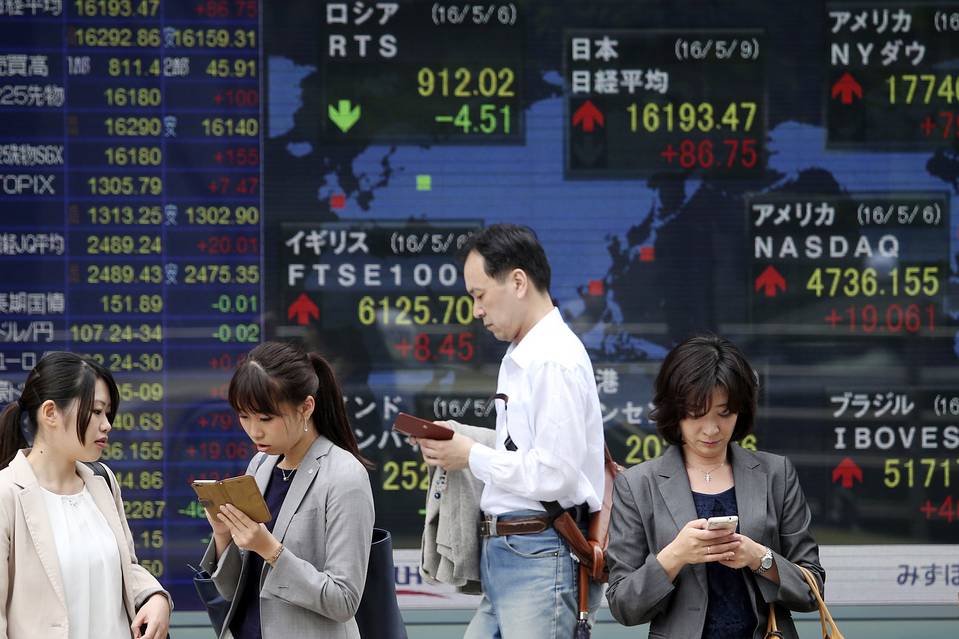
Asian stocks recovered from early losses to finish mostly higher on Monday as news of U.S.-China trade talks raised hopes for a de-escalation in trade tensions.
China and the United States will hold lower-level trade talks this week, just before new U.S. tariffs on $16 billion of Chinese goods take effect.
Chinese shares hit 2-1/2-year lows in early trading before reversing direction to end sharply higher following reports that China’s securities regulator is in discussion with brokerage economists and strategists to contain market volatility.
The benchmark Shanghai Composite Index jumped 29.50 points or 1.1 percent to 2,698.47, while Hong Kong’s Hang Seng Index surged up 384.61 points or 1.4 percent at 27,598.02.
Meanwhile, Japanese shares fell modestly in thin trading as investors awaited the latest developments in U.S.-China trade negotiations.
The Nikkei 225 Index dropped 71.38 points or 0.3 percent to 22,199.00, while the broader Topix Index closed 0.3 percent lower at 1,692.15, marking the lowest level since early April.
Tech stocks followed their U.S. peers lower after the Philadelphia SE Semiconductor index dropped 0.7 percent on Friday. Sumco Corp fell over 3 percent, while Advantest and Tokyo Electron dropped more than 1 percent each.
FamilyMart UNY Holdings shares fell as much as 11.3 percent after climbing 5.4 percent in the previous session.
Australian shares ended little changed as gains in material stocks were offset by disappointing outlooks from the likes of Woolworths Group and Ansell. The benchmark S&P/ASX 200 Index ended roughly flat at 6,345, while the broader All Ordinaries Index inched up 0.1 percent to 6,435.10.
Fortescue Metals Group rose 1.2 percent despite the company reporting a 58 percent fall in full-year statutory net profit.
Mining heavyweight BHP Billiton gained 1.3 percent and Rio Tinto edged up 0.3 percent. Gold miners Evolution and Newcrest jumped around 2.5 percent.
Woolworths Group shares shed 0.6 percent after the supermarket giant said that sales growth dropped off early in the new financial year. Rubber products maker Ansell plunged 7.2 percent after a profit warning over rising costs.
The big four banks ended down between 0.3 percent and 0.9 percent while energy companies Santos, Oil Search and Woodside Petroleum climbed 1-2 percent.
Economy
Nigeria Renews Push for West African Single Currency as ECOWAS Hold Talks
By Adedapo Adesanya
Nigeria is stepping up engagement toward the creation of a regional single currency, following fresh consultations among West African monetary authorities, following constant delay of achieving the goal.
In an update by the Central Bank of Nigeria (CBN) via its X handle, the Governor of the apex bank, Mr Yemi Cardoso, led the country’s delegation to the Committee of Governors meeting held in Monrovia, Liberia, where policymakers reviewed progress and renewed discussions on establishing the long-proposed single currency known as the Eco.
Last year, the West African bloc announced that the single regional currency would be launched by 2027 to foster greater economic integration among member states by facilitating trade through a unified payment system, enhancing price stability and reducing inflationary pressures.
In the latest development, the CBN statement noted that the Nigerian delegation also included Deputy Governor (Economic Policy), Mr Muhammad Sani Abdullahi.
“The meeting formed part of statutory engagements jointly organised by the Economic Community of West African States alongside the West African Monetary Agency, the West African Monetary Institute, and the West African Institute for Financial and Economic Management. The consultations brought together financial regulators and economic policymakers across the sub-region to assess convergence benchmarks required for launching the unified currency”, the apex bank said.
The Eco project is designed to deepen economic integration among ECOWAS member states by providing a common legal tender that would facilitate cross-border trade, enhance price transparency and reduce transaction costs tied to multiple currency exchanges. The initiative has been under discussion for over two decades but has experienced repeated postponements as member countries struggle to meet strict macroeconomic convergence criteria.
The apex bank noted that the meeting focused on evaluating member states’ performance against key economic indicators. These include inflation rate ceilings, fiscal deficit thresholds relative to gross domestic product, and foreign reserve adequacy, all considered critical safeguards for ensuring stability within a potential monetary union.
Despite many delays, ECOWAS latest move shows it may be aligning with Nigeria’s Minister of Foreign Affairs, Mr Yusuf Tuggar, saying last year that member states have started attaining benchmarks to see the goal actualised.
Economy
NCS Denies Manipulating FX Rates in Import, Export Valuation
By Adedapo Adesanya
The Nigeria Customs Service (NCS) has clarified how foreign exchange rates are applied in its import and export valuation, saying it neither determines nor alters rates used in cargo clearance.
The service, in a statement by its National Public Relations Officer, Mr Abdullahi Maiwada, explained that it relies solely on official figures transmitted by the Central Bank of Nigeria (CBN).
Mr Maiwada stated that recent public commentary surrounding forex pricing, investor reactions, and customs valuation had prompted NCS to explain the operational framework guiding its digital clearance platform.
“It is worthy of note that the reported exchange rate of N1,451.63/US$ for February 6, 2026 did not originate from the B’Odogwu system.
“That figure was sourced from trade.gov.ng, a legacy public trade information portal that does not reflect live Customs processing data,” it stated.
According to him, all exchange rates used in trade processing are automatically integrated into its Unified Customs Management System, known as B’Odogwu, which it described as the sole official portal for declarations, clearance, and valuation.
“It is important to provide factual clarification on how exchange rates are received, processed, and applied within the NCS digital clearance system, B’Odogwu, a Unified Customs Management System which serves as the sole official platform for Customs declarations, clearance, and valuation,” the statement reads.
The NCS spokesman said the Service receives rates electronically from the apex bank and applies them uniformly across commands nationwide, ensuring transparency, predictability, and compliance with statutory fiscal and monetary policies.
He argued that NCS does not generate or manipulate exchange rates under any circumstances.
Instead, it explained that the platform operates structured data-integration protocols designed to ingest and apply exchange-rate feeds exactly as transmitted.
“For the avoidance of doubt, the Nigeria Customs Service does not independently determine, generate, alter, or apply margins to foreign exchange rates used for import and export valuation.
“All exchange rates applied within the B’Odogwu platform are official rates electronically transmitted by the Central Bank of Nigeria, which remains the competent authority for exchange rate determination under Nigeria’s monetary framework,” Mr Maiwada added.
Economy
Dangote Gets $400m Chinese Construction Equipment for Refinery Expansion
By Aduragbemi Omiyale
To fast track the expansion of its Lagos-based refinery, Dangote Group has sealed a $400 million construction equipment deal with one of the leading manufacturers of construction machinery in China, XCMG Construction Machinery Company Limited.
A statement from the conglomerate disclosed that beyond refining, the expansion programme will see polypropylene production increase from 900,000 metric tonnes per annum to 2.4 million metric tonnes per annum.
Urea capacity in Nigeria will be tripled from 3 million to 9 million metric tonnes per annum, in addition to the 3 million metric tonnes per annum capacity in Ethiopia, strengthening the Group’s position as the largest urea producer globally.
There are plans to expand the Dangote Petroleum Refinery and Petrochemicals from 650,000 barrels per day to 1.4 million barrels per day, positioning it to become the largest refinery in the world.
The Chinese deal will enable Dangote Group to acquire additional wide range of advanced construction equipment to support ongoing and forthcoming projects across refining, petrochemicals, agriculture and large-scale infrastructure development. The new equipment will complement existing assets deployed for the refinery expansion, which is expected to be completed within three years.
Production capacity for Linear Alkyl Benzene (LAB) will also be increased to 400,000 metric tonnes per annum, positioning the Group as the largest producer in Africa and strengthening supply to the detergent and cleaning agents manufacturing industry. Additional base oil production capacity also forms part of the broader expansion programme.
Dangote Group described the agreement as a strategic investment aimed at deepening its construction footprint and accelerating its ambition to build a $100 billion enterprise by 2030.
“The additional equipment we are acquiring under this partnership will significantly enhance execution across our projects. With this investment, we are positioning ourselves to become the number one construction company in the world,” it stated.
-
Feature/OPED6 years agoDavos was Different this year
-
Travel/Tourism10 years ago
Lagos Seals Western Lodge Hotel In Ikorodu
-
Showbiz3 years agoEstranged Lover Releases Videos of Empress Njamah Bathing
-
Banking8 years agoSort Codes of GTBank Branches in Nigeria
-
Economy3 years agoSubsidy Removal: CNG at N130 Per Litre Cheaper Than Petrol—IPMAN
-
Banking3 years agoSort Codes of UBA Branches in Nigeria
-
Banking3 years agoFirst Bank Announces Planned Downtime
-
Sports3 years agoHighest Paid Nigerian Footballer – How Much Do Nigerian Footballers Earn