Economy
Buhari Reaffirms Resolve to Tackle Illicit Financial Flows
By Modupe Gbadeyanka
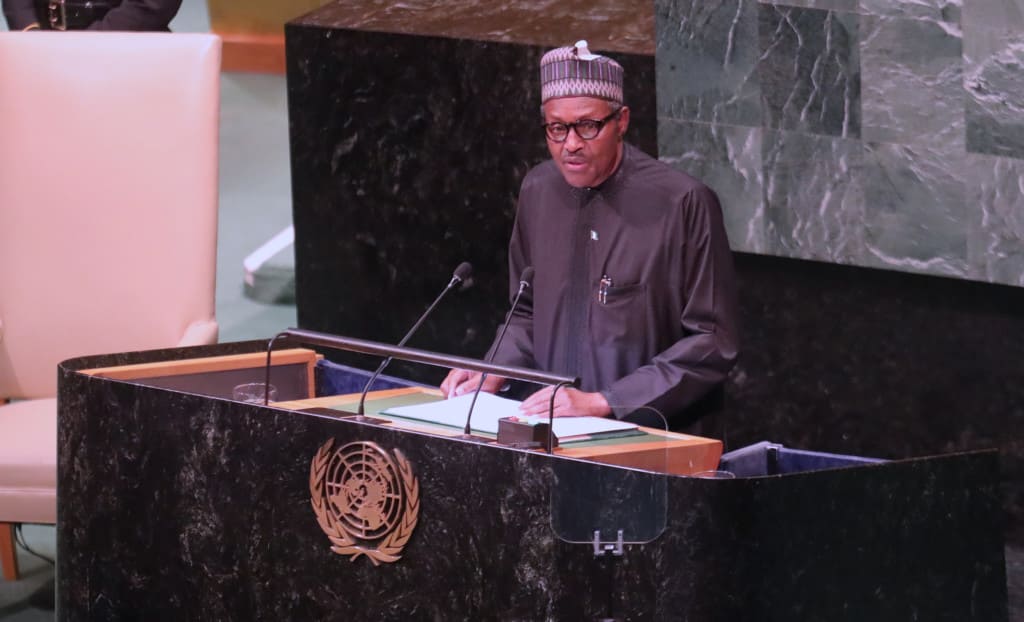
“For my administration, fighting corruption and Illicit Financial Flows (IFFs) in Nigeria is non-negotiable,” President Muhammadu Buhari has assured former President of South Africa and Chair of the AU/ECA High-Level Panel on Illicit Financial Flows from Africa, Mr Thabo Mbeki.
Mr Mbeki was in Abuja to meet Mr Buhari, who is also the current Champion of AU Anti-Corruption Campaign, to follow up on the efforts of AU Member States to implement the recommendations of the High-Level Panel Report (endorsed by the AU in 2015) and ultimately tackle IFFs nationally.
The visit also saw the Chair call upon the President in his capacity as the AU Anti-Corruption Champion to lead the efforts to engage action from other AU Member States towards tackling IFFs at the national, regional and continental level.
Prior to the Presidential visit, Mr Mbeki met with representatives of the Ministries, Departments and Agencies (MDAs) of the Federal Government of Nigeria which deal with Financial and legislative matters to gain an understanding of the country’s ongoing efforts to tackle Illicit Financial Flows.
In his remarks to the MDAs, the Mbeki recalled the 2015 Special Declaration to address IFFs, which was a realization by African leaders of the excessive losses due to illicit outflows. “The view was that the continent was losing resources which should have been available for its development to these illicit outflows,” he said. He emphasized the level of losses from IFFs, which at the time of the Panel’s Report was 50bn USD annually, but has now grown to about 80bn annually. He also indicated on a more positive note that, “Africa has led this agenda and brought it to global attention. This was evident when the African Heads of States asked our Panel to help address this issue”.
Mr Mbeki highlighted some of the recommended actions to address these IFFs saying that Nigeria and in turn, all other AU member states need legislation to deal with money laundering, financial intelligence and tax evasion. He underlined that this issue also requires action from global partners stressing, “since these funds leave the continent to destination countries, this problem cannot be solved by Africa alone. He acknowledged the capacity constraints nationally and continentally, saying, “As Africans, we must say that having identified the nature and size of the problem, we must work to address the issue. We need to act on this matter in any capacity necessary.”
The Deputy Executive Secretary and Chief Economist of the United Nations Economic Commission for Africa (ECA), Abdalla Hamdok for his part said that as a result of the Chair’s leadership, Africa was able to put the challenge of illicit finance on the global map. He referred to the Panel’s work and Report, whose impact has led to several important continental and global frameworks, including the Addis Ababa Action Agenda, as well as its inclusion in the Sustainable Development Goals.
As the Chair is required to report back to the AU Assembly of Heads of States and Government annually on the progress of implementing the recommendations of his Panel’s Report, Mr Hamdok said, “Several actions are being carried out, including this visit to Nigeria to determine the state of reaction to this issue, as well as “a technical project which is being worked on by the ECA to help capacitate AU member states against IFFs. Mr. Hamdok also stressed that all these efforts and those not yet mentioned are still, however, based on political will, which is crucial to reducing IFFs from the continent.
Attorney General of the Federation (AGF), Mr Abubakar Malami, for his part elaborated on Nigeria’s efforts to implement strategies to curb corruption and reduce IFFs. “We have taken major multi-dimensional policy decisions relating to institutions, legislations…and above all, recognizing the need for international collaboration as it relates to the fight against corruption and the minimization of illicit financial flows”. He noted that through legislative processes, Nigeria has “succeeded in establishing and capacitating institutions which are mandated with the statutory role of working to enforce financial regulations as well as tackle various misconducts including corruption and IFFs.”
He also detailed the efforts of the country in fighting corruption and IFFs through the deployment of relevant technology and international collaboration. Additionally, he highlighted the need for collaboration to make it more difficult for IFF perpetrators to move freely, invest in businesses and benefit from the proceeds of crime. He stressed that “we must work to repatriate these funds from the external perpetrators while working to detain them.
Permanent Secretary of Finance, Mahmoud Isa-Dutse delivered remarks on behalf of the Minister of Finance for Nigeria. In the speech, he commended the Chair and Panel for fighting this plague saying that IFFs have robbed Africa of the required wealth to help build schools, hospitals, roads and other necessary infrastructure. He added that the quest for Africa’s financial development will be accelerated if the efforts to recover these lost funds are successful and the continent’s development will no doubt receive a necessitated boost. In this regard, he spoke about the work of the Nigerian Extractive Industry Transparency Initiative (NEITI), which is being led by the Minister of Finance. This effort has helped the country recover lost assets from taxes because of the increased transparency.
The two-day event culminated with a technical workshop with Thabo Mbeki. Raymond Baker, President, Global Financial Integrity and Member of the High-Level Panel as well as the Secretariat of the Panel meet with the representatives of the financial agencies and departments. Part of the objectives of the workshop was to discuss the ECA’s proposed Development Assistance Project which aims to support Nigeria and other member states in the fight against IFFs. Following this visit, the Secretariat is expected to further engage the government of Nigeria and foster collaboration to build its capacity to stem IFFs from the country.
Economy
NGX RegCo Cautions Investors on Recent Price Movements
By Aduragbemi Omiyale
The investing public has been advised to exercise due diligence before trading stocks on the Nigerian Exchange (NGX) Limited.
This caution was given by the NGX Regulation Limited (NGX RegCo), the independent regulatory arm of the NGX Group Plc.
The advisory became necessary in response to notable price movements observed in the shares of certain listed companies over recent trading sessions.
On Monday, the bourse suspended trading in the shares of newly-listed Zichis Agro-allied Industries Plc. The company’s stocks gained almost 900 per cent within a month of its listing on Customs Street.
In a statement today, NGX RegCo urged investors to avoid speculative trading based on unverified information and to consult licensed intermediaries such as stockbrokers or investment advisers when needed.
It explained that its advisory is part of its standard market surveillance functions, as it serves as a measured reminder for investors to prioritise informed and disciplined decision-making.
The notice emphasised that the Exchange will continue to monitor market activities closely in line with its mandate to ensure a fair, orderly, and transparent market.
“NGX RegCo encourages all investors to base their decisions on publicly available information, including a thorough assessment of company fundamentals, financial performance, and risk profile,” a part of the disclosure said.
It reassured all stakeholders that the NGX remains stable, well-regulated, and resilient, saying the platform continues to foster an environment where investors can participate with confidence, supported by robust oversight and transparent market operations.
“Our primary responsibility is to maintain a level playing field where market participants can trade with confidence, backed by timely and accurate information.
“This advisory is a routine communication, reinforcing that sound fundamentals, not speculation, remain the foundation for sustainable investment outcomes. We are fully committed to preserving the integrity and stability of our market,” the chief executive of NGX RegCo, Mr Olufemi Shobanjo, stated.
Economy
Stronger Taxpayer Confidence, Others Should Determine Tax Reform Success—Tegbe
By Modupe Gbadeyanka
The chairman of the National Tax Policy Implementation Committee (NTPIC), Mr Joseph Tegbe, has tasked the Nigeria Revenue Service (NRS) to measure the success of the new tax laws by higher voluntary compliance rates, lower administrative costs, fewer disputes, faster resolution cycles, and stronger taxpayer confidence.
Speaking at the 2026 Leadership Retreat of the agency, Mr Tegbe said, “Sustainable revenue performance is built on trust and efficiency, not enforcement intensity,” emphasising that the legitimacy and predictability of the system are more critical than punitive measures.
He underscored that the country’s tax reform journey is at a critical juncture where effective implementation will determine long-term fiscal outcomes.
The NTPIC chief stressed that tax policy must serve as an enabler of governance, and should embody simplicity, equity, predictability, and administrability at scale.
These principles, he explained, foster voluntary compliance, reduce operational friction, and strengthen investor confidence. He warned that ad-hoc adjustments or policy drift could undermine reform momentum, unsettle businesses, and deter investment, which thrives on predictable rules rather than shifting announcements. Structured sequencing, clear transition mechanisms, and continuous feedback between policymakers and administrators are therefore critical to sustaining reform credibility.
Mr Tegbe further argued that revenue reform cannot succeed in isolation. Achieving sustainable gains requires a whole-of-government approach, leveraging robust taxpayer identification systems, integrated financial data, efficient dispute resolution, and harmonised coordination across federal and sub-national levels. This approach, he said, reduces leakages, eliminates multiple taxation, and reinforces confidence in the system.
He noted that the passage of four new tax laws marks only the beginning of a broader reform agenda, describing the initiative as a systemic recalibration of Nigeria’s fiscal architecture, rather than a routine policy update.
He further asserted that the true measure of success will be the credibility of implementation, not the design of the laws themselves.
The NRS, he noted, functions as the nation’s “Revenue System Integrator,” with outcomes reflecting the strength of an interconnected ecosystem that encompasses policy clarity, enforcement consistency, digital infrastructure, dispute resolution efficiency, and intergovernmental coordination.
Economy
NUPENG Seeks Clarity on New Oil, Gas Executive Order
By Adedapo Adesanya
The National Union of Natural and Gas Workers (NUPENG) has expressed deep concern over the Executive Order by President Bola Tinubu mandating the Nigerian National Petroleum Company (NNPC) Limited to remit directly to the federation account.
In a statement signed by its president, Mr William Akporeha, over the weekend in Lagos, the union noted that the absence of detailed public engagement had naturally generated tension within the sector and heightened restiveness among workers, who are anxious to know how the new directive may affect their employment, welfare and job security, especially as it affects NNPC and other major operations in the oil and gas sector.
It pointed out that the industry remained the backbone of Nigeria’s economy, contributing significantly to national revenue, foreign exchange earnings, and employment.
The NUPENG president affirmed that any policy shift, particularly one introduced through an Executive Order, has far-reaching consequences for regulatory frameworks, Investment decisions, operational standards, and labour relations within the sector.
According to him, “there is an urgent need for clarity on the scope and objectives of the Executive Order -What precise reforms or adjustments does it introduce? “Its implications for the Petroleum Industry Act -Does the Order amend, interpret, or expand existing provisions under PIA?
“Impact on workers and existing labour agreements-Will it affect job security, conditions of service, Collective Bargaining agreements or ongoing restructuring processes within the industry? “Effects on indigenous participation and local content development -How will it affect Nigerian companies and employment opportunities for citizens?”
He warned that without proper consultation and explanation, misinterpretations of the Executive Order may spread across the industry, potentially destabilising operations and undermining industrial harmony that stakeholders have worked hard to sustain.
“Though our union remains committed to constructive engagement, national development and stability of the oil and gas sector, however, we are duty-bound and constitutionally bound to protect the rights and welfare and job security of our members whose livelihoods depend on a clear, fair and predictable policy framework,” Mr Akporeha further stated.
-
Feature/OPED6 years agoDavos was Different this year
-
Travel/Tourism10 years ago
Lagos Seals Western Lodge Hotel In Ikorodu
-
Showbiz3 years agoEstranged Lover Releases Videos of Empress Njamah Bathing
-
Banking8 years agoSort Codes of GTBank Branches in Nigeria
-
Economy3 years agoSubsidy Removal: CNG at N130 Per Litre Cheaper Than Petrol—IPMAN
-
Banking3 years agoSort Codes of UBA Branches in Nigeria
-
Banking3 years agoFirst Bank Announces Planned Downtime
-
Sports3 years agoHighest Paid Nigerian Footballer – How Much Do Nigerian Footballers Earn