

Economy
Buhari Reaffirms Resolve to Tackle Illicit Financial Flows

By Modupe Gbadeyanka
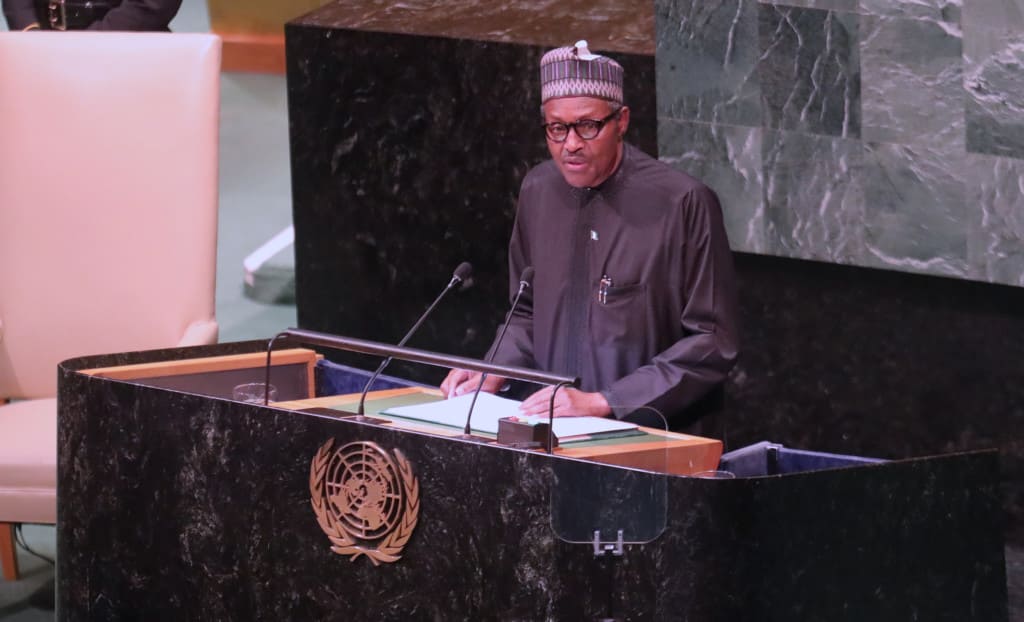
“For my administration, fighting corruption and Illicit Financial Flows (IFFs) in Nigeria is non-negotiable,” President Muhammadu Buhari has assured former President of South Africa and Chair of the AU/ECA High-Level Panel on Illicit Financial Flows from Africa, Mr Thabo Mbeki.
Mr Mbeki was in Abuja to meet Mr Buhari, who is also the current Champion of AU Anti-Corruption Campaign, to follow up on the efforts of AU Member States to implement the recommendations of the High-Level Panel Report (endorsed by the AU in 2015) and ultimately tackle IFFs nationally.
The visit also saw the Chair call upon the President in his capacity as the AU Anti-Corruption Champion to lead the efforts to engage action from other AU Member States towards tackling IFFs at the national, regional and continental level.
Prior to the Presidential visit, Mr Mbeki met with representatives of the Ministries, Departments and Agencies (MDAs) of the Federal Government of Nigeria which deal with Financial and legislative matters to gain an understanding of the country’s ongoing efforts to tackle Illicit Financial Flows.
In his remarks to the MDAs, the Mbeki recalled the 2015 Special Declaration to address IFFs, which was a realization by African leaders of the excessive losses due to illicit outflows. “The view was that the continent was losing resources which should have been available for its development to these illicit outflows,” he said. He emphasized the level of losses from IFFs, which at the time of the Panel’s Report was 50bn USD annually, but has now grown to about 80bn annually. He also indicated on a more positive note that, “Africa has led this agenda and brought it to global attention. This was evident when the African Heads of States asked our Panel to help address this issue”.
Mr Mbeki highlighted some of the recommended actions to address these IFFs saying that Nigeria and in turn, all other AU member states need legislation to deal with money laundering, financial intelligence and tax evasion. He underlined that this issue also requires action from global partners stressing, “since these funds leave the continent to destination countries, this problem cannot be solved by Africa alone. He acknowledged the capacity constraints nationally and continentally, saying, “As Africans, we must say that having identified the nature and size of the problem, we must work to address the issue. We need to act on this matter in any capacity necessary.”
The Deputy Executive Secretary and Chief Economist of the United Nations Economic Commission for Africa (ECA), Abdalla Hamdok for his part said that as a result of the Chair’s leadership, Africa was able to put the challenge of illicit finance on the global map. He referred to the Panel’s work and Report, whose impact has led to several important continental and global frameworks, including the Addis Ababa Action Agenda, as well as its inclusion in the Sustainable Development Goals.
As the Chair is required to report back to the AU Assembly of Heads of States and Government annually on the progress of implementing the recommendations of his Panel’s Report, Mr Hamdok said, “Several actions are being carried out, including this visit to Nigeria to determine the state of reaction to this issue, as well as “a technical project which is being worked on by the ECA to help capacitate AU member states against IFFs. Mr. Hamdok also stressed that all these efforts and those not yet mentioned are still, however, based on political will, which is crucial to reducing IFFs from the continent.
Attorney General of the Federation (AGF), Mr Abubakar Malami, for his part elaborated on Nigeria’s efforts to implement strategies to curb corruption and reduce IFFs. “We have taken major multi-dimensional policy decisions relating to institutions, legislations…and above all, recognizing the need for international collaboration as it relates to the fight against corruption and the minimization of illicit financial flows”. He noted that through legislative processes, Nigeria has “succeeded in establishing and capacitating institutions which are mandated with the statutory role of working to enforce financial regulations as well as tackle various misconducts including corruption and IFFs.”
He also detailed the efforts of the country in fighting corruption and IFFs through the deployment of relevant technology and international collaboration. Additionally, he highlighted the need for collaboration to make it more difficult for IFF perpetrators to move freely, invest in businesses and benefit from the proceeds of crime. He stressed that “we must work to repatriate these funds from the external perpetrators while working to detain them.
Permanent Secretary of Finance, Mahmoud Isa-Dutse delivered remarks on behalf of the Minister of Finance for Nigeria. In the speech, he commended the Chair and Panel for fighting this plague saying that IFFs have robbed Africa of the required wealth to help build schools, hospitals, roads and other necessary infrastructure. He added that the quest for Africa’s financial development will be accelerated if the efforts to recover these lost funds are successful and the continent’s development will no doubt receive a necessitated boost. In this regard, he spoke about the work of the Nigerian Extractive Industry Transparency Initiative (NEITI), which is being led by the Minister of Finance. This effort has helped the country recover lost assets from taxes because of the increased transparency.
The two-day event culminated with a technical workshop with Thabo Mbeki. Raymond Baker, President, Global Financial Integrity and Member of the High-Level Panel as well as the Secretariat of the Panel meet with the representatives of the financial agencies and departments. Part of the objectives of the workshop was to discuss the ECA’s proposed Development Assistance Project which aims to support Nigeria and other member states in the fight against IFFs. Following this visit, the Secretariat is expected to further engage the government of Nigeria and foster collaboration to build its capacity to stem IFFs from the country.


