Connect with us

Economy

Group Lauds Kwara Government for Improving IGR

Published

on

By Modupe Gbadeyanka

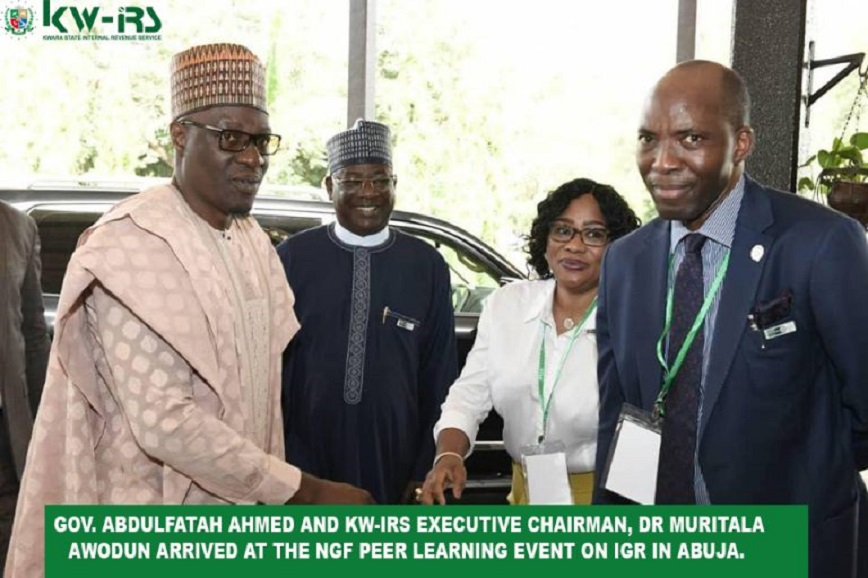
For improving the Internally Generated Revenue (IGR) of Kwara State, a group known Elites Network for Sustainable Development ENetSuD, has showered praises on the state government.

A statement issued by the coordinator of the Kwara-based civil society organization, Mr Alagbonsi Abdullateef, disclosed that the reform put in place by the administration of Governor Abdulfatah Ahmed was yielding results.

According to him, “IGR of Kwara State has commendably improved in recent times, which had greatly contributed to the total revenue of the state and has been sustaining it, especially at the period of dwindling FAAC allocation.”

“Year-by-year analysis of the Total revenue of Kwara state since 2012 showed a significant decline since 2015, which could be related to the dwindling FAAC allocation caused by recession and oil price.

“Interestingly, FAAC has been gradually increasing since 2016 (though below pre-recession periods like 2013 and 2014), and there is a possibility that the total revenue at the end of 2018 will equate or even surpass that of 2013, considering the fact that the monthly net FAAC to Kwara state has averagely remained around 3.5 billion since December 2017,” the statement said.

The KWSG, in its efforts to increase and diversify its revenue base for financial freedom and bolster efficacy in governance, signed the Kwara State Revenue Administration Law (Law No. 6 of 2015) on 22nd June 2015, which made the old Board of Internal Revenue defunct and gave birth to  the current Kwara State Internal Revenue Service (KW-IRS).

The current KW-IRS has significantly increased the State IGR compared to the periods that precede its formation. The impact of the current system of IGR in Kwara is evident from the percentage contribution of IGR to the annual total revenue in the state. For instance, between 2012 and 2015 when KW-IRS was formed, 2014 was the year with the highest percentage contribution of IGR to the total revenue of the state (22%), followed by 2013 (21.6%), while 2015 has the lowest (17.4%).

However, it is interesting to note that IGR has significantly contributed to the total revenue of the state since 2016. Specifically, the contributions of IGR to the State revenue in 2016 (40.1%), 2017 (37.2%) and 2018 (33.0%) are comparably higher than the years that precedes the creation of KW-IRS, even though the dwindling FAAC since 2016 could be an important confounder.

“Considering the unique importance of IGR to the economic viability of a state (especially in the era of unstable FAAC Allocation), responsible and patriotic citizens are expected to play their role in growing the economy by paying their taxes regularly. We are appealing to the citizens and residents of Kwara State to pay their taxes accordingly,” the group added.

“We are of the conviction that Kwarans will voluntarily continue to cooperate with Government on payment of taxes if the State Infrastructural Development commensurate with the taxes that are being paid. We therefore urge the KWSG to provide value for the tax-payers money,” ENetSuD said.

The group further said, “Many aspects of the economy in the state, including Education, Health, Road infrastructure, Environment, etc, need urgent attention of KWSG. For instance, we have repeatedly called the attention of KWSG to the pitiable condition of school infrastructure across the state.

“Many of the school buildings are dilapidated, and need urgent attention of the government. On health, the creation of State Health Insurance Scheme, and the commitment of 1% of the State Annual Consolidated Revenue Fund to the Scheme is commendable.

“However, the sector needs improvement in terms of manpower and facilities. The uncountable numbers of bad roads in the state also need the quick intervention of the government within the limit of the available resources,” it said further.

“Advising the KWSG on the need to improve IGR outside tax payment by citizens is of interest to us. The government should explore all the possible ways to attract investors to Kwara state, which will boost its economy. Investing in the agricultural sector to diversify the economy is also sacrosanct.

“While the practice of removing 500 million naira monthly as Kwara Infrastructure Development Fund (IF-K) from the IGR is good, KWSG is again urged to be prudent in spending, and make more savings from the available resources,” the statement said.


Modupe Gbadeyanka is a fast-rising journalist with Business Post Nigeria. Her passion for journalism is amazing. She is willing to learn more with a view to becoming one of the best pen-pushers in Nigeria. Her role models are the duo of CNN's Richard Quest and Christiane Amanpour.

Advertisement
Click to comment

Leave a Reply

Your email address will not be published. Required fields are marked *

Economy

Customs Street Chalks up 1.08% on Renewed Buying Pressure

Published

on

Customs Street NGX

By Dipo Olowookere

A 1.08 per cent growth was further printed by the Nigerian Exchange (NGX) Limited on Friday on improved appetite for Nigerian stocks.

Data showed that the insurance sector lost 0.61 per cent yesterday due to profit-taking as the energy space gave up 0.08 per cent, while the commodity counter closed flat.

However, the industrial goods landscape appreciated by 2.06 per cent, the banking index improved by 1.31 per cent, and the consumer goods sector expanded by 0.83 per cent.

At the close of business on Customs Street, the All-Share Index (ASI) increased by 1,563.92 points to 147,040.07 points from 145,476.15 points and the market capitalisation went up by N996 billion to N93.722 trillion from N92.726 trillion.

UAC Nigeria led the advancers’ log yesterday after it grew by 10.00 per cent to N96.80, Transcorp Hotels jumped by 9.71 per cent to N172.80, Royal Exchange appreciated by 8.89 per cent to N1.96, Ikeja Hotel soared by 8.74 per cent to N31.10, and Veritas Kapital leapt by 8.07 per cent to N1.74.

On the flip side, Union Dicon declined by 10.00 per cent to N6.30, ABC Transport slipped by 9.88 per cent to N3.10, AXA Mansard depreciated by 7.19 per cent to N12.90, FTN Cocoa lost 4.62 per cent to trade at N4.75, and Guinea Insurance dropped 3.36 per cent to finish at N1.15.

A total of 38 stocks ended on the gainers’ table and 17 stocks finished on the losers’ table, representing a positive market breadth index and strong investor sentiment.

Traders transacted 361.6 million equities for N14.8 billion in 21,051 deals yesterday versus the 1.9 billion equities worth N19.2 billion traded in 23,369 deals a day earlier, showing a decline in the trading volume, value, and number of deals by 80.97 per cent, 22.92 per cent, and 14.20 per cent, respectively.

The busiest stock for the session was Zenith Bank with 59.5 million units worth N3.6 billion, Access Holdings traded 46.1 million units valued at N973.0 million, Fidelity Bank exchanged 29.4 million units for N560.4 million, FCMB transacted 27.9 million units worth N293.9 million, and Tantalizers sold 13.0 million units valued at N29.8 million.

Continue Reading

Economy

Nipco, 11 Plc Crash OTC Securities Exchange by 4.76%

Published

on

NIPCO LPG Depot

By Adedapo Adesanya

Energy stocks influenced the 4.76 per cent loss recorded by the NASD Over-the-Counter (OTC) Securities Exchange on Friday, December 5.

The culprits were the duo of 11 Plc and Nipco Plc,with the former shedding N32.17 to end at N291.83 per share compared with the previous day’s N324.00 per share, and the latter down by N21.00 to sell at N195.00 per unit versus the previous session’s N216.00 per unit.

Consequently, the NASD Unlisted Security Index (NSI) slumped by 170.16 points to 3,401.37 points from 3,571.53 points and the market capitalisation lost N101.81 billion to close at N2.035 billion from the N2.136 trillion quoted in the preceding session.

The OTC securities exchange suffered the decline yesterday despite the share prices of three companies closing green.

Central Securities Clearing System (CSCS) Plc was up by N1.80 to close at N39.80 per share compared with Thursday’s price of N38.00 per share, Air Liquide Plc appreciated by N1.09 to N11.99 per unit from N10.90 per unit, and FrieslandCampina Wamco Nigeria Plc grew by 78 Kobo to N56.57 per share from N55.79 per share.

During the session, the volume of transactions rose by 6,885.3 per cent to 18.2 million units from 4.3 million units, the value of transactions ballooned by 10,301.7 per cent to N389.7 million from N347.2 million, but the number of deals declined by 29.7 per cent to 26 deals from 37 deals.

Infrastructure Credit Guarantee Company (InfraCredit) Plc ended the day as the most traded stock by value on a year-to-date basis with 5.8 billion units worth N16.4 billion, followed by Okitipupa Plc with 170.4 million units valued at N8.0 billion, and Air Liquide Plc with 507.5 million units worth N4.2 billion.

InfraCredit Plc also finished the day as the most traded stock by volume on a year-to-date basis with 5.8 billion units transacted for N16.4 billion, followed by Industrial and General Insurance (IGI) Plc with 1.2 billion units sold for N420.2 million, and Impresit Bakolori Plc with 536.9 million units worth N524.9 million.

Continue Reading

Economy

Naira Depreciates to N1,450/$1 at Official Forex Market

Published

on

Naira-Dollar exchange rate gap

By Adedapo Adesanya

The Naira depreciated further against the US Dollar in the Nigerian Autonomous Foreign Exchange Market (NAFEX) on Friday, December 5, as FX demand pressure mounts.

The Nigerian currency lost N2.60 or 0.18 per cent against the greenback to close at N1,450.43/$1 compared with the previous day’s N1,447.83/$1.

Equally, the domestic currency declined against the Pound Sterling in the official forex market during the session by N4.48 to trade at N1,935.45/£1, in contrast to Thursday’s closing price of N1,930.97/£1 and shrank against the Euro by 43 Kobo to end at N1,689.17/€1 versus the preceding session’s rate of N1,688.74/€1.

Similarly, the local currency performed badly against the US Dollar at the GTBank FX counter by N2 to close at N1,455/$1 versus Thursday’s N1,453/$1 but traded flat at the parallel market at N14.65/$1.

As the country gets into the festive period, pressure mounted on the local currency reflecting higher foreign payments and lower FX inflows.

However, there are expectations that the Nigerian currency will be stable, supported by interventions by to the Central Bank of Nigeria (CBN) in the face of steady dollar Demand and inflows from Detty December festivities that will give the Naira a boost after it depreciated mildly last month.

Traders cited by Reuters expect that the Naira will trade within a band of N1,443-N1,450/$1 next week, buoyed by improved FX interventions by the apex bank.

As for the crypto market, it was down yesterday due to profit-taking associated with year-end trading. However, the December 1-Year Consumer Inflation Expectation by the University of Michigan fell to 4.1 per cent from 4.5 per cent previously and 4.5 per cent expected. The 5-Year Consumer Inflation Expectation fell to 3.2 per cent from 3.4 per cent previously and 3.4 per cent expected.

With the dearth of official economic data of late, these private surveys have taken on a new level of significance and the market banks of them to make decisions.

Cardano (ADA) depreciated by 5.7 per cent to $0.4142, Dogecoin (DOGE) slid by 5.1 per cent to $0.1394, Ethereum (ETH) dropped by 3.9 per cent to $3,039.75, Solana (SOL) declined by 3.8 per cent to $133.24, and Litecoin (LTC) fell by 3.7 per cent to $80.59.

Further, Bitcoin (BTC) went down by 2.6 per cent to sell at $89,683.72, Binance Coin (BNB) slumped by 2.2 per cent to $883.59, and Ripple (XRP) shrank by 2.1 per cent to $2.04, while the US Dollar Tether (USDT) and the US Dollar Coin (USDC) remained unchanged at $1.00 each.

Continue Reading

Trending