Connect with us

Economy

Local Equities Sheds N93b as Market Awaits Outcome of MPC Meeting

Published

on

Nigerian Stocks

By Dipo Olowookere

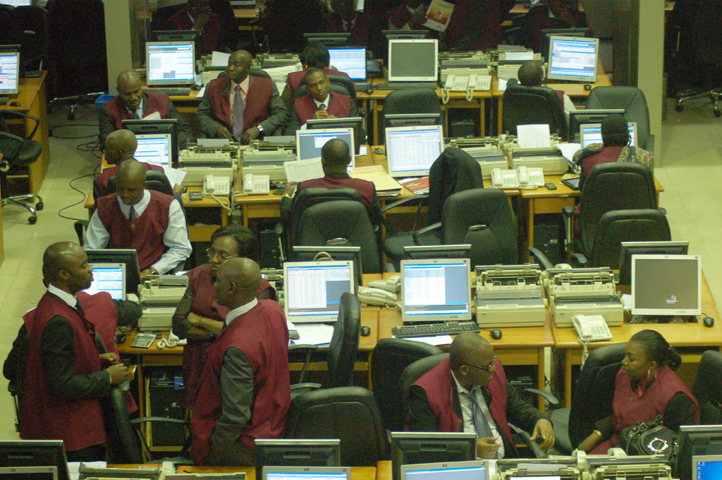
Activities resumed on the floor of the Nigerian Stock Exchange (NSE) on Wednesday after a day off on Tuesday to observe the public holiday declared by federal government in commemoration of Eid-el Maulud celebrated by Muslims in the country.

However, at the close of the midweek trading session, the stock market was down by 0.78 percent, pushing the year-to-date loss to 16.40 percent.

Even the release of the inflation data on Wednesday by the National Bureau of Statistics (NBS), which said inflation dropped to 11.26 percent in October 2018 from 11.28 percent, did not do enough to lift the local bourse.

Yesterday, the Central Bank of Nigeria (CBN) commenced its last Monetary Policy Committee (MPC) meeting for this year and would announce outcome of their deliberations on Thursday. Already, observers have predicted that the monetary policy rate (MPR) would be left at 14 percent, especially with the ease in the inflation rate last month.

But despite the loss recorded by the market yesterday, the volume and value of transactions increased by 60.53 percent and 95.04 percent.

A total of 237.8 million shares worth N3.5 billion were traded on the floor of the exchange on Wednesday compared with the 148.1 million units valued at N1.8 billion sold on Monday.

Business Post reports that the All-Share Index (ASI) reduced on Wednesday by 252.45 points to settle at 31,969.79 points, while the market capitalisation went down by N93 billion to finish at  N11.671 trillion.

Leading the top losers’ chart yesterday was Presco, which lost N4.10k of its share price to quote at N62.15k per share.

It was followed by Dangote Cement, which shed N3.50k to end at N200 per share, and GTBank, which depreciated by N1.10k to settle at N35.85k per share.

Lafarge Africa declined by N1 to close at N15 per share, while Ecobank reduced by 50 kobo to settle at N15.50k per share.

Conversely, Mobil Oil finished as the day’s highest price gainer after adding N15 to its share price to close at N165 per share.

Stanbic IBTC grew by N2 to end at N50 per share, while Flour Mills appreciated by 60 kobo to settle at N18.60k per share.

International Breweries rose by 55 kobo to end at N30.75k per share, while Prestige Assurance went up by 6 kobo to finish at 67 kobo per share.

At the close of market on Wednesday, the Financial Services sector led the activity chart with 132.6 million shares sold for N2.1 billion, while the Oil and Gas industry trailed with 59.5 million equities transacted for N313 million.

Oando emerged as the most traded stock at the market yesterday with a turnover of 58.6 million units of its shares sold for N298.7 million.

It was followed by Zenith Bank, which accounted for 24 million units of its shares traded for N577.6 million, with FCMB exchanging 21.6 million equities exchanged for N33.1 million.

GTBank traded 20.8 million shares worth N759.6 million, while Fidelity Bank transacted 16.1 million equities valued at N31.6 million.


Dipo Olowookere is a journalist based in Nigeria that has passion for reporting business news stories. At his leisure time, he watches football and supports 3SC of Ibadan. Mr Olowookere can be reached via [email protected]

Click to comment

Leave a Reply

Your email address will not be published. Required fields are marked *

Economy

Champion Breweries to Strengthen Market Position

Published

on

champion breweries uyo

By Aduragbemi Omiyale

One of the leading brewers and beverage companies listed on the Nigerian Exchange (NGX) Limited, Champion Breweries Plc, has expressed its commitment to strengthening its market position.

The beer maker gave this assurance while reacting to its financial performance for the first half of 2026, which was strong, driven by solid commercial performance, improved operational efficiencies, and the successful expansion of its business portfolio following the acquisition of EnjoyBev B.V.

In the period under review, the organisation boosted its growth platform through strategic investment, delivered resilient operating performance, and successfully transitioned to a new group structure.

Its revenue reached N35.73 billion, while second-quarter revenue amounted to N21.37 billion. Operating profit stood at N6.17 billion, and profit after tax attributable to the group was N2.65 billion, with second-quarter profit after tax of N1.76 billion.

The firm also successfully completed the acquisition of an 80 per cent equity interest in EnjoyBev B.V., strengthened its capital base through a successful capital raising programme that increased shareholders’ equity to N69.08 billion, and maintained full compliance with NGX free float requirements, with free float increasing to 25.72 per cent as of June 30, 2026.

“The first half of 2026 marks a defining chapter in Champion Breweries’ journey. We have not only delivered a strong operating performance but also successfully transformed our business into a broader beverage group with an expanded platform for sustainable growth.

“While higher finance costs associated with our strategic investment programme impacted profitability during the period, our underlying business remains strong.

“The combination of disciplined commercial execution, continued investment in our brands and route-to-market capabilities and improving operational efficiency positions us well for future growth.

“We remain focused on creating long-term value for shareholders, strengthening our market position, and capturing the opportunities presented by our expanded business platform,” the acting chief executive of Champion Breweries, Mr Rasheed Adebiyi, said.

Continue Reading

Economy

How Digital Payments Are Changing the Way Global Businesses Operate

Published

on

crypto payment

For businesses operating across borders, payments are no longer simply the final step in a transaction. The way money moves can influence where a company sells, how quickly it can enter a new market, and how easily customers can complete a purchase. As digital payment methods become more diverse, businesses are adjusting not only their checkout options but also the way payment processes fit into wider operations.

This shift is particularly visible in international commerce. A company can now serve customers in multiple markets without relying on a single payment method or a traditional physical presence in each location. Digital payments have become part of the infrastructure that supports increasingly distributed business models.

A More Connected Payment Environment

Global commerce has created a more complicated payment environment. Customers in different countries may have very different expectations about how a purchase should be paid for. Some markets rely heavily on cards, while others have seen rapid adoption of digital wallets, bank-based payment methods, or other local alternatives.

For businesses, this variety creates both opportunities and practical challenges. Offering payment options that customers recognize can reduce friction during a transaction, while supporting several markets may require businesses to work with different payment technologies and providers.

Digital payments have therefore become closely connected to market expansion. A company entering a new country does not only need to consider demand for its products or services. It also needs to understand how customers in that market prefer to pay and whether its existing payment setup can accommodate those expectations.

6a7b071354914.webp

More Choices for Businesses and Customers

The growth of digital payments has expanded the range of choices available on both sides of a transaction.

Consumers can increasingly choose between cards, digital wallets, bank transfers, mobile payment methods and other forms of electronic payment. Businesses, meanwhile, can select from different technologies and payment providers depending on their markets and operational requirements.

This development has changed the role of payments in the customer experience. Payment is no longer necessarily treated as an isolated technical process that begins only after a purchasing decision has been made. The available options can influence whether a customer completes a transaction in the first place.

For international businesses, flexibility can be particularly important. A payment method that is familiar and convenient in one market may be less relevant in another. Supporting a broader selection can allow businesses to adapt their payment experience without changing the underlying product or service.

The Rise of Alternative Payment Models

Traditional card and bank-based payments remain important, but the digital payments landscape has expanded beyond these established methods. Digital wallets, account-to-account payments, mobile solutions and cryptocurrency have all contributed to a broader definition of what a digital transaction can look like.

Cryptocurrency remains a smaller part of the overall payments landscape, but it has created another category of payment technology for businesses to consider. Specialized solutions such as BitHide can provide businesses with tools for handling crypto payments as part of their broader payment operations.

The significance of this development is not necessarily that every business will adopt cryptocurrency. Rather, it demonstrates how the payment landscape continues to diversify. Businesses operating internationally can increasingly choose from different models instead of relying on a single approach across every market.

Payments Are Becoming Part of Business Operations

As payment systems become more digital, their role increasingly extends beyond accepting money from customers. Payment processes can interact with accounting, order management, customer records and other parts of a company’s digital operations.

This is particularly relevant for businesses with large transaction volumes or customers in multiple countries. Manual payment processes can become difficult to manage as the number of transactions, currencies and payment methods increases. Digital systems can help businesses organize these processes within a wider operational framework.

The result is a gradual shift in how companies think about payments. Instead of treating payment processing as a separate function, businesses are increasingly considering it alongside other elements of their digital infrastructure.

This does not mean that every company needs a complex payment setup. The appropriate approach depends on the business model, target markets, transaction volumes and types of customers involved. For some companies, a small number of established payment methods may be sufficient. Others may need a more flexible arrangement because of the markets they serve.

Adapting to Different Markets

One of the more important changes brought by digital payments is the ability to adapt payment experiences to different markets.

International businesses often face differences in consumer behavior, financial infrastructure and preferred payment methods. A payment strategy that works well domestically may therefore require adjustments when a company expands internationally.

Digital payment technology can make these adjustments more practical, but it does not remove the need for local market knowledge. Businesses still need to understand customer preferences, applicable requirements and the practical costs associated with different payment methods.

This makes payment strategy part of international expansion rather than an issue that can be addressed only after a new market has been entered.

What Comes Next for Global Businesses

The digital payments market is likely to continue becoming more diverse as businesses and customers adopt new ways of moving money. The important change may not be the replacement of one payment method by another, but the growing ability to combine different methods according to the needs of a particular business or market.

For global companies, this creates an emphasis on adaptability. Payment systems need to support the way a business operates rather than becoming a limitation on where and how it can sell.

Digital payments are consequently becoming more than a convenient alternative to cash or traditional payment processes. They are increasingly connected to international commerce, customer experience and day-to-day business operations. As payment options continue to develop, companies that can adapt their payment strategies to different markets will be better positioned to operate in an increasingly digital global economy.

Continue Reading

Economy

Dangote Refinery Accepts 52.6m Barrels of 68.1m Crude Offered in Q2 2026

Published

on

nigerian crude oil

By Adedapo Adesanya

The Dangote Refinery accepted 52.6 million barrels of crude oil and condensate from producers in the second quarter of 2026, representing 78 per cent of the 68.1 million barrels offered to the refinery, according to the Nigerian Upstream Petroleum Regulatory Commission (NUPRC).

The refinery, which required about 63 million barrels during the three-month period, received the largest share of crude volumes offered to domestic refineries, accounting for about 98 per cent of total volumes offered by producers.

The figures were contained in the commission’s latest data on the implementation of the Domestic Crude Supply Obligation (DCSO), which showed that producers supplied 53.7 million barrels to local refineries between April and June.

The Q2 performance translated to a 97.4 per cent compliance rate with the DCSO, which is enforced by the NUPRC under Section 109 of the Petroleum Industry Act (PIA) 2021.

The agency said the DCSO framework operates on a “willing buyer, willing seller” basis, with monthly consultations between producers and refiners used to determine crude allocation volumes.

Despite producers offering the Dangote Refinery about 5.1 million barrels more than its quarterly requirement, the plant accepted 52.6 million barrels, leaving about 15.5 million barrels of the offered volume unaccepted.

NUPRC said the difference highlighted the need for continued coordination between producers and domestic refiners, particularly on commercial terms and logistics.

The commission attributed the improved DCSO compliance in the second quarter to increased local crude production and the signing of long-term crude supply agreements backed by bankable Sales and Purchase Agreements (SPAs).

According to NUPRC, these agreements have reduced transactional difficulties and improved the predictability of crude supply, enabling domestic refineries to plan their offtake more effectively.

Monthly data showed mixed performance during the quarter. In April, producers offered 19.31 million barrels against an allocation of 18.13 million barrels, while refineries received 20.88 million barrels, representing a 114.9 per cent delivery rate.

In May, producers offered 23.19 million barrels against an allocation of 18.78 million barrels, but actual deliveries fell to 14.23 million barrels, resulting in a 75.8 per cent compliance rate.

In June, producers offered 26.84 million barrels against an allocation of 18.17 million barrels, while refineries received 18.61 million barrels, representing a 102.4 per cent performance rate.

The NUPRC said it would continue to enforce the DCSO under the PIA while leveraging increased domestic production and commercial supply arrangements to support Nigeria’s energy sufficiency objectives.

Continue Reading