Connect with us

Health

African Leaders Launch New Health Financing Scheme

Published

on

By Modupe Gbadeyanka

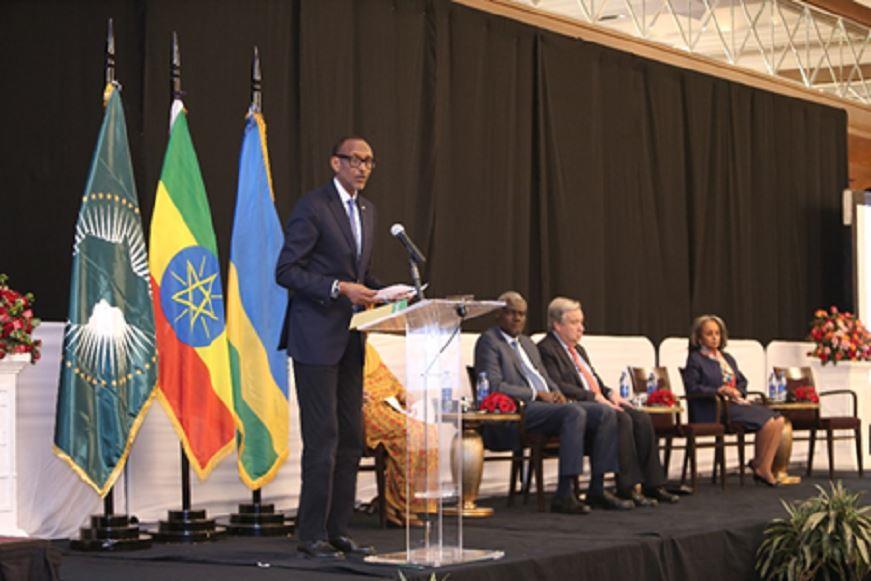
Last weekend, some African Heads of State and Government, Ministers of Health and Finance, business leaders and global partners gathered to launch a new initiative aimed at increasing commitments for health, improving the impact of spending and ensuring the achievement of universal health coverage across Africa’s 55 countries.

With the 2030 Agenda for Sustainable Development just over a decade away, President of Rwanda, Mr Paul Kagame, who doubles as the African Union Chairman, convened the Africa Leadership Meeting: Investing in Health to encourage African governments and global partners to translate commitments into measurable actions, align spending with country and continental priorities, and identify efficiencies that will improve millions of lives across the continent.

“Governments should surely be willing and able to increase domestic investment in healthcare. A good indicator of this is the progress we have made toward securing the financial health of the African Union and mobilising our own resources for joint priorities, such as the Peace Fund. We should be the first ones to contribute to efforts that directly benefit our people,” said President Kagame.

Moussa Faki Mahamat, AU Commission Chair declared, “We set ambitious health targets for 2030: ending epidemics and achieving universal health coverage for all. But the reality is that without substantial increases in domestic investment, and a radical change in the way health is harmonised to domestic and continental priorities, we will soon lose any realistic chance of reaching these objectives. Member States and Africa’s partners must reorient health spending and health systems to target the diseases across the life cycle that have the greatest measurable impact on mortality and human capital development. We have a responsibility to African citizens to increase our investments today and we must not turn our back on them.”

Since the Abuja Declarations in 2000 and 2001, Africa’s progress in improving health outcomes has been significant. Life expectancy has increased by more than a decade, deaths from infectious diseases like malaria have halved in Sub-Saharan Africa, and under 5 mortality rates have seen an increased rate of reduction.

However, enormous challenges remain. More than half of Africa’s population currently lack access to essential health services, and millions die every year from commonly preventable diseases. Meanwhile, only three AU Member States dedicate 5% of GDP to health, as set out in the Abuja declarations. Between 2016-16, 30 Member States increased the percentage of government budget invested in health, while 21 decreased their investment.       

The new initiative is the first platform of its kind bringing together governments, business leaders and the global development community, to coordinate efforts and resources for health.

“I am tremendously inspired by this African-led initiative to boost investments in health across Africa,” said Peter Sands, Executive Director of the Global Fund. “To end epidemics, strengthen health systems and deliver universal health coverage, we all have to step up our investments in health.”

The meeting saw public and private sectors, as well as donor governments, pledge up to US$200 million to help end epidemics and bring universal health coverage to all. Higherlife Foundation, the Government of Ireland and Government of France all committed to increased financing of health in Africa, with the Government of Japan tabling universal health coverage as an agenda item at the G20 Osaka Summit later this year, carrying forward commitment to and collaboration on health.

Meanwhile, African leaders urged countries to increase efficiency in their health sectors. The World Health Organization estimates that efficiency improvements could unlock at least 20%, and as much as 40%, of current spending on health, creating significantly better outcomes. More effective tax and revenue collection systems were also discussed, noting that improvements in these areas could have the potential to raise an additional US$200 billion annually.

African leaders and global partners alike noted that the return on investment from increased and improved health financing is remarkable – 9-20 times the level of investment. $30 per person can generate $100bn in economic gains five years later.

Ethiopian President, Sahle-Work Zewde, opined that, ‘Africa needs transformational leadership. We must bring hope and opportunity to our people and offer them full and prosperous lives. Growing our continent will be impossible if we do not put significant investments in health.”

Recent months have seen concerning news which puts decades of progress at risk: measles and malaria cases rising, the rising toll of Ebola, and a rise in vaccine-derived polio outbreaks. Adding to the challenge is the fact that development assistance for health has stagnated since the 2008 financial crisis. While Africa accounts for 24% of the world’s disease burden and for 16% of the global population, it receives just 1% of global health spending.

Dr Seth Berkley, CEO of Gavi, the Vaccine Alliance commented, “Since 2000, more than 293 million children in Africa have been immunised thanks to Gavi support. While we know that governments across the continent face a range of competing, worthy priorities, it’s inspiring to see so many choose to put the health of their population first. Gavi commends the African Union and the Government of Rwanda for their leadership in improving health outcomes for the continent and stands ready to support countries in their efforts towards building sustainable immunisation and health programmes to help ensure no child dies from a preventable disease.”

Bill Gates, Co-Chair, Bill and Melinda Gates Foundation said, “The time to mobilise domestic resources for health is now. The nations of the African Union have set bold, ambitious targets. If governments increase their investments in health, not a decade from now, but immediately, we know it is possible to meet set targets. We can end the epidemics of AIDS, TB, and malaria. We can achieve universal health coverage and grow Africa’s economy in the process.”

Dr. Tedros Adhanom Ghebreyesus, Director-General, World Health Organization commented, “Universal health coverage is not a luxury only rich countries can afford. All countries can make progress with the resources they have. The Addis Ababa Call to Action is a powerful commitment from African Union leaders to increase domestic financing for health, and to hold themselves accountable for that commitment.”


Modupe Gbadeyanka is a fast-rising journalist with Business Post Nigeria. Her passion for journalism is amazing. She is willing to learn more with a view to becoming one of the best pen-pushers in Nigeria. Her role models are the duo of CNN's Richard Quest and Christiane Amanpour.

Click to comment

Leave a Reply

Your email address will not be published. Required fields are marked *

Health

NAFDAC Strengthens Regulation of Blood, Blood Products in Nigeria

Published

on

blood products

By Modupe Gbadeyanka

As part of its efforts to safeguard public health in Nigeria, the National Agency for Food and Drug Administration and Control (NAFDAC) has strengthened its regulatory framework for blood and blood products.

A statement signed on Thursday by the Director General of NAFDAC, Prof Mojisola Adeyeye, disclosed that to achieve its goal, the agency will collaborate with relevant authorities and stakeholders to establish a robust regulatory framework that promotes the availability of safe, quality-assured and efficacious blood and blood products, while strengthening public confidence in Nigeria’s healthcare system.

NAFDAC said it intends to partner with government institutions, healthcare providers, blood establishments, development partners and other stakeholders for the robust oversight.

Mrs Adeyeye disclosed that already, her organisation has received the support of the Minister of Health and Social Welfare, Prof Ali Pate.

According to her, NAFDAC has been given the mandate to regulate blood and blood products in line with global best practices and the World Health Organisation (WHO) recommendation that these products be subject to oversight by National Regulatory Authorities (NRAs) for medicines.

She said blood and blood products are classified as essential medicines and must be consistently available with assured quality, safety and affordability, stressing that the aim is to protect patients throughout the blood transfusion chain.

Effective regulatory oversight will support the quality and safety of blood products from donor assessment and collection through testing, processing, storage, transportation and use, the NAFDAC chief noted.

Several African countries, including Egypt, Ghana, South Africa, Tanzania, Zimbabwe, Senegal and Rwanda, have already established regulatory oversight of blood and blood products by their NRAS, she added.

Mrs Adeyeye pointed out that NAFDAC’s renewed regulatory preparedness builds on its broader transformation into a modern, science-based regulatory authority.

Already, it has attained WHO Maturity Level 3, completed WHO Global Benchmarking ML3 re-assessment, obtained WHO prequalification for its drug laboratory, and established internationally accredited laboratory and quality management systems. These capabilities provide a strong foundation for the effective regulation of blood and blood products.

As part of its preparedness, NAFDAC has established a dedicated Vaccines, Biologicals and Medical Devices Registration and Regulation Directorate to oversee the registration and regulation of these products.

The agency established a Vaccines, Biologicals and Medical Devices Laboratory Services many years ago, but became a Directorate in 2024, responsible for quality control, including laboratory testing and lot release, while the Directorate of Evaluation and Research provides oversight of Good Manufacturing Practices. An ultra-modern laboratory facility is also being developed to further strengthen its capacity for the assessment and quality control of vaccines and biologics.

Continue Reading

Health

GoMed Offers Nigerian Students Free Reproductive Health Services

Published

on

GoMed digital self-care platform

By Modupe Gbadeyanka

An organisation known as GoMed Nigeria is offering free reproductive health services to Nigerian students through a digital self-care platform.

This is being delivered through a partnership with the United Nations Population Fund (UNFPA) and the Lagos State Government.

The pilot scheme will be available to students of the University of Lagos. They will enjoy easier and more private access to essential health products, accurate information, and professional support.

Young Nigerians face some of the highest rates of unintended pregnancy and unmet need for contraception in the world.

Cost, distance, stigma, misinformation, and fears about confidentiality routinely stop students from seeking the products and guidance they need, with consequences that include unintended pregnancy, unsafe abortion, sexually transmitted infections and interrupted education.

The self-care platform is designed to remove each of these barriers. Through the platform, students receive free contraceptives and other sexual and reproductive health commodities provided through the Lagos State Ministry of Health and UNFPA, exclusive discounts on health essentials, and fast, discreet delivery directly to campus and student hostels.

Students can also access trusted sexual and reproductive health information and services through UNFPA’s SoftLife 247 and U-Plan platforms. Through U-PLAN, they can chat directly with qualified Family Planning Service Providers to receive accurate information and address their concerns. They can also confidently engage with GoMed’s registered pharmacists for confidential, judgement-free guidance on medicines and other health products.

“Students should be able to get reliable health information and essential products without cost, distance or fear of judgement becoming barriers.

“This platform brings free sexual and reproductive health commodities, other affordable health products and professional guidance together, with discreet delivery directly to students on campus,” the chief executive of GoMed Nigeria, Mr Anthony Edeki, said.

Also speaking, UNFPA in Nigeria Resident Representative, Muriel Mafico, said, “As the UN agency mandated for “Sexual and Reproductive Health and Rights”, we are committed to reducing preventable maternal deaths and addressing the unmet need for family planning, including by providing and overseeing access to life-saving commodities worldwide.

“Working alongside our partners, we’re helping roll out the digital Self-Care Platform—so that vital, life-changing information can reach more people, more easily. Together, we want to empower Nigeria’s next generation to make informed health choices and achieve stronger health outcomes and a brighter future.”

Continue Reading

Health

FG Approves Framework for 24-hour Electricity to Hospitals

Published

on

24-hour Electricity to Hospitals

By Modupe Gbadeyanka

A financing framework to accelerate the electrification of health facilities nationwide has been approved by the federal government.

The approval was announced at the third meeting of the Inter-Ministerial Steering Committee (IMSC) of the Nigeria Power for Health Initiative (NPHI), a presidential programme jointly coordinated by the Federal Ministries of Power and Health and Social Welfare.

The committee was constituted to ensure reliable electricity in at least 30 per cent of Nigeria’s health facilities by the end of 2027.

At the meeting, chaired by the Minister of State for Health and Social Welfare, Mr Isiaq Salako, and co-chaired by the Minister of Power, Mr Joseph Tegbe, members of the Inter-Agency Technical Committee (IATC) presented the recommendations under consideration.

Speaking at the meeting, Mr Salako said the Steering Committee approved a financing framework to mobilise investment for healthcare electrification, alongside a facility energy management framework requiring participating hospitals to build sustainable systems for managing their energy infrastructure.

He said the committee also cleared eight (8) private sector proposals for further engagement, drawn from about 70 submissions received during the National Healthcare Electrification Investor Matchmaking Week in Lagos.

The Health Minister added that Energy Management Teams are already in place at federal tertiary hospitals, with state governments being encouraged to set up similar structures. The initiative will now be institutionalised through dedicated budgetary provisions and a full-time Project Coordination Unit to oversee implementation.

On his part, Mr Tegbe declared that the initiative must now move from announcements to actual project delivery.

Describing the NPHI as one of the President Bola Tinubu administration’s flagship programmes, he said the emphasis should shift towards commissioning completed projects that Nigerians can see for themselves, rather than further groundbreaking ceremonies and public messaging.

He emphasised the need for teaching hospitals, state hospitals, and primary healthcare centres to be fully energised, noting that the Rural Electrification Agency has already energised 5 Federal Teaching Hospitals and several other health facilities nationwide.

He also tied the initiative directly to patient outcomes, arguing that dependable power would end hospitals’ reliance on emergency generators, and pledged that the Ministry would continue to prioritise the initiative’s funding needs while ensuring value for money.

Continue Reading