Connect with us

Jobs/Appointments

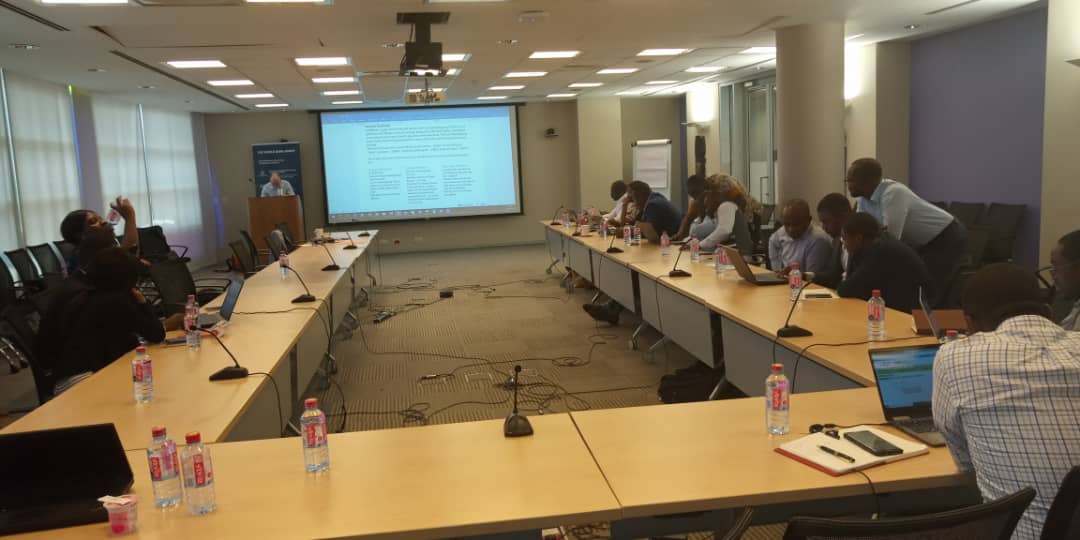
Banking, Real Estate Executives Undergo Training

Published

on

By Roger A. Agana

After decades of efforts, a standard document to regulate the activities of the building and construction industry in Ghana has been instituted.

The comprehensive Building Code, GS1207 of 2018, encompasses requirements and recommendations for efficiency and standards for Residential and Non-Residential buildings and as well cover planning, management and practices in the construction of buildings.

The document also covers the smooth and safe operation of the building and construction industry such as Occupancy Classification and Use, Site Development and Land Use, General Building Heights and Areas. It also includes types of Construction, Fire and Smoke Protection Features, Interior Furnishes, Energy efficiency and Sustainability, Soils and Foundations, Electrical Systems and Allied Installations, Plumbing Systems, Lift and Conveying Systems, Safeguards during Construction and Green Building Requirements.

In the backdrop of setting standards to ensure that Ghana’s building environment is safe and meets international standards, Stanbic Bank has signed an MOU with the International Finance Corporation (IFC), a member of the World Bank Group, to train 18 staff of Stanbic Bank as certified Edge Experts, to support developers to be able to go green.

According to Mr Stanislaus Deh, head of product personal and business banking at Stanbic Bank Ghana, in an interview with Newsghana.com.gh at the training, on Thursday February 28, 2019, at the World Bank Office in Accra, he said, “What we are doing as a bank in spearheading this project is to make sure that every project that we finance, that is building, we go green with the people.”

“And the good thing is that, when you go green, it benefits you, it increases your profile, it prepares you for the regulations that are going to hit us very soon from 2020,” he added.

In an answer to the question, as to whether the people will be willing to adopt green buildings, he said, “For me, a lot of people will be more than willing to adopt it. What we have to do to scale up more now is together with the international community educate people quickly, so they know why we are doing what we are doing now.”

Mr Deh, expatiated that, the Sustainable Principles Committee of Ghana, has for the past three years been developing the sustainable principles for the banks. Saying, “Basically, like we all know that sustainability has got to do with meeting the needs of the present generation without compromising that of the future. So, looking at the fact that, in the past three years we as a world have agreed to deal with climate change. The country as a whole is doing what they can do to deal with mitigation and adoption.”

According to him, one of the low hanging fruits when it comes to climate change has to do with the issue of green buildings and built environments. “So for us in Stanbic Bank, apart from the Ghana Home Loans, we are one of the biggest in terms of providing built environments for the country. So, as the team in Stanbic, we thought that it is time to lead the crusade for green buildings with energy efficiency, water efficiency, and making sure that material embodiments are also good to be yoked with the regulations for the buildings to be certified as green.”

On his part in an interview, Mr Dennis Papa Odenyi Quansah, Program Lead for IFC EDGE Green Building Market Transformation Program in Ghana and Nigeria, explained that, “It is important to invest in green buildings, because it will minimize the use of water and electricity in buildings.

Green building structures are energy efficient, environmentally friendly and use resources wisely as well.”

He said, it wasn’t for nothing that the government of Ghana instituted the Ghana Building Code. That it was set up to champion efficient usage of scarce resources including energy and water

According to him, Green building is a step in the right direction towards conserving global energy because, energy consumption is predicted to grow by 37% by 2035 and 96% of this expected growth will be attributable to developing nations. Mr Quansah said, there is the need for green construction which offers a chance to secure emission cuts at a low cost.

A section of the trainees commended the authorities of Stanbic Bank and IFC, for the great opportunity to train them as certified Edge Experts, to support developers to be able to go green. They however called for more of such trainings in order to get more experts to help in the education.


Modupe Gbadeyanka is a fast-rising journalist with Business Post Nigeria. Her passion for journalism is amazing. She is willing to learn more with a view to becoming one of the best pen-pushers in Nigeria. Her role models are the duo of CNN's Richard Quest and Christiane Amanpour.

Click to comment

Leave a Reply

Your email address will not be published. Required fields are marked *

Jobs/Appointments

How Do Large Companies Manage Employee Contact Information Efficiently?

Published

on

HR information systems

When a Fortune 500 company onboards 500 new employees in a single quarter, managing their contact information becomes a logistical challenge that can make or break internal communication. Traditional methods of distributing business cards and maintaining contact databases often fall short, leading to outdated information, wasted resources, and frustrated employees trying to connect with colleagues across departments.

The digital transformation of contact management has revolutionized how large organizations handle this critical aspect of business operations. From cloud-based directories to mobile-first solutions, companies are discovering new ways to ensure their teams stay connected efficiently.

The Scale Challenge: Why Traditional Methods Fail

Large corporations face unique challenges when managing employee contact information. A company with 10,000 employees might experience a 15-20% annual turnover rate, meaning they’re updating information for 1,500-2,000 positions yearly. Add in role changes, department transfers, and office relocations, and the volume of updates becomes staggering.

Traditional paper business cards present several problems at scale:

  •       Average cost of $200-400 per employee annually for printing and reprinting
  •       3-4 week lead times for new cards when information changes
  •       Environmental waste from outdated cards
  •       No way to track distribution or usage
  •       Impossible to update recipient’s saved contacts retroactively

Email signature management also becomes complex when multiplied across thousands of employees, with inconsistent formatting and outdated information creating a fragmented brand experience.

Modern Solutions: Digital-First Approaches

Leading organizations have shifted to digital contact management systems that offer real-time updates and centralized control. These platforms typically include:

Cloud-Based Employee Directories

Enterprise directory solutions integrate with existing HR systems to maintain accurate, searchable databases of employee information. These platforms often sync with Active Directory or LDAP systems, ensuring changes propagate automatically across the organization.

Digital Business Card Platforms

Modern digital business card solutions for teams allow companies to deploy hundreds of cards in minutes through bulk import features. Unlike traditional cards, digital versions update instantly across all shared contacts, eliminating the cascade of outdated information that plagues physical cards.

Mobile Contact Management Apps

Companies are increasingly adopting mobile-first solutions that allow employees to share and update contact information directly from their smartphones. The best platforms work without requiring recipients to download apps, reducing friction in the sharing process.

Security and Compliance Considerations

Enterprise contact management isn’t just about convenience—it’s about protecting sensitive employee data. Large companies must consider:

  •       Data sovereignty requirements for multinational operations
  •       GDPR compliance for European employee data
  •       SOC 2 certification for vendor platforms
  •       Role-based access controls to limit information exposure
  •       Audit trails for tracking access and changes

Security-conscious organizations look for platforms with enterprise-grade certifications and clear data handling policies. The ability to control what information different employee groups can access becomes crucial for maintaining privacy while enabling collaboration.

Integration with Existing Systems

The most successful contact management implementations integrate seamlessly with existing enterprise tools. Key integration points include:

HR Information Systems (HRIS)

Automatic synchronization with platforms like Workday, SAP SuccessFactors, or BambooHR ensures contact information stays current without manual intervention. When an employee’s role changes in the HRIS, their contact details update everywhere automatically.

Customer Relationship Management (CRM)

Sales teams benefit from integration between contact management and CRM systems. When customer-facing employees update their information, it flows directly to Salesforce, HubSpot, or Microsoft Dynamics, maintaining consistency across customer touchpoints.

Communication Platforms

Integration with Microsoft Teams, Slack, and email clients ensures employees can access colleague information within their daily workflow. Some platforms even enable direct contact sharing within these communication tools.

Measuring Success and ROI

Forward-thinking companies track specific metrics to evaluate their contact management effectiveness:

  •       Time to productivity for new hires accessing colleague information
  •       Reduction in IT tickets related to contact updates
  •       Cost savings from eliminated printing and distribution
  •       Employee satisfaction scores regarding internal communication
  •       Compliance incidents related to outdated contact information

Companies using comprehensive digital contact solutions report average time savings of 5-10 hours per employee annually just from reduced contact management friction. For a 5,000-person organization, that translates to 25,000-50,000 hours of recovered productivity.

Best Practices for Implementation

Successfully transitioning to modern contact management requires thoughtful planning and execution. Organizations should consider these proven strategies:

Phased Rollout Approach

Rather than attempting company-wide implementation immediately, successful organizations often start with pilot programs in specific departments. Sales teams, with their high external contact needs, often serve as ideal early adopters who can demonstrate value to other departments.

Change Management and Training

Employee adoption improves dramatically with proper training and communication. Companies should emphasize the personal benefits—like never having outdated colleague contacts—alongside organizational advantages.

Clear Governance Policies

Establishing policies around information updates, access levels, and usage guidelines prevents confusion and ensures consistent implementation across departments.

The shift to digital contact management represents more than a technology upgrade—it’s a fundamental improvement in how large organizations enable employee connections. As remote and hybrid work models become permanent fixtures of the corporate landscape, efficient contact management will only grow in importance. Companies that invest in modern solutions today position themselves for more agile, connected operations tomorrow.

Continue Reading

Jobs/Appointments

CIPM Remains Sole Recognised Regulator of HR Practice in Nigeria

Published

on

CIPM HR Practice in Nigeria

By Adedapo Adesanya

The federal government has reaffirmed the Chartered Institute of Personnel Management of Nigeria (CIPM) as the only legally recognised regulatory body for Human Resource (HR) practice in the country.

This follows the release of a new directive aimed at professionalising HR functions across the Federal Public Service.

The directive, contained in a circular issued by the Office of the Head of the Civil Service of the Federation (OHCSF), mandates officers occupying HR positions in Ministries, Departments and Agencies (MDAs) to obtain approved professional certifications.

The circular, referenced HCSF/3065/Vol.1/230 and dated May 14, 2026, was signed by the Head of the Civil Service of the Federation, Mrs Didi Esther Walson-Jack.

According to the circular, the policy is part of ongoing reforms targeted at strengthening professionalism, ethical standards, competence and service delivery within the Federal Civil Service.

The government specifically recognised certifications issued by the Chartered Institute of Personnel Management of Nigeria (CIPM), alongside a few globally recognised HR professional bodies, further reinforcing the Institute’s statutory role in regulating and advancing HR practice in Nigeria.

Under the new policy, officers deployed to HR functions within the Federal Public Service are required to possess approved HR certifications within a 12-month grace period.

It was also granted to affected officers to regularise their certification status, after which only certified professionals will be eligible for deployment into designated HR roles.

Reacting to the development, the President and Chairman of the Governing Council of CIPM, Mr Ahmed Ladan Gobir, described the circular as a landmark step towards institutionalising professionalism in Nigeria’s public sector.

He said the directive aligns the nation’s civil service with global best practices in Human Resource Management while reinforcing the importance of professional competence and ethical compliance in workforce management.

Mr Gobir stressed that CIPM remains the only institute legally empowered to regulate HR practice in Nigeria, noting that the Institute’s enabling law grants it authority to set standards, certify practitioners and enforce discipline within the profession.

“While the circular recognises certain international certifications, it is important to reiterate that within Nigeria, CIPM remains the only Institute with the legal mandate to regulate the practice of Human Resource Management,” he stated.

Continue Reading

Jobs/Appointments

Kayode Oyekanmi Replaces Sola Kosoko as LTV General Manager

Published

on

Kayode Oyekanmi LTV General Manager

By Modupe Gbadeyanka

Lagos Television (LTV 8), Alausa, Ikeja, has a new General Manager, and he is Mr Kayode Oyekanmi, replacing Mrs Sola Kosoko, who was ousted by the Lagos State government.

Mr Oyekanmi was presented with his letter of appointment on Wednesday, May 13, 2026, by the Lagos State Head of Service, Mr Bode Agoro, in a brief ceremony.

The new General Manager of the state-owned broadcast station was tasked with using his vast experience in the media space to take LTV 8 to greater heights.

Mr Agoro expressed confidence in Mr Oyekanmi’s capacity to reposition Lagos Television and wished him a successful and impactful tenure of office.

Prior to his appointment, Mr Oyekanmi served as the Director of Strategy Centre at the Lagos State Ministry of Information and Strategy, a position he has held since 2022.

A seasoned brand communications practitioner, Mr Oyekanmi has over three decades of professional experience spanning both the private and public sectors, with expertise in Advertising, Public Relations, and global export services.

He commenced his public service career as a Public Affairs Practitioner on March 1, 2000, with the Lagos State Ministry of Information and Strategy.

The new LTV boss, a Lagos State indigene from Isale Eko, Lagos Island, has received several awards in recognition of his dedication, hard work, and commitment to the journalism profession.

He holds a Master’s degree in Public Administration (MPA) from the University of Lagos and a Bachelor’s degree in English Language and Education from Lagos State University.

He is an active Member of the Nigeria Union of Journalists (NUJ) and the Nigerian Institute of Public Relations (NIPR).

In addition, he is a voracious reader and a passionate lawn tennis player, and currently serves as the Charter President of the Lagos State Ministry of Information Toastmasters Club.

Continue Reading

Trending