Connect with us

Jobs/Appointments

Banking, Real Estate Executives Undergo Training

Published

on

By Roger A. Agana

After decades of efforts, a standard document to regulate the activities of the building and construction industry in Ghana has been instituted.

The comprehensive Building Code, GS1207 of 2018, encompasses requirements and recommendations for efficiency and standards for Residential and Non-Residential buildings and as well cover planning, management and practices in the construction of buildings.

The document also covers the smooth and safe operation of the building and construction industry such as Occupancy Classification and Use, Site Development and Land Use, General Building Heights and Areas. It also includes types of Construction, Fire and Smoke Protection Features, Interior Furnishes, Energy efficiency and Sustainability, Soils and Foundations, Electrical Systems and Allied Installations, Plumbing Systems, Lift and Conveying Systems, Safeguards during Construction and Green Building Requirements.

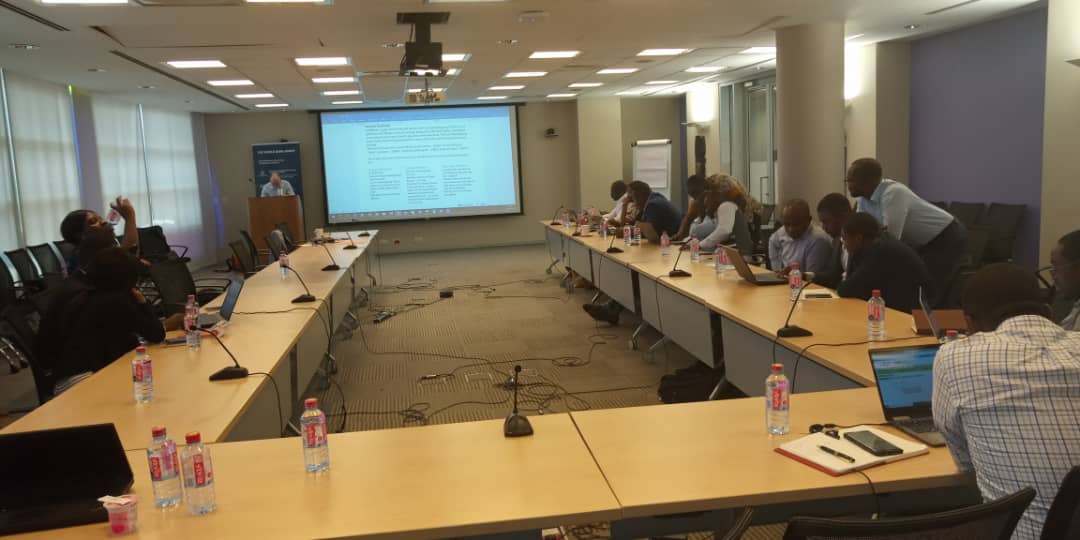
In the backdrop of setting standards to ensure that Ghana’s building environment is safe and meets international standards, Stanbic Bank has signed an MOU with the International Finance Corporation (IFC), a member of the World Bank Group, to train 18 staff of Stanbic Bank as certified Edge Experts, to support developers to be able to go green.

According to Mr Stanislaus Deh, head of product personal and business banking at Stanbic Bank Ghana, in an interview with Newsghana.com.gh at the training, on Thursday February 28, 2019, at the World Bank Office in Accra, he said, “What we are doing as a bank in spearheading this project is to make sure that every project that we finance, that is building, we go green with the people.”

“And the good thing is that, when you go green, it benefits you, it increases your profile, it prepares you for the regulations that are going to hit us very soon from 2020,” he added.

In an answer to the question, as to whether the people will be willing to adopt green buildings, he said, “For me, a lot of people will be more than willing to adopt it. What we have to do to scale up more now is together with the international community educate people quickly, so they know why we are doing what we are doing now.”

Mr Deh, expatiated that, the Sustainable Principles Committee of Ghana, has for the past three years been developing the sustainable principles for the banks. Saying, “Basically, like we all know that sustainability has got to do with meeting the needs of the present generation without compromising that of the future. So, looking at the fact that, in the past three years we as a world have agreed to deal with climate change. The country as a whole is doing what they can do to deal with mitigation and adoption.”

According to him, one of the low hanging fruits when it comes to climate change has to do with the issue of green buildings and built environments. “So for us in Stanbic Bank, apart from the Ghana Home Loans, we are one of the biggest in terms of providing built environments for the country. So, as the team in Stanbic, we thought that it is time to lead the crusade for green buildings with energy efficiency, water efficiency, and making sure that material embodiments are also good to be yoked with the regulations for the buildings to be certified as green.”

On his part in an interview, Mr Dennis Papa Odenyi Quansah, Program Lead for IFC EDGE Green Building Market Transformation Program in Ghana and Nigeria, explained that, “It is important to invest in green buildings, because it will minimize the use of water and electricity in buildings.

Green building structures are energy efficient, environmentally friendly and use resources wisely as well.”

He said, it wasn’t for nothing that the government of Ghana instituted the Ghana Building Code. That it was set up to champion efficient usage of scarce resources including energy and water

According to him, Green building is a step in the right direction towards conserving global energy because, energy consumption is predicted to grow by 37% by 2035 and 96% of this expected growth will be attributable to developing nations. Mr Quansah said, there is the need for green construction which offers a chance to secure emission cuts at a low cost.

A section of the trainees commended the authorities of Stanbic Bank and IFC, for the great opportunity to train them as certified Edge Experts, to support developers to be able to go green. They however called for more of such trainings in order to get more experts to help in the education.


Modupe Gbadeyanka is a fast-rising journalist with Business Post Nigeria. Her passion for journalism is amazing. She is willing to learn more with a view to becoming one of the best pen-pushers in Nigeria. Her role models are the duo of CNN's Richard Quest and Christiane Amanpour.

Click to comment

Leave a Reply

Your email address will not be published. Required fields are marked *

Jobs/Appointments

Elumelu Quits as UBA Chairman, Nnorom Takes Over

Published

on

tony elumelu and emmanuel nnorom

By Aduragbemi Omiyale

In line with the 12-year tenure prescribed for non-executive directors of banks by the Central Bank of Nigeria (CBN), Mr Tony Elumelu will on August 21, 2026, cease to be chairman of United Bank for Africa (UBA) Plc.

The board of the financial institution at its meeting on July 6, 2026, has elected Mr Emmanuel Nnorom as the new chairman.

In a notice to the Nigerian Exchange (NGX) Limited, the lender said Mr Elumelu’s successor, a non-executive director of the company, will assume the new role on August 21, 2026.

Mr Nnorom is a chartered accountant with over 40 years of experience in banking, finance and audit. He brings to the role extensive leadership experience and deep institutional knowledge of UBA.

“I am honoured by the trust the Board has placed in me and deeply conscious of the legacy I inherit.

“I look forward to working with my colleagues on the board, management and our staff across all our markets to sustain UBA’s momentum and continue delivering long-term value to our shareholders, customers and stakeholders,” Mr Nnorom stated.

Commenting on his retirement, Mr Elumelu said, “Serving United Bank for Africa has been one of the great privileges of my career.

“UBA has a unique competitive position, across Africa and globally, and I leave the Board with great confidence in UBA’s future.

“Emmanuel Nnorom is a leader of integrity, experience and sound judgement, and I am confident that the Bank will continue to thrive under his leadership.”

The board thanked him for his visionary leadership and exceptional contribution to the growth, transformation and institutional strength of the UBA Group.

Continue Reading

Jobs/Appointments

WACT-APM Terminals Appoints Obadagbonyi as Managing Director

Published

on

Courage Obadagbonyi

By Adedapo Adesanya

WACT-APM Terminals Nigeria has announced the appointment of Mr Courage Obadagbonyi as Managing Director, effective July 1, 2026, succeeding Mr Jeethu Jose and becoming the first Nigerian to hold the post.

The appointment reflects the organisation’s continued focus on developing strong leadership from within its global talent pool while ensuring sustained growth and operational excellence.

A seasoned executive with more than two decades of international experience, Mr Obadagbonyi has held leadership roles across finance, operations and general management at leading global organisations, including APM Terminals, General Electric and Lafarge.

Prior to this appointment, he served as Chief Financial Officer (CFO) for the APM Terminals Nigeria cluster, with responsibility for financial strategy across Nigeria and San Pedro, Côte d’Ivoire.

He also served in an acting capacity as Managing Director of APM Terminals Apapa between 2025 and March 2026, further strengthening his operational leadership experience.

With experience spanning sectors such as oil and gas, power generation, logistics and healthcare, Mr Obadagbonyi brings deep expertise in financial management, risk optimisation and business performance.

Speaking on his appointment, he said, “I look forward to building on the strong foundation already in place at WACT. The terminal plays a critical role in connecting businesses in Eastern Nigeria to global markets, and we will continue to focus on safe, reliable and efficient operations.”

On his part, the Chief Executive Officer of APM Terminals Nigeria, Mr Frederik Klinke, noted that the appointment reflects the company’s commitment to leadership development and long-term growth.

“Across APM Terminals globally, we see strong collaboration and talent development across our teams. This appointment reflects the depth of experience within our organisation and our continued focus on building capabilities that support sustainable growth. Nigerians have continued to distinguish themselves through exceptional performance and leadership. Colleagues from our Apapa and Onne terminals have contributed their expertise internationally while also bringing back valuable best practices to strengthen operations in Nigeria.”

He added that Mr Obadagbonyi’s experience would support the next phase of operational excellence and value delivery at WACT.

The outgoing MD, Mr Jose, said, “It has been a privilege to lead WACT-APM Terminals Nigeria during a period of meaningful progress. The team has built a strong platform for the future, and I am confident in the continued success of the organisation.”

West Africa Container Terminal (WACT)-APM Terminals in Onne, Rivers State, is one of Nigeria’s leading container terminals, having commenced commercial operations in 2006.

The company has continued to invest in capacity expansion and modernisation, including a $115 million terminal upgrade project launched in 2020. The upgrade also includes the deployment of reefer racks with a 600-plug capacity, as well as the expansion of the existing yard, a new workshop, a new terminal auto gate, modernised offices and state-of-the-art technology. These investments have enhanced efficiency, strengthened service delivery and reinforced WACT’s role as an important gateway for trade beyond Lagos.

Continue Reading

Jobs/Appointments

Unilever Nigeria Appoints Modupe Femi-Okunbanjo to Board

Published

on

Modupe Femi-Okunbanjo

By Aduragbemi Omiyale

A new member has joined the board of Unilever Nigeria Plc, and she is Mrs Modupe Femi-Okunbanjo, who was appointed as an executive director of the organisation.

Her appointment, according to a statement from the company, is effective June 30, 2026. It followed the resignation of Mr Ibrahim Sodipe as an executive director of the firm with effect from June 30, 2026.

Mr Sodipe was praised for his valuable service and significant contributions to the entity, particularly in driving improved turnover and profitability and supporting Unilever Nigeria’s continued progress towards sustainable and profitable growth.

Mrs Femi-Okunbanjo was described as an accomplished finance and governance leader who, for more than 15 years, has steered finance teams, shaped strategy, and strengthened risk management frameworks in the fast-moving consumer goods and telecommunications sectors.

She is currently the Financial Controller of Nigeria and Regional Controls Lead for West Africa at Unilever Nigeria, where she oversees financial governance, regulatory compliance, and enterprise risk management.

Her work has been pivotal in embedding ethical leadership and data-driven decision-making at board level, while ensuring organisations remain resilient in the face of shifting market dynamics.

The new board member has established a reputation for elevating financial reporting, advancing audit excellence, and strengthening governance frameworks, thereby positioning organisations for sustainable growth and long-term value creation.

In her previous roles, she has a consistent track record of delivering margin expansion, enhancing governance & control environments, and leading transformation in challenging macroeconomic conditions.

She is equally committed to developing future talent and advancing financial literacy among younger generations.

Prior to her joining Unilever Nigeria Plc in 2018, Mrs Femi-Okunbanjo held key roles at UAC of Nigeria Plc, Helios Towers Nigeria, and Makasa Sun Nigeria Limited, where she pioneered control frameworks from the ground up, eliminating revenue leakages, digitising operations and embedding financial discipline.

A Fellow of the Institute of Chartered Accountants of Nigeria (ICAN) and a Member of the Chartered Institute of Management Accountants (CIMA), she holds a Bachelor’s degree in Accounting from Lagos State University and an MBA with Specialisation in Strategy from the Edinburgh Business School, Heriot-Watt University, UK.

Continue Reading

Trending