General
Why ISOPADEC is Under Investigation—Irona
Recently, the Imo State government constituted an investigative panel to look into the management of the Imo state Oil Producing areas Development Commission (ISOPADEC).
While some saw this as a welcome development, others claimed it was part of the present government’s agenda to witch-hunt the immediate past government of Senator Rochas Okorocha.
But Deputy Governor of Imo State, Mr Gerald Irona explained that the decision to probe the commission was because of reports of mismanagement of the agency by previous administrations in the state.
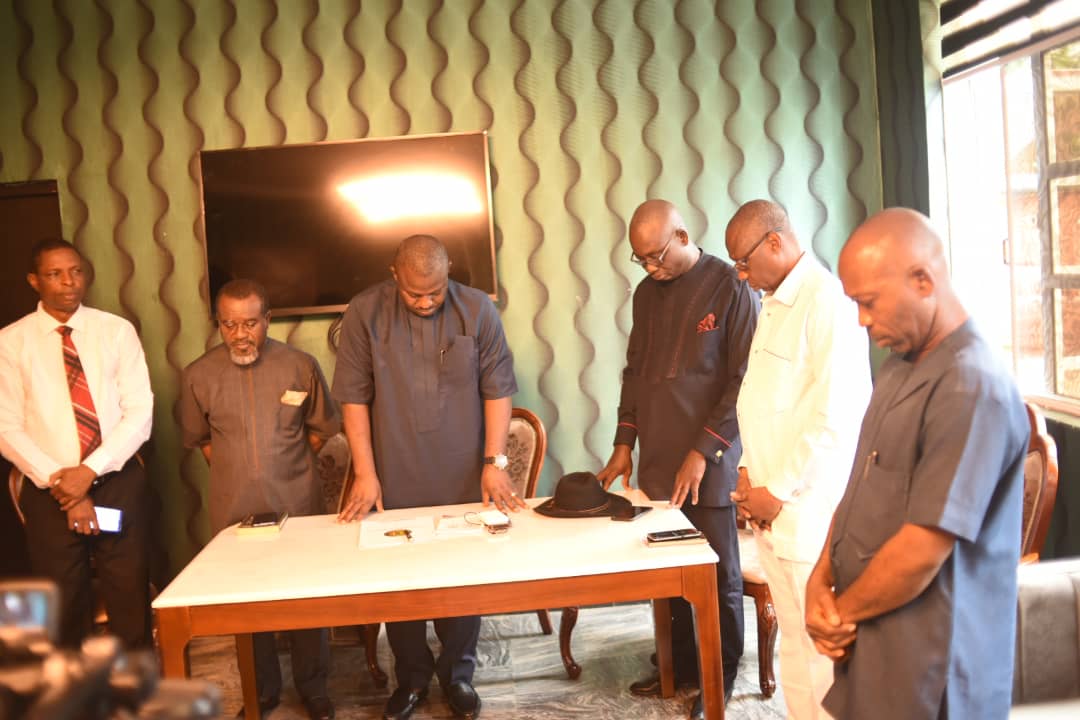
Speaking when he received a delegation of stakeholders from Ohaji, in Ohaji Egbema Local Government Area under the auspices of Ogbako Ohaji, a socio-cultural organisation, led by Chief Goddy Obodo, the Deputy Governor said, “Few weeks before the last administration of Rochas Okorocha left, over N420 million was released on the orders of the former Governor to buy vehicles.
“The funds were not for ISOPADEC use, but for other uses. The funds were ISOPADEC funds. The salary wage bill is a little over N40 million and they were receiving about N95 million.
“There were a lot of issues. We now insisted that we must look into what has transpired. We are not witch hunting anyone. We just want to get things right.”
“The government set up an investigative panel; a panel of enquiry to look into how the commission was managed in the past years. We need to know how much was received by the commission and how the funds were utilized. We need to know what they did with our money and who played what role. We want ISOPADEC to work well.”
“We must ensure that ISOPADEC functions properly as an interventionist agency. It is unacceptable that till date, communities in Ohaji/Egbema/Oguta do not have portable water and electricity. The new ISOPADEC management must rise to the challenge of addressing the needs of the people. We constituted an ISOPADEC Advisory Council to be able to guide and encourage the new management, with a view to ensuring that the spirit and letters of ISOPADEC are strictly adhered to. The era of sharing ISOPADEC money is over.”
Speaking on funding, the Deputy Governor assured that the Commission shall be funded according to the law establishing it, even as he charged the new management on accountability.
“ISOPADEC must be accountable. It shall be funded according to the law establishing it. Funding will not be an issue. The issue will be how to manage the funds. It calls for prudence. There must be consultation, transparency and accountability.”
He further assured the delegation that Adapalm Nigeria will be properly managed in the interest of the citizens.
Speaking earlier, leader of the delegation and former lawmaker, Chief Goddy Obodo expressed gratitude to the government of Chief Emeka Ihedioha for considering Ohaji indigenes in political appointments, assuring him of their continued support.
He described the Deputy Governor as a great gift to people of the area, promising that people of the area will not disappoint.
“We are here to identify with you. Carry our message of gratitude to Governor Emeka Ihedioha. We are here to express our happiness. Within one month of our administration, we are already feeling a wind of change. We are here to tell you that we are happy with the government. As long as politics is concerned, be rest assured that Ohaji is solidly behind you. Call us anytime, any day, we are for you.”
“For Eight years, ISOPADEC was almost closed down. For eight years, no one from Ohaji benefited anything from ISOPADEC. The people of Ohaji that have so far been given appointments are tested and trusted. They will not fail you.”
Speaking on Adapalm, Obodo stated: “Adapalm, at some point was in someone’s pocket. Today, the government has set up an Interim Management Committee to turn it around. Ohaji people are standing by you.”
On youth restiveness, Obodo argued that youth of the area were deceived into thuggery, urging the cooperation of all to change the narrative.
“They deceived Ohaji youth into thuggery. That is not our character. We are disciplined, honest and hardworking people. Please, help us to change this narrative.”
Other members of the delegation were: former Commissioner, Barr. Golden Nwosu, Chairman, Interim Management Committee of Adapalm, Dr. Anthony Kerunwa, ISOPADEC Chairman, Barr. Magnus Obido, member of ISOPADEC Board, Hon. Emeka Alihie, Imo State Publicity Secretary of the Peoples Democratic Party, Hon. Damian Opara, among others.
General
NMDPRA Records 30% Drop in Gas Imbalance on Western Network
By Adedapo Adesanya
The Nigerian Midstream and Downstream Petroleum Regulatory Authority (NMDPRA) says it recorded a 30 per cent reduction in gas imbalance on the country’s Western Network following the conclusion of its first-half 2026 Nigerian Gas Network Reconciliation (NGNR) Workshop.
The workshop brought together gas transporters, suppliers, shippers and off-takers to reconcile gas volumes traded between January and June 2026, while introducing a Network Entry/Exit Point Measurement Infrastructure Audit Template aimed at improving metering accuracy and accountability across the gas transmission network.
In a communiqué issued after the workshop, the authority said participants also reviewed the performance of the Nigerian Gas Transmission Network, assessed progress on major pipeline infrastructure projects, and received updates on the ELPS Gas Shrinkage Factor and Hydraulic Modelling Project.
Discussions focused on addressing metering gaps, improving network visibility through Supervisory Control and Data Acquisition (SCADA) integration, and enhancing system reliability ahead of the commissioning of the Ajaokuta-Kaduna-Kano (AKK) Pipeline System.
The workshop adopted key resolutions, including the execution of outstanding Network Exit Agreements, mandatory submission of measurement audit templates and closer collaboration among industry stakeholders to improve network pressure management.
Speaking at the closing session on behalf of the authority’s chief executive, Mr Rabiu A. Umar, the Director of Transportation Systems and Networks, Mr Joseph G. Musa, said the biannual reconciliation exercise had become critical to promoting equitable gas transactions, transparency, investor confidence and efficient network operations.
Mr Musa noted that since the NGNR process was introduced in 2023, it had significantly improved gas measurement, strengthened regulatory compliance through consequence management, reduced operational imbalances and contributed to a more reliable domestic gas supply.
The workshop concluded with participants adopting the reconciled H1 2026 gas volumes, reaffirming the authority’s commitment to a transparent, efficient and reliable domestic gas market.
General
Swedfund Supports Climate Resilience in African Food Systems With $12m
By Modupe Gbadeyanka
An investment that supports growing food and agriculture companies across Africa that strengthen agricultural value chains has been made by Swedfund.
The organisation is putting down about $12 million to strengthen climate resilience in African food systems through the Acumen Resilient Agriculture Fund II (ARAF II).
By improving access to markets, finance and essential services, these companies help smallholder farmers become more resilient to climate and economic shocks.
Over 30 million smallholder farmers operate across Sub-Saharan Africa, accounting for 80 per cent of all farms and producing 70 per cent of the region’s food (IFAD). Yet many face limited access to finance, quality inputs, reliable buyers and market information. At the same time, they are among those most exposed to climate change and weather-related shocks, which threaten harvests, incomes and food security.
The investment has an ambition to reach around four million smallholder farmers through ARAF II’s portfolio companies. It also aims to meet the criteria of the 2X Challenge, which promotes investments that support women’s economic empowerment.
ARAF II invests in businesses that address key gaps in agricultural value chains, from improving market access and reducing post-harvest losses to expanding financial and digital services for farmers. By helping these businesses grow, the investment aims to improve productivity, strengthen local value chains and increase the resilience of food systems.
Swedfund invests alongside other development finance institutions and investors to help mobilise long-term capital for businesses that often struggle to access financing despite their potential to strengthen food security, climate resilience and economic development across Africa.
“Climate change is already affecting the livelihoods of millions of smallholder farmers across Africa. Investing in businesses that improve access to markets, finance and agricultural services helps farmers strengthen their resilience, increase productivity and build more stable incomes. That is essential for more resilient food systems,” the Investment Director of Food Systems and Strategic Investments at Swedfund, Ms Helen Hagos, said.
General
SERAP Urges Tinubu to Probe Alleged N6.79bn Diversion in Police, Ministry
By Adedapo Adesanya
The Socio-Economic Rights and Accountability Project (SERAP) has urged President Bola Tinubu to order a probe into the alleged diversion, disappearance and misapplication of more than N6.79 billion in public funds within the Nigeria Police Force (NPF) and the Federal Ministry of Police Affairs.
The grave allegations are documented in the latest Annual Report of the Auditor-General of the Federation published on September 9, 2025.
SERAP said, “Anyone suspected to be responsible—including contractors, companies and public officials implicated in the report—should be promptly prosecuted, while all missing public funds, firearms and ammunition should be fully recovered, secured and properly accounted for.”
In the letter dated August 1, 2026, and signed by SERAP deputy director, Mr Kolawole Oluwadare, the organisation said: “The Auditor-General’s findings suggest a grave betrayal of the public trust and raise serious concerns about corruption and the management of public funds, police exhibits, firearms and ammunition.”
SERAP said: “The report also raises serious concerns over missing firearms and ammunition, the unauthorised use and release of police exhibits, failures to properly account for exhibits, and the insecure storage of firearms, creating significant risks to public safety and national security.”
According to the group, “The diversion of funds meant for policing, abandoned security projects, missing firearms and ammunition, and the misuse of police exhibits undermine the operational effectiveness of the Nigeria Police Force, weaken public confidence and may contribute to Nigeria’s worsening insecurity.”
The letter, read in part: “The report documented numerous alleged financial irregularities within the Nigeria Police Force and the Federal Ministry of Police Affairs, including payments for projects that were never executed, abandoned contracts, inflated contract costs, and irregular procurement.”
“The report also documented unretired cash advances, unsettled insurance claims, payments for services allegedly not rendered, and other suspected diversion and misapplication of public funds amounting to over ₦6.79 billion.”
“The allegations also include missing firearms and ammunition, the unauthorised use and release of police exhibits, failures to properly account for recovered firearms and other exhibits, and the insecure storage of firearms, posing serious risks to public safety and national security.”
“We would be grateful if the recommended measures are taken within seven days of the receipt and/or publication of this letter. If we have not heard from you by then, SERAP shall consider appropriate legal action to compel your government to comply with our request in the public interest.”
Some of the others include: N499,875,500.00 for the construction of Police College Phase II, Bashar, Plateau State; N12,931,000.00 for the rehabilitation of Block B, Department of Logistics and Supply (Works) building, Garki; N111,635,864.64 for the construction of 12 one-bedroom transit camp units and rehabilitation of the administration block at the NPF Pre-retirement Skills Acquisition Centre, Kudana, Kaduna State; N4,011,627.89 inserted as taxes to inflate a contract; N1,938,299,452.00 for 14 ongoing projects that were abandoned; N5,050,000.00 in monetary exhibits released without proper authorisation; N112,026,424.00 for outstanding allowances paid to officers to cover 2020 liabilities; and N6,000,000.00 as annual payment to the Inspector General of Police’s Senior Special Assistant on Revenue and Tax Matters.
Others include N10,080,000.00 as cash advances for the provision of office equipment and accessories for the NPF Database Management Centre; N438,066,845.73 for the supply of bulletproof vests, ballistic helmets and procurement of a Styr Punch Vistar troop carrier; N18,000,000.00 for the training of women in cosmetology and provision of empowerment kits in Ondo Central Senatorial District, Ondo State; N258,989,999.75 for the procurement of 10 JAC patrol vehicles for NPF outpost stations in Kano State; N30,853,250.00 as security allowances for personnel attached to the Ministry of Police Affairs; N681,406,593.18 for the settlement of insurance claims through insurance brokers; N1,628,108,434.18 for outstanding insurance policy liabilities for 2020/2021; N57,484,515.30 for the procurement of video cameras, customised umbrellas, gift bags and customised towels for the Nigeria Police Force Public Relations Office; N7,760,409.56 in withholding tax and value added tax that was not deducted from contracts awarded.