General
Ministers Donate 50% March Salary to FG’s COVID-19 Fight
By Adedapo Adesanya
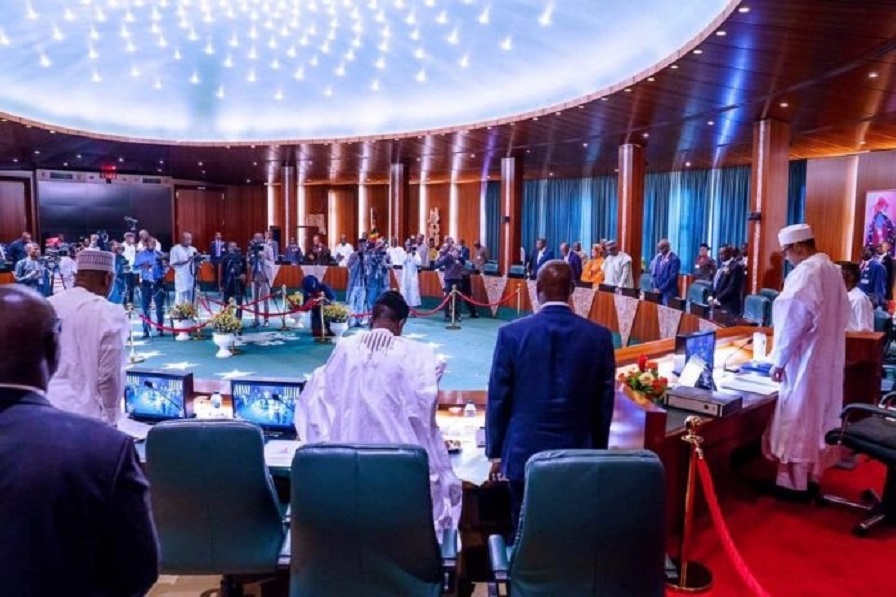
All 43 ministers under the President Muhammadu Buhari led administration have donated 50 percent of their March salaries to support the federal government’s effort to tackle the coronavirus pandemic.
This disclosure was made by the Minister of Information and Culture, Mr Lai Mohammed, on Saturday.
According to Mr Mohammed, the donation was coordinated by the Minister of State for Transportation, Ms Gbemisola Saraki.
In a statement issued by the Ministry of Information on Saturday in Abuja, Ms Saraki was quoted as saying that the donation from the ministers was a gesture of solidarity and support for the federal government’s efforts to tackle the disease.
”This global virus outbreak will require nations, continents and smaller communities to pull together to contribute their resources and support one another. This will facilitate an early resolution of the problem,” Ms Saraki was quoted as saying.
The Ministers also commended President Muhammadu Buhari for his leadership role in addressing the COVID-19 pandemic in Nigeria.
The Nigeria Centre for Disease Control (NCDC) confirmed 11 new cases on Friday. Eight of the cases were discovered in Lagos, while two were discovered in Enugu and one in Edo State.
The number of confirmed cases of coronavirus in Nigeria as at Saturday was 81, according to the NCDC. Out of which two have been discharged and one dead.
Of the 81 confirmed cases, Lagos has 52, the federal capital territory (FCT) 14, Ogun three and Oyo three. Edo, Bauchi and Enugu states have two cases each while Ekiti, Osun and Rivers states have one case each.
Mr Suleiman Achimugu, former managing director of the Petroleum Products Marketing Company (PPMC), is the only casualty from the disease so far. He died on Monday, March 30 after returning to the country from the United Kingdom.
General
Arridex Plans Mega Industrial Additive Manufacturing Plant in 2027
By Aduragbemi Omiyale
Plans are underway by Arridex to commission a mega industrial additive manufacturing facility in the first quarter of 2027.
The chief executive of the organisation, Mr Kayode Adeleke, disclosed this at the commissioning of the company’s omnifactory in Lagos some days ago by Governor Babajide Sanwo-Olu of Lagos State.
The new plant is the first multi-technology industrial additive manufacturing facility in West Africa.
The Arridex Omnifactory integrates multiple additive manufacturing technologies under a single roof, including Laser Powder Bed Fusion (L-PBF), Cold Spray, Fused Filament Fabrication (FFF), and Selective Laser Sintering (SLS), enabling on-demand production of industrial components, spares, and improved part designs for critical industries. Its large-format capabilities extend to full-size marine components and other large-scale industrial structures.
The Omnifactory’s commissioning is the point at which two decades of accumulated capability become infrastructure. Arridex began operations in 2005 as an asset integrity practice in Nigeria’s oil and gas sector and grew sector by sector into maritime, defence, construction, technology, and aerospace. The organisation has recorded zero lost-time incidents across more than seven million man-hours of operations.
For Nigeria and West Africa, the Arridex Omnifactory addresses a structural dependency that has long affected operational continuity across critical industries. Asset owners managing ageing infrastructure have routinely contended with extended procurement lead times, supply chains spanning multiple jurisdictions, and the increasing obsolescence of legacy parts whose original manufacturers may no longer exist. The Omnifactory manufactures those components on demand in Lagos.
Arridex holds Pioneer Status in additive manufacturing, granted by the Nigerian Investment Promotion Commission (NIPC), it is the first company qualified by the Nigerian Upstream Petroleum Regulatory Commission (NUPRC) for additive manufacturing deployment in the oil and gas sector, and has a joint venture partnership with the Defence Industries Corporation of Nigeria (DICON) for the local production of military-grade additive manufactured components, a set of recognitions that collectively signal the institutional grounding of what the Omnifactory represents.
“We did not set out to build the biggest company, but a resilient one. For over two decades, we have chosen the harder path, and that is to make in Africa what others import, to meet global standards without exception, and to put purpose before profit.
“The Arridex Omnifactory is where that conviction becomes infrastructure. The name on the door is new, but the work behind it is not. We are not stopping here. By the first quarter of 2027, we will commission the Arridex Mega Omnifactory, which will stand among the largest single-site industrial additive manufacturing facilities in the world. The next chapter of global manufacturing can be written from Lagos. We are building it,” Mr Adeleke commented.
On his part, Mr Sanwo-Olu lauded the firm for its “vision and commitment to building solutions that serve not only Nigeria but the wider African continent.”
“Lagos will continue to support investments that create opportunities, grow local capacity and position our state as a hub for innovation and industry,” he assured.
General
NMDPRA, NEITI Deepen Partnership on Data Transparency, Regulatory Reforms
By Adedapo Adesanya
The Nigerian Midstream and Downstream Petroleum Regulatory Authority (NMDPRA) and the Nigeria Extractive Industries Transparency Initiative (NEITI) have strengthened collaboration on data transparency, accountability and regulatory reforms in Nigeria’s petroleum sector.
The commitment was made during a visit by a NEITI delegation led by its Executive Secretary, Mr Musa Sarkin Adar, to the headquarters of NMDPRA, where discussions focused on enhancing data management, technology-driven regulation and transparency across the midstream and downstream segments of the oil and gas industry.
Speaking during the meeting, the chief executive of NMDPRA, Mr Rabiu Abdullahi Umar, said the Authority is implementing key reforms aimed at improving regulatory efficiency and ensuring the integrity of industry data.
According to him, two major initiatives, Project NEXUS and Project 365, are central to the authority’s reform agenda.
He explained that “Project NEXUS is designed to transform the implementation of the Petroleum Industry Act, PIA, while Project 365 is focused on automating the Authority’s processes and services.”
Mr Umar stressed that accurate and reliable data remain critical to effective regulation, policy formulation and decision-making in the petroleum sector.
“Reliable data remains critical to effective regulation and policy formulation,” he said, adding that NMDPRA is leveraging technology to improve product tracking across the petroleum value chain and enhance operational transparency.
The NMDPRA boss further reaffirmed the Authority’s commitment to working closely with NEITI, noting that stronger collaboration would support efforts to deepen transparency and accountability in the industry.
In his remarks, NEITI Executive Secretary, Mr Musa Sarkin Adar, sought NMDPRA’s support in providing critical industry data and information required for the agency’s forthcoming reports.
Mr Adar specifically requested information relating to refinery operations as well as beneficial ownership in the midstream and downstream petroleum sectors, areas that have increasingly become key components of transparency reporting in the extractive industry.
He also invited NMDPRA to participate in NEITI’s exhibition at the 2026 Extractive Industries Transparency Initiative (EITI) Global Conference scheduled to be held on October 8 and 9, 2026, in Brussels, Belgium.
The meeting also featured contributions from NMDPRA’s Executive Director, Hydrocarbon Processing Plants, Installations and Transportation Infrastructure, HPPITI, Mr.= Francis Ogaree, and Executive Director, Economic Regulation and Strategic Planning, ER&SP, Mrs Zainab Gobir.
General
The Hidden Cost of Managing HR Across Multiple Systems: The 234 Solutions Perspective
As part of the ongoing conversation around the future of work, 234 Solutions explores the challenges shaping HR, payroll, and workforce management in today’s workplace.
Many HR teams aren’t working from one system. They’re working from five. A system for payroll. Another for attendance. A shared drive for onboarding documents. An inbox full of leave requests. A spreadsheet someone built three years ago that everyone’s too afraid to touch.
Individually, each of these feels manageable. Together, they create a quiet but very real problem.
Every time an employee’s details change, someone has to update it in multiple places and hope nothing gets missed. Every payroll run means cross checking data between systems that don’t talk to each other. Every report means pulling numbers from different sources, reconciling them manually, and praying the figures align.
It’s not chaos. It just looks like extra steps. And those extra steps add up.
What starts as a few minutes here and there becomes hours lost every week, hours that should be going toward hiring, culture, performance, and the people’s conversations that actually move a business forward. Instead, HR teams are spending their time being system administrators.
The irony is that none of these platforms are bad at what they do individually. The problem is the space between them, the manual handoffs, the duplicate entries, the version control headaches, and the inevitable errors that creep in when humans have to bridge what technology should.
Employees feel it too. A leave request that sits in limbo because it’s waiting on an approval in a system a manager rarely checks. An onboarding experience that feels disjointed because no one has a complete picture. Delays that erode trust, quietly.
The question HR leaders are increasingly asking isn’t “do we need better tools?” It’s “do we need fewer of them?”
That’s the thinking behind 234 Solutions, a platform built to bring HR, payroll, and workforce operations into a single, connected experience. Less switching. Less chasing. Less falling through the cracks. And more time for the work that actually requires a human.
-
Feature/OPED6 years agoDavos was Different this year
-
Travel/Tourism10 years ago
Lagos Seals Western Lodge Hotel In Ikorodu
-
Showbiz3 years agoEstranged Lover Releases Videos of Empress Njamah Bathing
-
Banking8 years agoSort Codes of GTBank Branches in Nigeria
-
Economy3 years agoSubsidy Removal: CNG at N130 Per Litre Cheaper Than Petrol—IPMAN
-
Banking3 years agoSort Codes of UBA Branches in Nigeria
-
Banking3 years agoFirst Bank Announces Planned Downtime
-
Sports3 years agoHighest Paid Nigerian Footballer – How Much Do Nigerian Footballers Earn