Connect with us

Health

Osinbajo Canvasses Private Investment in Health Sector

Published

on

private investment in health

By Modupe Gbadeyanka

Private investors have been urged to consider putting their money in the health sector as the federal government strives to attain Sustainable Development Goals (SDGs) 3 and 9 adopted by the United Nations General Assembly (UNGA) in 2015.

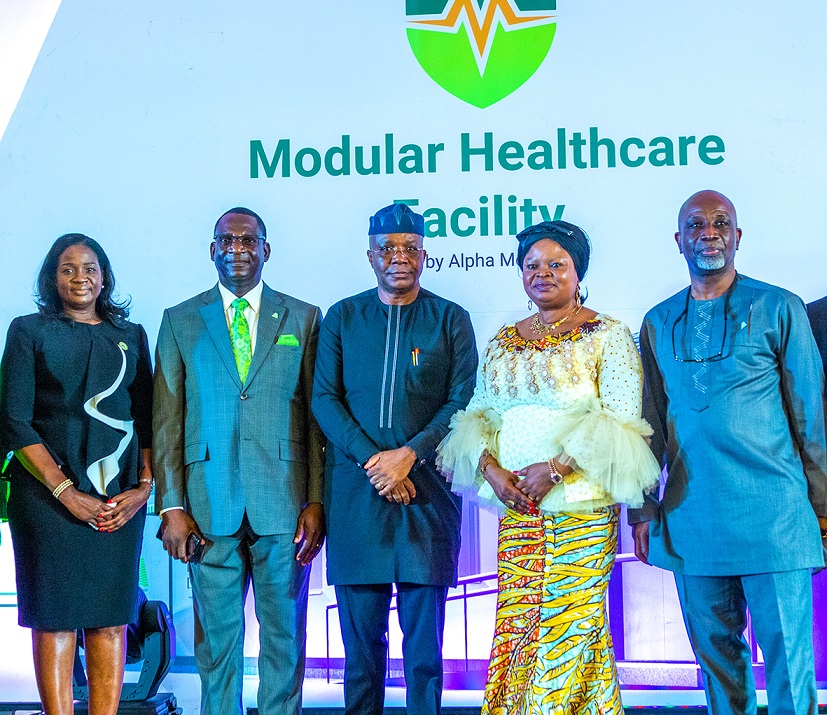
This call was made by the Vice President of Nigeria, Mr Yemi Osinbajo (SAN), on Wednesday during the state-of-the-art Modular Healthcare Facility (MHF) launch by Alpha Mead Healthcare Management Services at Gbagada General Hospital, Gbagada, Lagos.

The MHF is a customised, mobility-enhanced, prefabricated portacabin with detachable modules equipped with state-of-the-art clinical and diagnostic equipment designed to take quality healthcare services to the doorstep of all Nigerians.

Represented by the Senior Special Assistant to President Muhammadu Buhari on Sustainable Development Goals (SDGs), Mrs Adejoke Orelope-Adefulire, Mr Osinbajo said private investment in health would help Nigeria attain the two vital SDGs.

“I want to commend Alpha Mead Healthcare Management Service Limited for this initiative. I applaud the company for harnessing its scientific and technological expertise to make this solution available for use in the country. It will go a long way in supporting our journey towards the 2030 Agenda for Sustainable Development,” he said.

Professor Osinbajo added that Alpha Mead’s MHF has “appropriately captured SDG Goal 9, which aims at building resilient infrastructure, promote industrialisation, and foster innovations across sectors including health, innovation, infrastructure, and new skill in technology development.”

The MHF, he further noted, will help drive SDG 3 and one of its targets of achieving universal health coverage in low and medium-income countries.

The Vice President explained that universal health coverage “is designed to ensure that everyone has access to key promotive, preventive, curative, and habilitative health services of good quality at an affordable cost without the risk of financial hardship linked to paying for healthcare services.”

Professor Osinbajo urged other private sector players to emulate Alpha Mead because its MHF would complement the government’s efforts at transforming medical diagnostics and reduce the barriers to access to quality healthcare in Nigeria.

Also speaking, Group Chairman, Alpha Mead Group, Mr Mutiu Sunmonu, explained that the launch of the MHF confirms that the company’s brand promise of ‘we care’ is not just a platitude but a living commitment that expresses its essence as an organisation.

He added that access to quality healthcare is the greatest challenge in Nigeria’s health sector, but the Modular Healthcare Facility would help address this.

According to Mr Sunmonu, “a product that accelerates access, addresses manpower shortages, leverages technology and can be rolled out on a massive scale is what our healthcare sector needs, and we are happy to be leading this innovation.”

He added that for Alpha Mead, “the MHF is more than a healthcare facility. It is also an entrepreneurial package capable of serving both social and economic purposes by creating jobs and business opportunities for Small and Medium Scale Enterprise, professional healthcare workers, and support staff.”

The Group Managing Director, Alpha Mead Group, Engineer Femi Akintunde, who did a product presentation, disclosed that the MHF is equipped with a Radiology Information System, Picture Archiving Communication System (RISPACS), Enterprise Electronic Medical Records (EMR) and Telehealth infrastructure for real-time reporting of investigation and remote consultation.

The Ogun State Commissioner for Health, Dr Tomi Coker, who delivered a goodwill message, ex-Lagos State Commissioner, Dr Jide Idris and several other players in the health and technology sectors attended the launch.


Modupe Gbadeyanka is a fast-rising journalist with Business Post Nigeria. Her passion for journalism is amazing. She is willing to learn more with a view to becoming one of the best pen-pushers in Nigeria. Her role models are the duo of CNN's Richard Quest and Christiane Amanpour.

Advertisement
Click to comment

Leave a Reply

Your email address will not be published. Required fields are marked *

Health

SUNU Health Named Most Customer Focused HMO of the Year

Published

on

SUNU Health --logo

By Modupe Gbadeyanka

The decision of the management of SUNU Health Nigeria Limited to adopt the strategy of placing the enrollee and customer at the heart of its operations has started to pay off.

The company was recently announced as Most Customer-Focused Health Insurance Company of the Year at the Customer Service Standard Magazine Awards 2025.

The recognition underscored the company’s success in translating its dedication into tangible enrollee satisfaction and superior market service at the Nigerian Health Maintenance Organisation (HMO) landscape.

It also highlights the organisation’s dedicated efforts in streamlining claims processing, enhancing access to quality healthcare providers, and maintaining transparent, responsive communication channels with its diverse client base across Nigeria.

The accolade further serves as a powerful testament to the successful integration of digital solutions and human-centric service models at SUNU Health.

It positions the firm as a leader not only in providing robust health plans but also in delivering the supportive, personalized care that enrollees truly value.

“Clinching the Most Customer-Focused Health Insurance Company of the Year award is not just an honour; it is a validation of the core philosophy that drives every member of the SUNU Health team.

“We believe that healthcare is fundamentally a service industry, and our success is measured by the well-being and satisfaction of our enrollees,” the chief executive of SUNU Health, Mr Patrick Korie, commented.

“This award reinforces our resolve to continuously innovate and set new benchmarks for customer experience in the Nigerian health insurance sector.

“Our commitment to providing accessible, high-quality, and seamless healthcare solutions remains our top priority as we move into the new year (2026),” he added.

Continue Reading

Health

Nigeria Launches First National Antimicrobial Resistance Survey

Published

on

Antimicrobial Resistance Survey

By Adedapo Adesanya

Nigeria has launched its first nationally representative survey on antimicrobial resistance to generate critical data to guide evidence-based policies, improve patient outcomes, and strengthen health system resilience.

Antimicrobial resistance occurs when bacteria, viruses, fungi, and parasites evolve to resist treatment, making infections harder to cure.

As a result, surveillance is essential to track resistance patterns, identify priority pathogens, and guide targeted interventions and with support from the World Health Organization (WHO) and other partners, the initiative marks a milestone in the country’s public health response.

Nigeria becomes the third country globally to partner with WHO on a national antimicrobial resistance survey. having been selected based on the country’s strong commitment to AMR surveillance, its updated WHO Nigeria NAP 2.0, and readiness to expand laboratory and data systems.

Africa’s most populous country ranks 20th globally for age-standardized mortality due to antimicrobial resistance . In 2019, an estimated 263,400 deaths in Nigeria were linked to  it—more than the combined deaths from enteric infections, tuberculosis, respiratory infections, maternal and neonatal disorders, neglected tropical diseases, malaria, and cardiovascular diseases.

Globally, resistant infections in tertiary care settings cost between $2,371 and $29,289 per patient episode, extend hospital stays by an average of 7.4 days, and increase mortality risk by 84 per cent.

The survey will see the establishment of a national baseline on antimicrobial resistance prevalence to monitor interventions, assess the distribution, burden (morbidity, mortality, DALYs, cost), and diversity of AMR across regions and populations, as well as contribute to the global target of reducing AMR deaths by 10 per cent by 2030, in line with the political declaration endorsed at the 79th United Nations General Assembly in 2024.

It also seeks to strengthen routine antimicrobial resistance surveillance, including diagnostics, sample referral systems, and laboratory capacity.

Using WHO’s standardized methodology, the survey will run for 12–15 months and cover 40–45 randomly selected health facilities nationwide. Patients with suspected bloodstream infections (BSIs) will be identified using standard case definitions, and blood samples will be analysed in quality-assured laboratories.

Data will be collected across all age groups, covering clinical, demographic, laboratory, financial, and outcome indicators. Follow-up will occur at discharge, 28 days, and three months post-infection. The survey will sample approximately 35,000 patients suspected of BSIs to obtain around 800 isolates of the most common pathogens.

Dr Tochi Okwor, Acting Head, Disease Prevention and Health Promotion, Nigeria Centre for Disease Control and Prevention (NCDC) said, “With WHO’s support, we are confident the survey will generate the evidence needed to protect public health.”

WHO Representative in Nigeria, Dr Pavel Ursu, reaffirmed WHO’s commitment stating that ,“Nigeria is taking a decisive step toward combating AMR with an approach grounded in data, science, and measurable impact. This survey will provide the clarity needed to drive smarter policies, stronger surveillance, and better patient outcomes. Nigeria is laying the foundations for a resilient health system, one that protects lives, strengthens trust, and ensures that essential medicines remain effective for future generations.”

Adding her input, Dr Laetitia Gahimbare, Technical Officer at WHO Regional Office for Africa, added:“Strengthening surveillance enhances Nigeria’s capacity to detect and respond to AMR threats, supporting better patient outcomes, reinforcing health security, and building a resilient system.”

Professor Babatunde Ogunbosi, Paediatric Infectious Diseases Specialist at University College Hospital, Ibadan, highlighted the broader impact:, “This survey is about more than data. It’s about building national capacity for research, diagnostics, and policy. It integrates science into public health decision-making.”

Continue Reading

Health

Our Vision Extends Beyond Offering Health Insurance Packages—SUNU Health

Published

on

SUNU Health walk

By Modupe Gbadeyanka

One of the leading Health Maintenance Organisations (HMOs) in Nigeria, SUNU Health, has said its philosophy is proactive wellness, noting that this was why it recently partnered with The Divine Physician and St. Luke Catholic Chaplaincy Centre for a community health initiative.

The chief executive of the company, Dr Patrick Korie, said, “SUNU Health’s vision extends far beyond merely offering health packages and insurance.”

“We are fundamentally interested in proactive wellness—preventing illness rather than just treating it. This annual exercise is a crucial part of that commitment, and we will continue to champion it for as long as we exist,” he stressed.

The medical practitioner led the company’s annual Health Walk in Lagos on Saturday, November 8, 2025. The event drew hundreds of health enthusiasts, including the Chaplain of the centre, Rev Fr. John Okoria SJ.

His active participation reinforced the spiritual and moral commitment to holistic well-being, proving crucial in mobilizing staff and community members, thereby ensuring the vital wellness message reached a broad and deeply engaged audience.

The health walk covered several major streets in Lagos, starting from Ishaga Road and navigating through Itire Road, Randle Avenue, Akerele, Ogunlana Drive, and Workers Street before concluding back at the starting point. Following the vigorous walk, participants engaged in a session of high-energy aerobics and other outdoor exercises, reinforcing the day’s focus on fitness.

“We are delighted to champion this vital health initiative alongside the Catholic Chaplaincy Centre LUTH/CMUL. The turnout was truly delightful, reflecting the community’s deep desire to embrace wellness.

“Collaborations like this amplify our message and commitment to the Nigerian community,” the Brand and Corporate Communications Lead at SUNU Health, Mr Samuel Olayemi, stated.

Continue Reading

Trending