Connect with us

Auto

How To Identify Hybrid Car

Published

on

hybrid-car

By Igono Joseph Okeme

Identifying a hybrid car shouldn’t be all that different, or strange. Most of the car brands today in the hybrid market have one thing or the other that have set them apart as leaders in their various fields.

It should not be difficult for you to spot a hybrid car that has just gone pass you down the street or on the road.

For instance, this information would only be based on Toyota’s Hybrid Synergy Drive (HSD).

Toyota calls its hybrid system HSD, meaning it derives its motion from a combination of either the internal combustion engine or the electric motors attached to its CVT (Continuous Variable Transmission).

How do you identity a hybrid?

* Toyota uses its hybrid logo, positioned at the passenger side front end and on the rear of the car.

* You notice when the car passes by you when driven, you hardly hear any noise. Though thus varies according to the speed demand ad at that time. If for instance the ECU (engine control unit) determines that the vehicle demands more speed and torque, the computer commands either both the engine and the electric motors to be in synchronization when driving. But if it (computer) decides less torque might be needed, the electric motors would be ones to keep running.

*You hardly see any emissions coming out if the tail pipe. However, emissions level could be visible, if only the internal combustion aspect of the system is ON.

The reason being that the by-product of fuel combustion is usually CO2 and others.

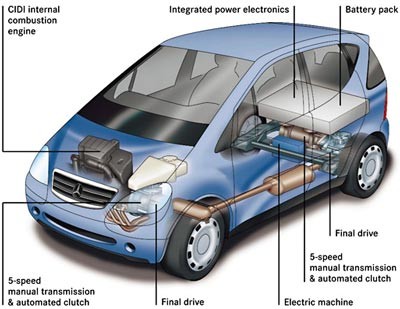
*It has two batteries positioned at the rear.

The small one is usually a 12 Volts battery, which powers the electronics of the car like the radio and the rest.

The other battery, commonly called a hybrid battery or a traction battery, has a nominal voltage of 244.8 volts (thus is for a Camry hybrid 2008).

The voltages of batteries vary from one Toyota hybrid to another, according to the number of cells in the battery pack.

Such batteries have the capability to electrocute one to death. So, please if you are not a qualified hybrid technician, it’s advisable you stay away from hybrid cars.

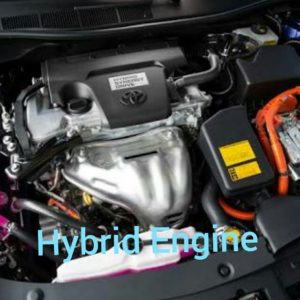
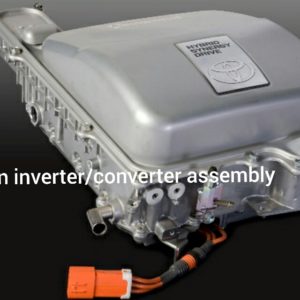
*At the hood (bonnet), you have what’s called an inverter/converter assembly. It resembles a conventional battery somewhat. It is positioned where your normal battery would be at the front.

The inverter/assembly system inverts and converts the hybrid battery’s voltage from 244.8 to almost more than twice the nominal voltage needed to power the electric motors that drive the car.

*Presence of ORANGE cables routed from the battery through to the front. The cables are equivalent to carriers of high tension voltages on our normal transmission lines on the street. I mean when touched carelessly, can electrocute someone. These cables are connected to your car’s electric AC system and water pump.

*The radiator coolant and the inverter coolants are separated differently.

* Power steering is electrically driven and has a separate ECU for its operation. You don’t see power steering fluids and spills anywhere in the engine compartment.

*The transmission is superb. It houses the two electric motors responsible for driving the car electrically and charging the hybrid battery.

The transmission is a variable continuous one, meaning when you drive, the engagement is not felt as the normal traditional automatics, where you feel the selections as the transmission selects.

The transmission also uses a special transmission fluid called Toyota’s World Standard fluid. Any other fluid would KILL the transmission system.

*The braking systems are bled differently. You can bleed the front brakes as a normal conventional car while the rear requires special softwares for its operation. The rear brakes are operated by the brake actuator and if proper tools aren’t used for the bleeding process, it would take ages to be able to bleed the air out of the rear brake system because of accumulated air bubbles.

*A READY indicator comes on when the hybrid is being started.

Remember. Hybrid cars don’t have kick starters and alternators.

With this piece, you shouldn’t find it difficult differentiating between a hybrid and a normal car when you encounter one.
hybrid-car1 hybrid-car2

Dipo Olowookere is a journalist based in Nigeria that has passion for reporting business news stories. At his leisure time, he watches football and supports 3SC of Ibadan. Mr Olowookere can be reached via [email protected]

Advertisement
2 Comments

2 Comments

Leave a Reply

Your email address will not be published. Required fields are marked *

Auto

Detty December: Pernod Ricard, FRSC Launch Anti-Drunk Driving Campaign

Published

on

Pernod Ricard FRSC

By Adedapo Adesanya

Global leader in the spirits and wine industry, Pernod Ricard, in partnership with the Federal Road Safety Corps (FRSC), has launched the Don’t Drink and Drive campaign in Lagos to raise awareness about the dangers of drunk driving and promote responsible drinking habits among road users, during the Detty December festivities.

The campaign, themed Take Responsibility for Your Safety – Don’t Drink and Drive, aims to reduce road accidents and fatalities during the festive season and beyond. According to the FRSC, drunk driving remains a leading cause of road crashes in Nigeria, with Lagos State being particularly vulnerable due to its vibrant nightlife and high vehicle population.

Speaking at the launch event, the Managing Director of Pernod Ricard Nigeria, Mr Michael Ehindero, emphasized the company’s commitment to promoting responsible drinking and road safety.

“At Pernod Ricard Nigeria, we believe in encouraging responsible choices and promoting a culture of safety on our roads,” he said.

Corps Commander Kehinde G. Hamzat, Sector Commander of FRSC Lagos State, who was represented by Deputy Corps Commander Edith Eloka echoed the importance of collective responsibility in ensuring road safety. “Road safety is a shared responsibility, and we must work together to prevent crashes and save lives,” he said.

The campaign includes sensitization programs for commercial drivers, road users, and the general public, as well as collaborations with government agencies, civil society, and private sector partners to amplify the message of responsible drinking and road safety.

It is part of Pernod Ricard Nigeria’s global Sustainability & Responsibility roadmap, which aligns with the United Nations Sustainable Development Goal 3 that promotes good health and well-being, and is reflected in its global purpose statement, which states: “We are committed to being a responsible and sustainable company, creating a better tomorrow for all our stakeholders.”

The event secured 1,500 pledges from participants at the Ikeja City Mall, The Event Centre, and ABC Transport Company, with goodwill messages from stakeholders, including the National Union of Road Transport Workers (NURTW), the Ministry of Transportation, the National Drug Law Enforcement Agency (NDLEA), and the Nigerian Association of Road Transport Owners (NARTO).

While admonishing safe road usage, Corps Road Safety Commander, Mr Godwin Uweni, Head of Operations, Ikotun Unit Command FRSC, advised motorists to prioritize road safety and adhere to FRSC guidelines.

At ABC Motor Park, there was a head-to-head trivia competition with gift items and stickers with the “Don’t Drink & Drive” message to drivers, who were also encouraged to share their experiences on social media, using the branded hashtag, Don’t Drink and Drive.

Last year, the company partnered with FRSC and other stakeholders to promote road safety through the Don’t Drink and Drive campaign, and responsible drinking practices with its Drink More Water activation.

Continue Reading

Auto

Lagride Gets $100m UBA Loan for EV Charging Infrastructure, Others

Published

on

Lagride $100m UBA loan

By Modupe Gbadeyanka

The United Bank for Africa (UBA) Plc has provided a financing facility worth about $100 million to assist Lagride expand its electric vehicle charging infrastructure in Lagos State.

The loan would also be used by the company to scale its Drive-to-Own programme and enable 3,500 Lagos drivers to transition from daily earners into long-term asset owners, business operators and mobility investors.

The partnership strengthens Lagos State’s transportation ecosystem and accelerates the shift toward a structured, technology-enabled and financially bankable mobility sector.

Over the past 10 months, Lagride has rebuilt its entire onboarding and operational system for drivers, known as Lagride Captains.

The platform introduced a performance-led Drive-to-Earn structure supported by weekly and monthly rental models. This system has generated consistent 90-day usage and repayment data across the fleet, allowing UBA and other financial institutions to assess driver performance with accuracy, confidence and transparency.

Eligibility for the programme is based on clearly defined performance thresholds, repayment discipline, safety compliance and service consistency.

Through this approach, Lagride has emerged as the most structured, data-driven and credit-ready mobility platform in Nigeria, setting a new benchmark for bankable driver financing and asset ownership.

EV Infrastructure Expansion

As part of the milestone, Lagride also unveiled an expanded electric vehicle charging facility in Alausa, Lagos, reinforcing its long-term commitment to clean, future-ready mobility.

The expanded infrastructure is designed to support the growing electric vehicle segment within Lagride’s fleet, reduce operational downtime and enable more efficient, sustainable transportation at scale. By pairing driver financing with practical EV infrastructure, Lagride is positioning itself as a mobility platform built not just for today’s Lagos, but for the next generation of urban transport.

“Lagride was created to give Lagos a modern, disciplined and technology-driven mobility system while ensuring that drivers are not left behind.

“The goal is for drivers who we call Captains to become business owners, fleet partners and mobility investors, not just drivers.

“This $100 million partnership with UBA moves thousands of captains closer to owning productive assets, managing multiple cars and building stronger financial futures. It is a major step forward in our commitment to driver prosperity and the future of smart mobility in Lagos,” the chairman of Lagride, Ms Diana Chen, said.

On his part, the chief executive of UBA, Mr Oliver Alawuba, said Lagride represents the kind of transformational, well-governed and data-backed initiative that UBA exists to support across Africa.

Continue Reading

Auto

Police to Resume Tinted Glass Permit Enforcement January 2

Published

on

tinted glass permit

By Aduragbemi Omiyale

The Nigeria Police Force has said it would begin the enforcement of the controversial tinted glass permit despite an ongoing case in the court.

In a statement on Monday night signed by its spokesman, Mr Benjhami Hundeyin, the police said the reason for the resumption of the enforcement was due to insecurity in the country.

The enforcement, the statement noted, will resume on Friday, January 2, 2026, and motorists who require the tinted glass permit have been encouraged to apply through the approved channels and ensure that their vehicles comply with legal procedures.

The police noted that there was not a time the court prevented it from going ahead with the implementation of the tinted glass permit, noting that this was for the “safety of all citizens.”

“It is important to clarify that at no point did the court restrain the Nigeria Police Force from enforcing the provisions of the law regarding the use of tinted glass on vehicles.

“Nonetheless, in the spirit of responsibility, transparency, and public convenience, the Force suspended enforcement to allow motorists ample opportunity to regularise their documentation and complete the registration process without pressure,” parts of the statement today stated.

“Recent trends, however, reveal a disturbing rise in criminal activities perpetrated with the aid of vehicles fitted with unauthorised tinted glass. Some individuals and organised criminal groups have exploited this gap to conceal their identities and facilitate crimes ranging from armed robbery to kidnapping and other violent crimes.

“In view of this, the Nigeria Police Force has found it both necessary and urgent to resume full enforcement as a proactive measure to safeguard our communities.

“Consequently, enforcement of tinted glass permit will resume on January 2, 2026,” it declared.

“The Inspector-General of Police (IGP) Kayode Adeolu Egbetokun, assures the public that the renewed enforcement will be carried out with utmost professionalism, respect for the rights of citizens, and in accordance with extant laws.

“He adds that the Force remains committed to promoting public safety and upholding the rule of law while working collaboratively with all stakeholders to keep Nigeria secure,” the statement added.

Continue Reading

Trending