

World
Geopolitics: Russia Extending its Sphere of Influence in Africa’s Sahel

By Kester Kenn Klomegah
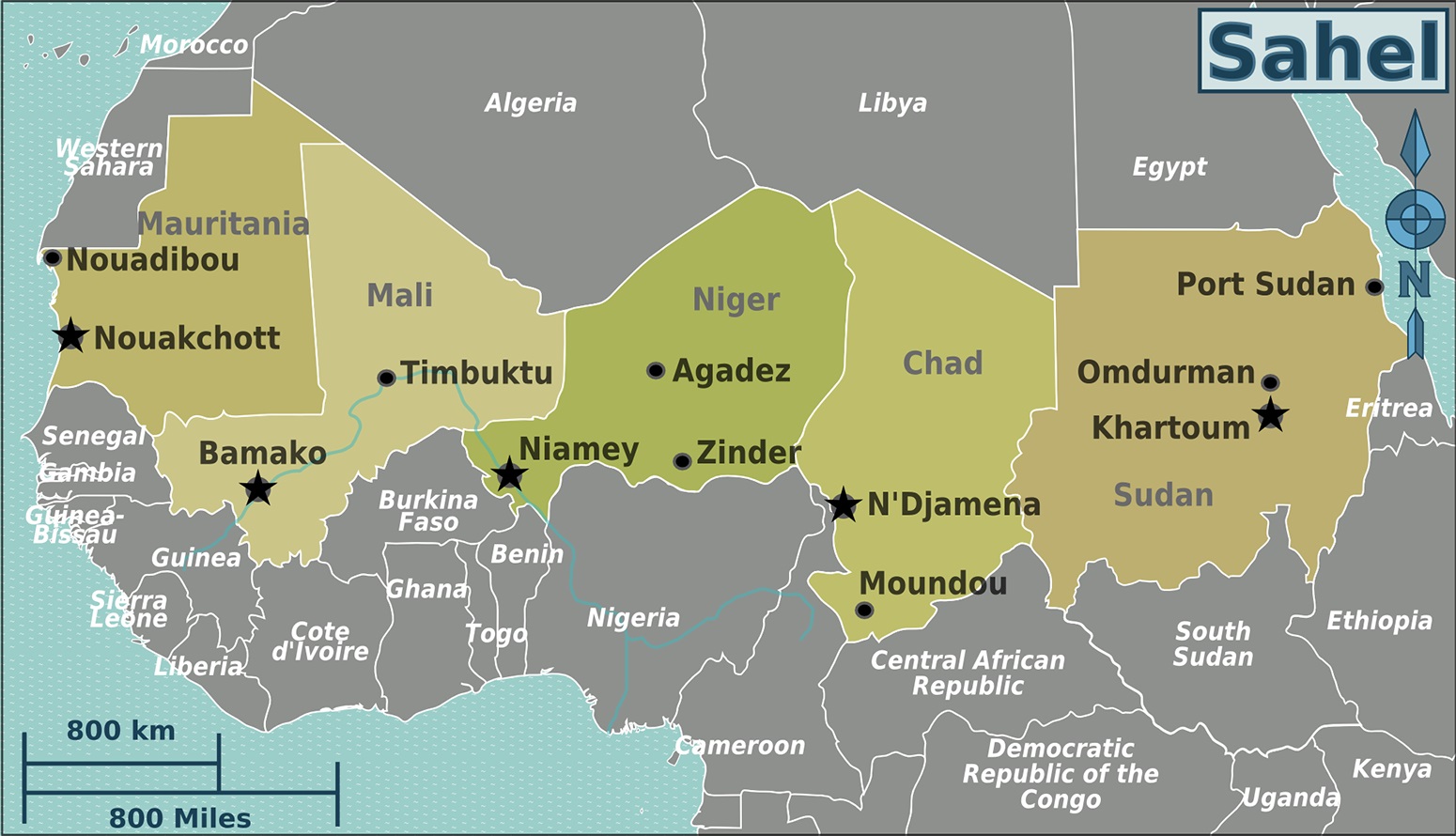
With renewed and full-fledged interest to uproot French domination, Russia has ultimately begun making inroads into Africa’s Sahel region, an elongated landlocked territory located between North Africa (Maghreb) and West Africa, and also stretches from the Atlantic Ocean to the Red Sea.
While it remains largely underdeveloped and the greater part of the population impoverished, terrorist organizations including Boko Haram and Al-Qaeda in the Islamic Maghreb (AQIM) are operating and have contributed to the frequent violence, extremism and instability in this vast region.
Usually referred to as the G5 Sahel, it consists of Burkina Faso, Chad, Mali, Mauritania and Niger. Besides instability, these countries are engulfed with various socio-economic problems primarily due to the system of governance and poor policies toward sustainable development. There are, in addition, rights abuse and cultural practices that affect development.
In July 2020, the United States raised concern over the growing number of allegations of human rights violations and abuses by state security forces in the entire Sahel. The US response came after the documents released by Human Rights Watch in early July. France, former colonial power, still attempts at dominating the region. France has announced the pulling out of the military force, abruptly ending its counter-terrorism operations and thus creating a huge vacuum.
By 2022, France plans to reduce and move its troops and will be restricted to regions that are not strategic for combating terrorism, which indicates that they will probably only act in the security of specific points, such as diplomatic and international organizations facilities. That ends the so-called “Operation Barkhane”, which was a military mission marked by a tactic of permanent occupation of the Sahel countries by French troops. The French government, however, apparently will try to reorganize its strategy in Africa. It seems that the focus of action will turn to the Gulf of Guinea.
For fear and concerns about the new rise of terrorism, the Sahel-5 countries are turning to Russia. Last year after the political power changed hands on August 18 in Mali, a former French colony with a fractured economy and a breeding field for armed Islamic jihadist groups, Russia offered tremendous assistance.
By showing support for the military government in Mali, Russia has utterly ignored or violated the protocols for implementing the “Silencing the Guns” agenda in West Africa, a flagship programme of the African Union’s Agenda 2063. Now Russia is capitalizing on this loophole opportunity, eyeing Chad and Mali as possible conduits, to penetrate into the Sahel.
Foreign Ministers of the Sahel countries have been lining up for visits to Russia, the latest being the Minister of Foreign Affairs, African Integration and Chadians Abroad of the Republic of Chad, Cherif Zene Mahamat, who paid a working visit on December 6‒8. Prior to that, Malian Foreign Minister Abdoulaye Diop visited in November. In both meetings, several critical issues were discussed: military assistance to fight growing terrorism, and efforts to strengthen political dialogue and promote some kind of partnerships relating to trade and the economy in the region.
In the middle of November, Chairperson of the African Union Commission, Moussa Faki Mahamat, agreed with Sergey Lavrov on terms of helping with the necessary equipment, weapons and ammunition in the Sahel. Lavrov referred to this in his opening remarks as “military and technical cooperation” with AU’s Chairperson Faki Mahamat – “a worthy representative in this high position of pan-regional importance.”
“We discussed African affairs at length: the difficult situation in the Sahara-Sahel zone that was destabilized after NATO’s aggressive attack on Libya. This was followed by an inflow of terrorists, smugglers, and volumes of illegal weapons from the north to the south of Africa. These criminals were particularly attracted to this area and the Lake Chad region,” Lavrov told the media conference following the closed-door meeting on December 7.
In the process, it is necessary to mobilize all available resources of the Africans and the international community for fighting terrorist groups. Nevertheless, it is also necessary for Russia’s efforts to maintain the joint forces of the Sahel Five, according to Lavrov. He further assured: “we will continue supporting it with the supply of arms and hardware and personnel training, including peacekeepers, as it is very important to help put an end to this evil and other challenges and threats, including drug trafficking and other forms of organized crime.”
According to several narratives, Russia has agreed to push the Wagner mercenaries into the entire Sahara-Sahel, including the G5 Sahel group of Burkina Faso, Chad, Mali, Mauritania, and Niger, which focused on combating terrorism. Many experts say Russia has set out to battle against the neo-colonial tendencies of France and stepping also to join what is often phrased “the scramble for resources” in Africa.
In his remarks, Lavrov explicitly points to creating favourable conditions for the implementation of Russian projects in Chad, including in the field of energy and the extraction of mineral resources.
Further to such narratives, Russia has meanwhile embarked on fighting “neo-colonialism” which it considers as a stumbling stone on its way to regain a part of its Soviet-era influence in Africa. Russia has sought to convince Africans over the past years of the likely dangers of neocolonial tendencies perpetrated by the former colonial countries and the scramble for resources on the continent. However, all such warnings could fall on deaf ears as African leaders choose development partners with funds to invest in the economy.
It is necessary to acknowledge that neither France, Russia, the United States nor any colonizing force will truly solve the problems that confront Africa. Some African leaders sign non-transparent agreements, routinely ignore both the executive and legislative decisions on tendering national projects and natural resources.
There have been cases, where huge natural-resource projects were given away without cabinet discussions and parliament’s approval. Apparently, these agreements on resources extraction hardly deliver broad-based development dividends.
Meanwhile, there are vivid indications that Russia is broadening its geography of diplomacy covering poor African countries and especially fragile States that need Russia’s military assistance. Chad, Mali and Niger, for example, have appeared on its radar, Russia sees some potential there – as a possible gateway into the Sahel in Africa.
Russian Foreign Ministry has explained in a statement posted on its website, that Russia’s military-technical cooperation with African countries is primarily directed at settling regional conflicts and preventing the spread of terrorist threats and fighting the growing terrorism in the continent. Worth noting here is that Russia, in its strategy on Africa is reported to be also looking into building military bases on the continent.
Over the past years, strengthening military-technical cooperation has been part of the foreign policy of the Russian Federation. Russia has signed bilateral military-technical cooperation agreements with many African countries. Researchers say it plans to build military bases as this article explicitly reported, among others.
Research Professor Irina Filatova at the Higher School of Economics in Moscow explains in an emailed conversation that “Russia’s influence in the Sahel has been growing just as French influence and assistance has been dwindling, particularly in the military sphere. It is for the African countries to choose their friends, but it would be better to deal directly with the government, than with (mercenaries of the Russian) Wagner group, whose connection with the government was barely recognized.”
In very particular cases, she suggested: “If they wanted the Russians to come and fight Islamist groups, it would be much better to ask the government to send regular troops. Wagner’s vigilantes are not responsible to anybody, and the Russian government may refuse to take any responsibility for whatever they do in case something goes wrong.”
In another interview, Grigory Lukyanov, a Senior Researcher at Russia’s Institute of Oriental Studies, explained that such relations are useful particularly in the field of resource extraction and security services, where Russia has competitive advantages.
According to media reports, the arrival of Russian mercenaries in the Sahel—of which thousands are expected—would jeopardize other external commitments to fighting terrorism, and limit development assistance from international organizations. For example, Reuters has reported that a possible contract could be worth US$10.8 million, or estimated more per month, depending on the contract, working with the Russian private military company Wagner Group.
Down the years, Kremlin has been saying the Russian government has no ties to the business of Wagner Group. Then at the same time, the Russian authorities have fiercely defended Wagner Group’s military business in countries facing conflicts that it has the legitimate right to work and pursue its business interests anywhere in the world as long as it did not break Russian law.
Reports indicated that the African Union has supported the activities of the Wagner group in Africa. While civilian abuses by the Russian mercenary group are rampant, especially in the Central African Republic, the African Union has displayed insensitivity in taking any drastic decision.
The Russians arrived in the Central African Republic in 2017 after the meeting between President Faustin-Archange Touadera and President Vladimir Putin and Russia’s Foreign Minister. Russian donated weapons to CAR’s weak military and provided 175 military instructors. Since then, the number of Russian instructors has grown to 1,200.
According to Pauline Bax, a Senior Editor and Policy Advisor at the International Crisis Group, “The situation in CAR is very precarious, a lot of the fighters are not necessarily Russians. There is a Libyan contingent. There are Syrian fighters, people from Ukraine and Chechnya fighters as well.
It is hard to get any clear idea of what exactly they do in the countryside. And this Wagner force together with the national army has managed to secure a lot of mining zones as well as major towns in the country, which was unprecedented, this has not happened in the Central African Republic in the last 20 years.”
United Nations Secretary-General António Guterres has often spoken against such collaboration, the use of Russian mercenaries in Africa. Instead, he has suggested pursuing the creation and deployment of the G5 Sahel Joint-Force and the United Nations Integrated Strategy (UNIS) for the Sahel could bring tangible progress. The countries in the region are particularly encouraged to adopt, with support from international partners, the necessary measures to fully implement the support plan in developing the region.
The Sahel-Sahara, the vast semi-arid region of Africa separating the Sahara Desert to the north and tropical savannas to the south, is as much a land of opportunities as it is of challenges. Although it has abundant human and natural resources, offering tremendous potential for rapid growth, there are deep-rooted challenges – environmental, political and security – that may affect the prosperity and peace of the Sahel.
For this reason, the United Nations has come up with a unique support plan targeting 10 countries to scale up efforts to accelerate prosperity and sustainable peace in the region. Burkina Faso, Cameroon, Chad, The Gambia, Guinea Mauritania, Mali, Niger, Nigeria and Senegal. The creation and deployment of the G5 Sahel Joint-Force and the United Nations Integrated Strategy (UNIS) for the Sahel could bring tangible progress.
The best option is to consider national and regional institutions, bilateral and multilateral organizations, the private sector and civil society organizations to work towards operationalizing and implementing the United Nations Security Council resolutions on the Sahel aim at attaining regional peace, and further accelerate the achievement of the Sustainable Development Goals (SDGs).
This article was first and originally published by IDN-InDepthNews


