Connect with us

Auto

Private Sector Pumps $50m into Presidential CNG Initiative

Published

on

presidential CNG initiative

By Adedapo Adesanya

Nigeria’s private sector has injected more than $50 million in actual investments in refuelling stations, conversion centres, and mother stations in the Presidential Compressed Natural Gas Initiative (PCNGI), which is set for initial rollout to the public by the end of May.

The Special Adviser to the President on Information and Strategy, Mr Bayo Onanuga, disclosed this in a statement on Sunday in Abuja, saying the programme was part of the many intervention programmes to reduce the burden of an increase in pump price on the masses.

To actualise the programme, President Bola Tinubu launched the presidential CNG initiative in October 2023 to deliver cheaper, safer and more climate-friendly energy.

He added that the government had provided N100 billion (part of the N500 billion palliative budget) to purchase 5,500 CNG vehicles, 100 electric buses and more than 20,000 CNG conversion kits, alongside spurring the development of CNG refilling stations and electric charging stations.

“With necessary tax and duty waivers approved by President Tinubu in December 2023, the PCNGI committee is partnering with the private sector to deliver the promise on the initiative.

“Also, a safety policy document on 80 standards and regulations that must be strictly adhered to by operators has been developed and approved to ensure CNG conversions are done safely and reliably,” he said.

Mr Onanuga said that the deployment of CNG buses and tricycles and the vision to get at least one million natural gas-propelled vehicles on the roads by 2027 would mark a major energy transition in the country’s transportation industry.

He said that the use of more expensive diesel and petrol would gradually be phased out, when many vehicles, including trucks, run on natural gas, adding that 30 of the 36 states had the gas in abundance.

“Remarkably, the Tinubu administration, in driving the nation to the desired destination, has flagged open a new industry, along with thousands of new jobs.

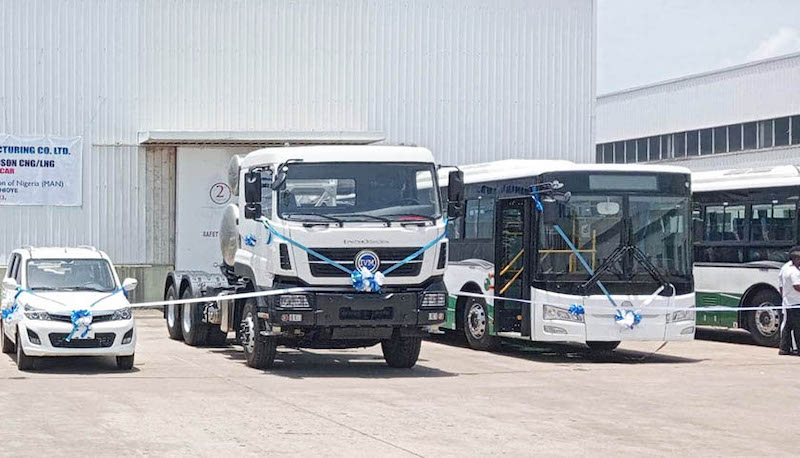
“Four plants owned by JET, Mikano, Mojo, and Brilliant EV located in various parts of the country are involved in the assembly of the Semi Knocked Down (SKD) components of the CNG buses.

“JET, which has received the SKD parts, is coupling the buses in Lagos and is working towards delivering 200 units before the first anniversary of the Tinubu administration.”

Mr Onanuga said that Brilliant EV would assemble electric vehicles meant for Kano and Borno, which would not have access to CNG for now as well as in key Nigerian cities and university campuses.

“In all, over 600 buses are targeted for production in the first phase that will be accomplished this year.

“A new plant on the Lagos-Ibadan Expressway will assemble thousands of tricycles.

“The SKD parts, manufactured by the Chinese company LUOJIA in partnership with its local partner to support the consortium of local suppliers of CNG tricycles, are set for shipment to Nigeria and expected to arrive early in May.

“About 2,500 of the tricycles will be ready before May 29, 2024.”

He said that thousands of conversion kits for petrol-powered buses and taxis that want to migrate to CNG are also ready with CNG cylinders.

The Presidential aide added that the Federal Government intended to provide them at subsidised rates, especially to commercial vehicle drivers, to bring down the cost of public transportation.

He revealed that the PCNGI was working with 22 other agencies, including the Standards Organisation of Nigeria and Nigeria Automotive Design and Development Council, to deliver 80 Natural Gas Vehicle Conversion and Associated Appliances Standards for the country.

He added that an app MYCNG.NG to embed the Nigeria Gas Vehicle Monitoring Systems would show CNG conversion and refuelling sites in the country.

“The Tinubu administration is an enabler of the evolving CNG industry. In collaboration with the private sector, the PCNGI is set to deliver 100 conversion workshops and 60 refuelling sites spread across 18 states before the end of this year.

“The vision of Mr. President to deliver one million gas vehicles cannot be possible without the private sector, including the RTEAN, NARTO, NURTW, and players in the downstream sector of the transportation chain and financiers.”


Adedapo Adesanya is a journalist, polymath, and connoisseur of everything art. When he is not writing, he has his nose buried in one of the many books or articles he has bookmarked or simply listening to good music with a bottle of beer or wine. He supports the greatest club in the world, Manchester United F.C.

Advertisement
Click to comment

Leave a Reply

Your email address will not be published. Required fields are marked *

Auto

Passengers Lament as Uber, Bolt Drivers Strike in Lagos

Published

on

Uber Technologies System Nigeria Limited

By Dipo Olowookere

Rising operational costs and declining earnings have forced drivers of ride-haling platforms like Uber and Bolt to embark on a three-day warning strike in Lagos.

This situation has not gone down well with their customers in the metropolis, who have expressed frustration over the strike.

“Though I am not happy with the action of the drivers, I feel for them because they operate in a harsh environment,” a customer of Bolt, Mr Seyi Adeniji, said.

When Business Post checked the Uber app on Monday morning to book a ride from Egbeda to Megida Ayobo, both in the Alimosho Local Government Area of Lagos State, it was functional, but with fewer drivers available for pick-up, with prices ranging from N5,200 on Uber X to N7,400.

One of the drivers, who spoke with this newspaper but begged for anonymity, said efforts by them for improved packages have failed.

It was gathered that when nothing concrete came out from talks with operators of the platforms, drivers, under the aegis of the Amalgamated Union of App-Based Transporters of Nigeria (AUATON), Lagos State Chapter, decided to begin a warning strike from March 16 to 18, 2026, to further press home their demands.

They want an immediate review of ride fares to reflect current economic conditions. They also seek a cut in commission charges by ride-hailing companies, and want the introduction of a guaranteed minimum trip fare.

The drivers have asked for insurance coverage, an end to unjust deactivation of driver accounts without proper investigation, and greater transparency in how fares and commissions are calculated.

In addition, they want improved safety protections for drivers through better rider-verification systems, emergency panic buttons, and faster response mechanisms in cases of security threats.

According to a statement from the spokesman of the organisation, Mr Steven Iwindoye, many drivers are struggling to remain financially viable due to increasing fuel prices, vehicle maintenance costs, inflation and other living expenses, while fare structures on ride-hailing platforms have remained largely unchanged.

“Drivers operating on platforms such as Uber, Bolt, inDrive and Lagride continue to face rising operational costs, including the high price of fuel, vehicle maintenance, inflation and daily living expenses.

“Unfortunately, the fare structures and policies of these companies have not been adjusted to reflect these economic realities,” the statement said.

It was stressed that many drivers now work extremely long hours yet still struggle to earn a sustainable income, clarifying that, “This strike is not intended to punish commuters but to demand fair treatment, economic sustainability and safety protections for the drivers who power the ride-hailing industry.”

Continue Reading

Auto

InDrive Fetes Abuja Drivers in Ramadan Shukran Campaign

Published

on

inDrive Ramadan Shukran Campaign

InDrive, a leading global ride-hailing platform operating in nine African countries, is celebrating Ramadan season with a targeted driver appreciation programme in Abuja, tagged’Ramadan Shukran campaign’, with active Muslim drivers on the platform to receive curated food hampers and personalised thank-you cards.

The initiative, designed to strengthen the company’s relationship with its driver community at a time when many are working long hours while observing the fast, is not based on financial incentives or performance-based rewards but on practical support for the month and a direct expression of appreciation for the role drivers play in the platform’s daily operations.

Four Abuja-based Muslim content creators who understand the social and religious considerations of the period have been delivering 200 hampers across key districts in the city. The hampers, which contain everyday Ramadan essentials to support suhoor and iftar, including staple foods and beverages commonly consumed during the fasting period, come in warm-toned Ramadan packaging and include a handwritten-style card from Indrive with the message “Shukran,” which means thank you.

Each creator is assigned a specific coverage area to ensure broad reach and local relevance, with deliveries taking place around prayer times and fasting schedules, which are captured with the participating drivers’ consent.  The campaign, serving as a broader positioning goal to publicly recognise drivers through creator-led storytelling, will further reinforce inDrive’s people-first identity and increase awareness among drivers who are not currently on the platform.

The campaign reflects inDrive’s deliberate shift toward relationship-building through culturally relevant engagement during one of the most significant periods in the Muslim calendar.

Continue Reading

Auto

Glovo Unveils New Road Safety Feature for Safety of Nigerian Riders

Published

on

Glovo in Nigeria

By Modupe Gbadeyanka

To enhance the safety of riders in Nigeria, a leading multicategory technology company, Glovo, has launched a new road safety feature on its mobile application.

The initiative was introduced in collaboration with the Federal Road Safety Corps (FRSC). It was designed to address key challenges in Nigeria’s fast-growing e-commerce and mobility ecosystem by implementing data-driven preventive measures to enhance road safety.

Also, Glovo has concluded plans with the FRSC to organise a road safety training. This has already been done in Lagos, with the training coming to Abuja on Friday, strengthening rider protection and road safety standards across Nigeria.

The Interim General Manager for Glovo Nigeria, Ms Reni Onafeko, said the new feature reflects the company’s long-term investment in safety, innovation, and responsible business growth in Nigeria.

Ms Onafeko explained that the feature combines advanced technology with structured training to ensure safer roads for riders and the broader public, highlighting the feature’s voluntary opt-in nature, explaining that riders can use it to improve their safety.

“The launch of this new feature reflects our commitment to building a culture of prevention rather than reaction. By equipping riders with real-time data about their riding behaviour, we are empowering them to make safer decisions every day. This initiative is about protection, education, and continuous improvement.

“Our approach combines innovation, partnership, and human-centred design. We are not just introducing a feature; we are reinforcing our responsibility to protect the people who power our platform every day.

“By working closely with regulators and organising safety training for riders, we are contributing to safer roads and a more sustainable ecosystem in Nigeria,” she stated.

In his remarks, the Senior Special Assistant to the Lagos State Governor on Transportation Education and Innovation, Mr Oluwatobi Idowu, noted that the training was a good initiative by Glovo Nigeria, urging riders to take advantage of the unique opportunity to familiarise themselves with the necessary safety rules while driving.

On his part, the Assistant Corps Commander for the Lagos Sector Command of the FRSC, Mr Philip Ogah, who represented the Lagos State Sector Commander, Mr Kehinde G. Hamzat, commended Glovo Nigeria for facilitating a refresher course for riders.

He noted that the training was necessary to help riders be really conscious about their safety, stating that it was better for them to be equipped with such interactive safety tools.

“There are levels of preparation before driving on the road. As a rider, learning is key and a continuous process. This kind of training makes you more informed as you drive.

“As a technological platform, it is good to see that Glovo keeps on ensuring that riders are trained to have a better usage of and better behaviour on Nigerian roads,” the FRSC chief in Lagos stated.

Also speaking, the Head of Operations at Glovo Nigeria, Oluwaseun Okugboye-Bello, explained that the introduction of the safety feature on the Glovo app has become an essential new addition for riders’ self-improvement while collaborating with the platform, noting that it was incorporated into the app to protect riders, commuters, and pedestrians.

At the end of the training session, certificates were presented to 70 participants.

Continue Reading

Trending