Connect with us

Banking

Senate Seeks CBN’s Full Disclosure on Unremitted N1.44trn Surplus

Published

on

senate cbn

By Adedapo Adesanya

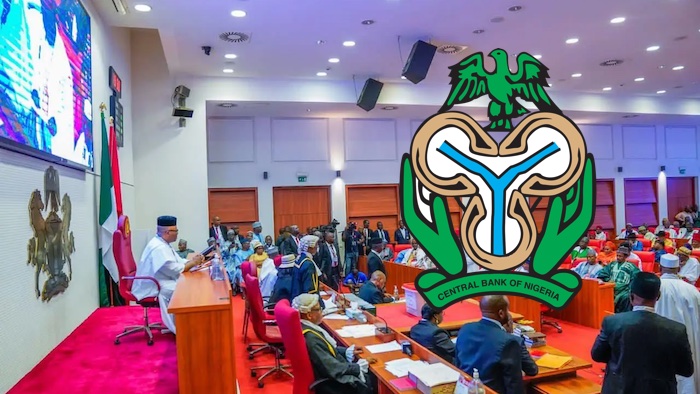
The Senate has demanded detailed explanation from the Central Bank of Nigeria (CBN) over the alleged non-remittance of N1.44 trillion in operating surplus.

The Senate Committee on Banking, Insurance and Other Financial Institutions, chaired by Mr Tokunbo Abiru, opened its statutory briefing with a firm call for transparency at the apex bank, noting that the Auditor-General’s query on the unremitted funds required a full, clear and documented response, insisting that public trust in monetary governance depended on strict accountability.

While acknowledging the CBN’s achievements in stabilising the foreign exchange market and reducing inflation, Mr Abiru underscored that such progress must be accompanied by institutional responsibility.

He stated the Senate expected the CBN to explain the circumstances surrounding the query, outline corrective steps taken and reveal safeguards against future lapses.

This came as the Governor of the central bank, Mr Yemi Cardoso, appeared before the senate committee and offered an extensive review of economic conditions, asserting that Nigeria was experiencing renewed macroeconomic stability across major indicators.

Mr Cardoso attributed the progress to bold monetary reforms, foreign-exchange liberalisation and disciplined liquidity management implemented since mid-2025.

According to him, headline inflation had declined for seven consecutive months, from 34.6 per cent in November 2024 to 16.05 per cent in October 2025, marking the steepest and longest disinflation trend in over a decade.

Food inflation accruing to him also slowed to 13.12 per cent, supported by improved supply conditions and exchange-rate predictability.

The CBN governor described the foreign-exchange market as fundamentally transformed, adding that speculative attacks and arbitrage opportunities had largely disappeared.

According to him, the premium between the official and parallel markets had fallen to below two per cent, compared to over 60 per cent a year earlier. As of November 26, the naira traded at N1,442.92 per dollar at the Nigerian Foreign Exchange Market, stronger than the N1,551 average recorded in the first half of 2025.

He also announced a sharp rise in external reserves to $46.7 billion, the highest in nearly seven years and sufficient to cover over ten months of imports.

Diaspora remittances, he noted, had tripled to about $600 million monthly, while foreign capital inflows reached $20.98 billion in the first ten months of 2025, 70 per cent higher than in 2024 and more than four times the 2023 figure.

Cardoso further confirmed that the CBN had fully cleared the $7 billion verified FX backlog, restoring investor confidence and strengthening Nigeria’s balance-of-payments position.

On banking-sector stability, he reported that recapitalisation efforts were progressing smoothly. Twenty-seven banks had already raised new capital, with sixteen meeting or surpassing the new regulatory thresholds ahead of the March 31, 2026 deadline, highlighting improvements in ATM cash availability, digital-payments oversight and cybersecurity compliance.

Despite the positive indicators, the Senate sought clarity on several policy decisions.

Mr Abiru pressed for explanations on the sustained 45 per cent Cash Reserve Ratio (CRR), the 75 per cent CRR applied to non-Treasury Single Account public-sector deposits, FX forward settlements, mutilated naira notes in circulation, excessive bank charges, failed electronic transactions and the compliance of CBN subsidiaries with parliamentary oversight.

He also requested an update on the activities of the Financial Services Regulatory Coordinating Committee, arguing that stronger inter-agency cooperation was necessary to maintain public confidence.

The session later moved into a closed-door meeting.

Adedapo Adesanya is a journalist, polymath, and connoisseur of everything art. When he is not writing, he has his nose buried in one of the many books or articles he has bookmarked or simply listening to good music with a bottle of beer or wine. He supports the greatest club in the world, Manchester United F.C.

Advertisement
Click to comment

Leave a Reply

Your email address will not be published. Required fields are marked *

Banking

VAT on USSD, Mobile Transfer Fees Not Introduced by Nigeria Tax Act—NRS

Published

on

USSD War

By Modupe Gbadeyanka

The Nigeria Revenue Service (NRS) has denied reports that customers performing financial transactions would pay a Value Added Tax (VAT) of 7.5 per cent from January 19, 2026.

Information about this emanated from messages sent out to customers of a financial institution, informing them of the new development in compliance of Nigeria’s new tax laws, especially the Nigeria Tax Act 2025.

It was claimed that Nigerians, as part of efforts of the government to generate more funds from taxes, would begin to pay VAT for the use of banking services like USSD and others.

But reacting in a statement signed by its management on Thursday, January 15, 2026, the tax collecting agency emphasised that the VAT collection for such services was not new.

It stressed that customers have always paid taxes for electronic money transfers and others, as this is charged on the fee, not from the main amount of the transaction.

“The Nigeria Revenue Service wishes to address and correct misleading narratives circulating in sections of the media suggesting that Value Added Tax (VAT has been newly introduced on banking services, fees, commissions, or electronic money transfers. This claim is categorically incorrect.

“VAT has always applied to fees, commissions, and charges for services rendered by banks and other financial institutions under Nigeria’s long-established VAT regime. The Nigeria Tax Act did not introduce VAT on banking charges, nor (sic) did it impose new tax obligation on customers in this regard.

“The Nigeria Revenue Service urges members of the public and all stakeholders to disregard misinformation and to rely exclusively on official communications for accurate, authoritative, and up-to-date tax information,” the statement read.

Business Post reports that what this basically means is that if a customer sends N10,000 and the bank charges N50 for the service, a 7.5 per cent VAT on the N50, which is N3.75, would be paid by the sender, not N750, which is 7.5 per cent of N10,000.

VAT on banking fees

Continue Reading

Banking

Paystack Enters Banking Space With Ladder Microfinance Bank Acquisition

Published

on

Paystack

By Adedapo Adesanya

Nigerian-born payments company, Paystack, has announced its entry into the banking sector with the launch of Paystack Microfinance Bank (Paystack MFB) after the acquisition of Ladder Microfinance Bank.

The bank continues Paystack’s push into consumer products and adds a banking layer to its business-focused payment product, coming ten years after the company was founded with the goal of simplifying payments for businesses using modern technology.

In Nigeria alone, the company says its systems process trillions of Naira every month, supporting more than 300,000 businesses and millions of customers. According to Paystack, this growth highlighted a broader need beyond payments, prompting the decision to build a more comprehensive financial offering.

Paystack MFB will begin lending to businesses before expanding to consumers. It will also offer banking-as-a-service (BaaS) products to companies building financial products and treasury management products.

The company explained that while payments are a critical part of the financial journey, businesses and individuals increasingly require a full financial operating system. This includes the ability to store money securely, move funds easily, gain clarity from financial data, and access tools that support long-term growth. Developers, Paystack added, also need reliable, secure, and compliant infrastructure to build new financial solutions efficiently.

To address these needs, Paystack said it has established Paystack Microfinance Bank as a separate and independent entity from Paystack Payments Limited.

The new microfinance bank operates with its own license, governance structure, and product roadmap, although it will work closely with its sister company.

“By adding Paystack MFB to our family of brands, we’re finding the right balance through combining the rapid innovation of a tech-first platform with the stability of traditional banking,” said Ms Amandine Lobelle, Paystack’s chief operating officer.

Last year, it launched its controversial consumer payments app Zap, and now it is taking a step further with the company securing regulatory backing to become a deposit-taking institution. According to a statement, the bank will be guided by the same principles that shaped Paystack’s early success, including reliability, simplicity, transparency, and trust.

Paystack MFB has begun operations with a small group of early members and plans a gradual rollout to more businesses and individuals. The company also announced the opening of a waitlist for interested users and confirmed it is recruiting a dedicated team to help build its long-term banking infrastructure.

Continue Reading

Banking

N1.3bn Transfer Error: EFCC Recovers N802.4m from Customer for First Bank

Published

on

EFCC First Bank N802.4m transfer error

By Modupe Gbadeyanka

The Economic and Financial Crimes Commission (EFCC) has helped First Bank of Nigeria to recover the sum of N802.4 million from a suspect, Mr Kingsley Eghosa Ojo, who unlawfully took possession of over N1.3 billion belonging to the bank.

The funds were handed over the financial institution by the Benin Zonal Directorate of the anti-money laundering agency on Monday, January 12, 2026, a statement on Tuesday confirmed.

First Bank approached the EFCC for the recovery of the money through a petition, claiming that the suspect received the money into his account after system glitches.

The commission in its investigation; discovered that the suspect, upon the receipt of the money, transferred a good measure of it to the bank accounts of his mother, Mrs Itohan Ojo and that of his sister, Ms Edith Okoro Osaretin, and committed part of the money to completion of his building project and the funding of a new flamboyant lifestyle.

With the recovery of the money from the identified bank accounts, the EFCC handed it over in drafts to First Bank.

While handing over the lender, the acting Director for the Directorate, Mr Sa’ad Hanafi Sa’ad, stressed his organisation would continue to discharge its mandate effectively in the overall interests of society.

“The EFCC Establishment Act empowers us to trace and recover proceeds of crime and restitute the victim. In this case, First Bank was the victim and that is exactly what we have done.

“We will continue to discharge our duties to ensure that fraudsters do not benefit from fraud and that economic and financial crimes are nipped in the bud,” he said.

In his response, the Business Manager for First Bank in Benin City, Mr Olalere Sunday Ajayi, who received the drafts on behalf of the bank, commended the EFCC for the swiftness and the professionalism it brought to bear in the handling of the matter and expressed the bank’s gratitude to the commission.

He described the EFCC as one of Nigeria’s most effective and reliable institutions.

Meanwhile, Mr Kingsley and all other suspects in the matter have been charged to court for stealing by the EFCC.

Continue Reading

Trending