Banking
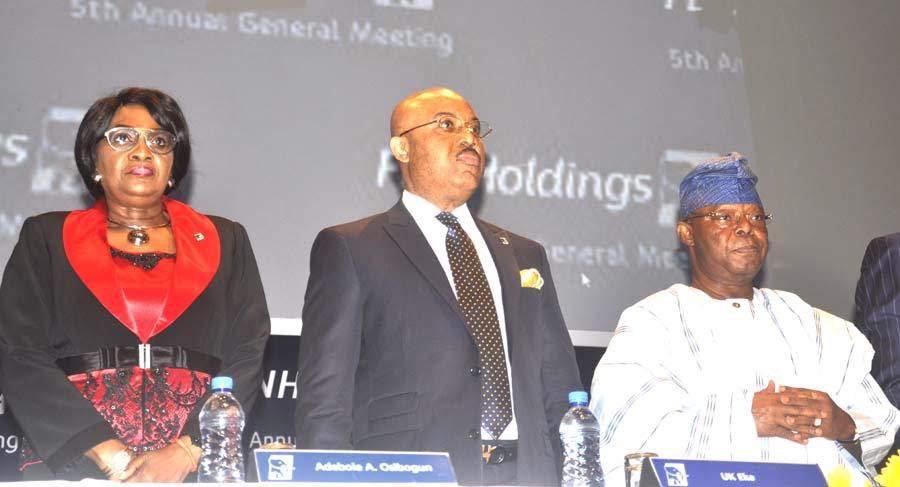
Shareholders Furious Over FBN Holdings High NPL Ratio of 22.8%
By Modupe Gbadeyanka
The board and management of FBN Holdings Plc have been tasked to make efforts within their reach to recover almost all the Non-Performing Loans (NPLs).
Expressing their frustrations at the firm’s Annual General Meeting (AGM) in Lagos on Tuesday, the shareholders said the bad loans were affecting performance of the company.
They said the N150.4 billion reflected in the group’s 2017 financial statements as payment for impairment charges was too high despite being lower than the N226 billion paid in 2016.
As at December 31, 2017, the NPL of FBN Holdings stood at 22.8 percent, which shareholders said was very high.
But responding to this issue, Group Managing Director of FBN Holdings Plc, Mr Urum Kalu Eke, assured shareholders that something would be done to address the NPLs.
He said the company was also worried about the issue because it had affected its performance in the past.
According to him, the management was taking necessary strategies to recover the bad loans, saying these steps were yielding results as seen in the reduction of the NPL to 22.8 percent in 2017 from 24.4 percent.
“Even though we have not recorded a full resolution of our NPLs, we have made significant progress in dealing with a number of these names and more fundamentally, ensured a strong asset quality from recent credits.
“As a result, NPL for the period declined from 24.4 percent in 2016 to 22.8 percent in 2017,” the bank chief said at the meeting.
On his part, Chairman of FBN Holdings Plc, Mr Oba Otudeko, said the institution made significant progress last year.
According to him, the group’s flagship subsidiary, First Bank Nigeria Limited, sustained its leadership position in the e-payment space, emerging as the first financial institution in Nigeria and West Africa to issue 10 million cards to customers.
He added that the bank was recognised as the first financial institution in Nigeria to achieve an electronic transaction volume of 100 million in a month.
Mr Otudeko said FBN Holdings would consolidate on the progress made in the previous year to deliver a strong and sustainable performance that enhances returns to shareholders.
Also at the Tuesday’s event, the shareholders approved the payment of N8.974 billion dividend proposed by the board. This represents 25 kobo per share for the 2017 financial year.
A look at the firm’s performance last year showed that its gross earnings grew by 2.3 percent to N595.4 billion from N581.8 billion in 2016, while its profit before tax appreciated to N56.3 billion from N22.9 billion.
Furthermore, its customer deposits went up to N3.14 trillion from N3.10 trillion in 2016, while the total assets increased to N5.2 trillion from N4.7 trillion two years ago.
Also, the group posted a net-interest income of N331.5 billion against N304.4 billion in 2016, while the non-interest income dropped by 31.3 percent to N113.7 billion from N165.5 billion a year earlier.
The operating income during the year went down to N444.8 billion from N469.9 billion in 2016, while the operating expenses increased by 7.7 percent to N238 billion from N220.9 billion two years ago.
Last year, its impairment charge for credit losses stood at N150.4 billion in contrast to N226 billion in 2016, while the profit after tax went up by 178.8 percent to N47.8 billion from N17.1 billion in 2016.
As at the close of transactions on the floor of the exchange yesterday, shares of the company were traded at N11.50k per share.
Banking
PalmPay Taps Ex-NIBSS Executive Samuel Oluyemi as Chief Operating Officer
By Adedapo Adesanya
One of Nigeria’s top digital banks, PalmPay, has appointed a former executive of the Nigeria Inter-Bank Settlement System (NIBSS), Mr Samuel Oluyemi, as its chief operating officer.
In his new role, Mr Oluyemi will oversee the financial technology company’s operations in Nigeria, where it offers a broad range of digital financial services to individuals and businesses.
Mr Oluyemi will also engage with regulators to ensure the company’s expansion aligns with Nigeria’s financial, digital and social inclusion objectives.
Prior to joining the company, Mr Oluyemi spent more than two decades at NIBSS, where he served as business development lead.
During his tenure, he drove the development of several critical payment infrastructure projects, including the digital validation of Nigerian international passports, e-Dividend Mandate Management System (e-DMMS), and the Electronic Pensions Contribution Collection System (EPCCOS).
Also, he played a key role in the introduction and early adoption of the NIBSS Instant Payment (NIP) platform, Nigeria’s first real-time interbank transfer system launched in 2011, and later supported its extension to other financial institutions.
Mr Oluyemi obtained a master’s degree in Monetary Economics from the University of Ibadan and has participated in several local and international professional training programmes.
Commenting on the appointment, Managing Director of PalmPay Nigeria, Mr Chika Nwosu, said that the company was strengthening its leadership team to support its longterm vision.
Banking
Flutterwave Pauses IPO Plans Amid African Banking Expansion Push
By Adedapo Adesanya
Africa’s most valuable fintech, Flutterwave, has signalled that its long-anticipated initial public offering (IPO) remains firmly on the back burner as the company intensifies efforts to transform itself into a licensed financial institution across the continent.
The firm’s chief executive, Mr Olugbenga Agboola, said the firm is focused on building sustainable profitability, diversifying its revenue streams and expanding its banking footprint before considering a stock market listing.
Speaking to The Africa Report, Mr Agboola described an IPO as a future financing milestone rather than an immediate strategic objective.
“An IPO is a financing event, not a strategy,” he said. “We are not holding any pressure to go public. This gives us the flexibility to be patient and ensure when we do list, we’re doing so from a position of strength.”
The comments come as Flutterwave embarks on an acquisition-led expansion strategy aimed at securing banking licences and deeper regulatory access across Africa.
Mr Agboola revealed that the company is currently in the process of acquiring a bank in East Africa, though he declined to disclose the institution or country involved.
The planned acquisition is expected to provide Flutterwave with an established customer base, existing banking infrastructure and regulatory approvals, significantly shortening the time required to enter new financial services markets.
According to Mr Agboola, the company’s expansion priorities include Kenya, Ghana, Rwanda, Tanzania, South Africa and Egypt, while the Democratic Republic of Congo and Ethiopia remain under consideration for future growth.
Rather than building banks from scratch in every market, Flutterwave intends to adopt a mix of acquisitions, licences and strategic partnerships depending on local regulatory conditions.
“The vision is not to form a bank in every country but to ensure that every African business has access to more than financial services,” Mr Agboola said in the interview.
The banking push follows recent regulatory and corporate developments, including the Central Bank of Nigeria’s approval of Flutterwave’s banking licence and the acquisition of open banking startup Mono.
Together, the moves underscore a broader strategy to expand beyond payments and establish new revenue streams in lending, liquidity management and business banking services.
Flutterwave plans to focus on institutional deposits from businesses already using its platform rather than competing aggressively for retail deposits.
The company intends to leverage transaction data from its payments network to provide short-term working capital, merchant financing, invoice discounting and trade finance products for small and medium-sized enterprises.
Mr Agboola disclosed that the bulk of the capital earmarked for banking operations will be directed toward credit support and liquidity buffers, with additional allocations for lending and banking infrastructure.
The strategy reflects a growing trend among African fintech firms seeking banking licences to reduce dependence on traditional financial institutions and gain greater control over settlement, liquidity management and product development.
Despite speculation about a near-term public listing, Mr Agboola maintained that Flutterwave’s immediate focus remains execution and growth.
He noted that the company will only consider an IPO after achieving stronger profitability and establishing scale across its payments, banking and remittance businesses.
In February 2025, he told Bloomberg that Flutterwave would only pursue a public offering after becoming profitable. He also stated in late 2024 that the company was “not in the IPO race.”
Founded in 2016, Flutterwave has processed more than one billion transactions valued at over $40 billion across 35 African countries. The company recently secured fresh funding that lifted its valuation to $3.3 billion, with American blockchain firm Ripple leading the investment round.
For now, however, Flutterwave appears more interested in building the foundations of a pan-African financial institution than rushing to the public markets, positioning banking expansion as the next phase of its growth story while keeping an eventual IPO firmly on the long-term horizon.
Banking
Is Femi Otedola Set for Full Control of First Holdco?
By Adedapo Adesanya
Nigerian businessman Femi Otedola has strengthened his position as the largest shareholder in First Holdco Plc, increasing his stake to 26 per cent through the acquisition of additional shares worth N222.21 billion on the Nigerian Exchange (NGX) Limited.
According to a disclosure on the NGX on Thursday, the chairman of First Holdco acquired further 1,779,094,976 shares of the group at N124.90 per share.
The transaction on the Nigerian main bourse takes Mr Otedola’s position to 11,763,018,192 shares from 9,277,792,037 as of June 30 2026, as per the company’s unaudited results, making him the largest shareholder of the oldest financial institution in Nigeria.
The acquisition also has implications under Nigeria’s takeover rules, which require any shareholder that acquires 30 per cent or more of a listed company to make a mandatory offer to the remaining shareholders.
With an estimated 26 per cent stake in First Holdco, which is equivalent to nearly 12 billion shares out of the company’s 45.48 billion outstanding shares, Mr Otedola is now nearing the regulatory threshold.
The gap to the mandatory takeover threshold is about 2.49 billion shares, fewer than the block Otedola acquired in July 2026 alone. A further purchase of a similar scale would trigger Nigeria’s mandatory takeover rules, requiring him to make an offer for all the remaining shares of First Holdco Plc, the parent company of First Bank of Nigeria Limited.
As of now, the billionaire has given no indication that he intends to trigger a mandatory takeover, consistently describing his share purchases as a long-term investment rather than a path to outright control of the group.
Mr Otedola’s stake-building has been years in the making but gathered significant pace in 2026. He held 6.68 billion shares, representing 15.95 per cent of First Holdco, at the end of June 2025, when the company had 41.88 billion shares outstanding.
By March 31, 2026, his holding had risen to 8.06 billion shares against an expanded share capital of 44.45 billion. Three months later, his stake increased to 9.28 billion shares after he acquired about 1.22 billion shares in a single quarter, largely through indirect holdings. A further acquisition through his investment vehicle, Calvados Global Services, this month pushed his holdings above the 10 billion-share mark for the first time.
He has also reiterated that the money committed is his own rather than borrowed.
In recent months, Mr Otedola has also made other high-profile investment moves beyond the banking sector, including acquiring a luxury residence in London’s exclusive Mayfair district, underscoring his growing international real estate portfolio.
He is believed to have participated in a financing arrangement involving the Dangote Refinery, placing funds with the facility as it secured working capital to support the scale-up of operations.
With the 30 per cent threshold now within reach, is a First Holdco takeover Mr Otedola’s next move?