Banking
Stanbic IBTC Calls for Innovative Climate-smart Financing
By Adedapo Adesanya
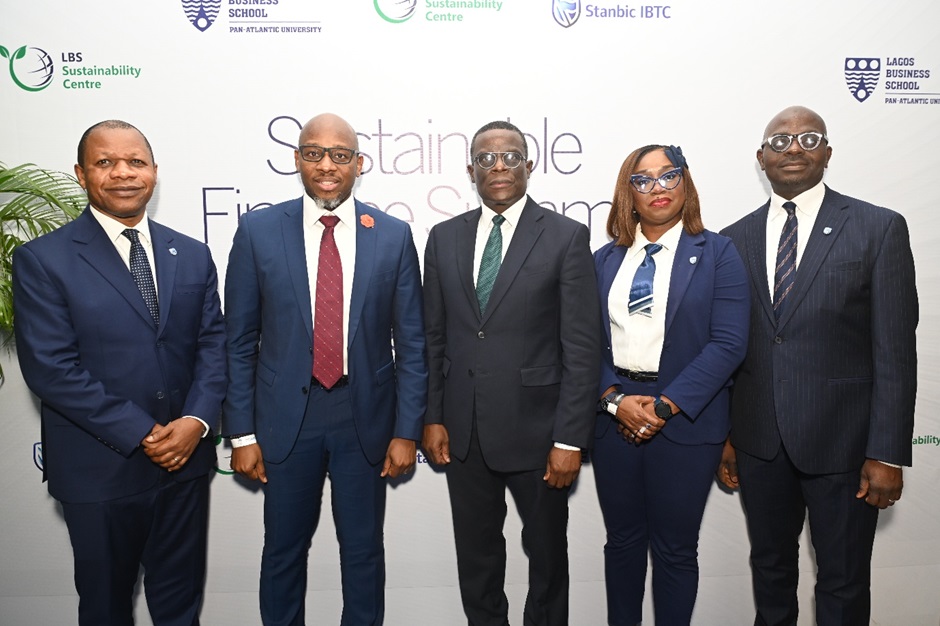
Stanbic IBTC Holdings through its Sustainable Finance Summit 2.0 has sets the pace for leveraging innovative climate-smart financing.
The event, held in partnership with the Lagos Business School Sustainability Centre (LBSSC), concluded with unprecedented success, establishing new benchmarks for sustainable finance discourse and innovation in Nigeria and across Africa to tackle climate challenges.
The hybrid summit, themed Financing Resilience: Digital Innovation and AI for Climate Smart Communities, attracted over three thousand participants both physically at the Civic Centre, Lagos and through YouTube live streaming, representing diverse sectors from across Nigeria and internationally.
The forum delivered significant value across multiple dimensions. Industry impact included the unveiling of innovative AI-powered climate risk assessment tools being developed by leading Nigerian fintech companies.
Mr Kunle Adedeji, Acting Chief Executive, Stanbic IBTC Holdings, expressed, “The overwhelming success of this summit validates our vision of positioning Nigeria at the forefront of sustainable finance innovation. We have witnessed remarkable collaboration between financial institutions, technology innovators, and policymakers, resulting in concrete commitments and actionable solutions.
“This event has not only strengthened our position as industry leaders but has also demonstrated the transformative power of bringing together diverse stakeholders around our shared commitment to climate-smart financial solutions,” he said.
On his part, Mr Wole Adeniyi, Chief Executive, Stanbic IBTC Bank also reiterated that the seminar delivered concrete value to all participant categories.
Financial professionals gained practical insights into implementing AI-driven ESG assessment tools and accessing new sustainable investment opportunities—technology innovators connected with potential investors and partners, with several startups securing follow-up meetings for funding discussions. Regulators participated in productive policy dialogues and gained exposure to international best practices in sustainable finance regulation.
The summit’s emphasis on meaningful dialogue and active participation proved phenomenally successful. Live Q&A sessions generated probing questions and insightful answers, networking sessions facilitated new business connections and potential partnerships, technology demonstration zones attracted significant engagement with firsthand exploration of climate finance tools, and panel discussions sparked animated debates on the future of sustainable finance in Africa.
In her presentation titled The Power of digitisation in Stanbic IBTC’s climate risk management and opportunity discovery, Mrs Bunmi Dayo-Olagunju, Deputy Chief Executive, Stanbic IBTC Bank, highlighted the significance of digitisation.
She emphasised that data digitisation enables more precise and timely measurement of climate risks across various portfolios. She described how AI and machine learning facilitate predictive modelling for various scenarios, including floods, droughts, and credit stress situations.
According to her, “Nigeria must persist in implementing strong and effective measures to combat climate risks. We should prioritise sustainable land use practices, promote environmental education, and strengthen policies that support climate adaptation and mitigation.
“Collective action at all levels; government, businesses, and civil society is essential to ensure a sustainable future for our nation in the face of climate change,” she stated.
Speaking during the event, Professor Kemi Ogunyemi, Business Ethics and Members, Management Board, Lagos Business School, stated, “At the Lagos Business School Sustainability Centre, we believe that collaboration between academia and industry is vital in addressing the pressing challenges posed by climate change. The success of the Stanbic IBTC Sustainable Finance Summit 2.0 highlights the collective potential of diverse stakeholders coming together to drive innovation in sustainable finance.
“As we continue to foster meaningful dialogue and partnership, we are excited to see the tangible impact our efforts will have on creating climate-smart communities across Nigeria and beyond.”
According to the lender, the success of the Sustainable Finance Summit 2.0 reinforces Stanbic IBTC’s position as Nigeria’s leading innovator in sustainable finance, demonstrating the powerful impact of academic-industry collaboration in addressing climate challenges.
In his keynote address titled Artificial Intelligence and Sustainable Finance: Steps for a Climate-Resilient Economy, Mr Segun Ajayi, Country Director, Oracle Nigeria, emphasised the transformative potential of artificial intelligence (AI) in reshaping Africa’s economic landscape. He articulated a vision where AI acts as a catalyst for the continent’s transition from being viewed primarily as a region characterised by high risks to one abundant with high potential.
“With AI, Africa can transition from being perceived as high risk to being seen as high potential.”
Through his address, Mr Ajayi called for collaboration among governments, the private sector, and technology providers to effectively harness the power of AI. He emphasised the importance of developing the right policies and frameworks that facilitate the implementation of AI solutions while upholding ethical standards.
Mr Ajayi’s insights serve as a hopeful reminder of the role technology can play in paving the way for a climate-resilient economy in Africa, fostering an environment where potential is recognised and nurtured.
Banking
CBN, NCC Set up Committees to Protect Consumers Against Fraud
By Modupe Gbadeyanka
In a bid to ensure consumer safety across the telecommunications and financial services sectors, the Central Bank of Nigeria (CBN) and the Nigerian Communications Commission (NCC) have decided to work together.
On Monday, both organisations sealed a Memorandum of Understanding (MoU) for the establishment of joint committees for the protection of consumers against fraud in the sectors.
The two teams set up by the CBN and the NCC include the Joint Committee on Payment Systems and Consumer Protection, and the Joint Committee on Telecoms Identity Risk Management System (TIRMS) Portal.
Through the TIRMS portal, which aggregates data on churned (recycled) phone numbers, as well as numbers flagged within the financial services sector, it will now have enhanced visibility into the status of phone numbers, one of the most widely utilised resources in the sector, although regulated by the NCC.
With this, according to the chief executive of NCC, Mr Aminu Maida, financial institutions will be able to determine when a line is active, when it has been swapped, when it has been disconnected due to inactivity and reassigned to a new subscriber, and when it has been flagged for suspicious or fraudulent activity. “This ensures that our financial services industry is better equipped with timely and relevant information to effectively combat e-fraud, particularly those perpetuated using phone numbers, in the country,” he stated.
It was stated that the partnership between the two parties will reduce electronic fraud, which has become increasingly pervasive, with significant implications for the integrity of the digital economy.
In his remarks, the Governor of the CBN, Mr Yemi Cardoso, said the MoU will strengthen coordination on approvals, technical standards, and innovation trials, including sandbox testing that supports market-led solutions, while safeguarding stability.
“Going forward, the CBN remains fully committed to working with the NCC to deliver a safer, more resilient, and more inclusive digital financial system that supports national productivity, protects consumers, and strengthens trust in Nigeria’s digital economy,” the central bank chief said.
Banking
Wema Bank Looks to Deepen Role as Catalyst for Growth, Market Presence
By Aduragbemi Omiyale
Mid-level Nigerian lender, Wema Bank Plc, has set its eyes on expanding its market presence and supporting the government in achieving its $1 trillion economy by 2030.
In a statement, the financial institution said it hopes to achieve these and others through its recently recapitalisation exercise, which saw its capital base rise to about N265 billion, well above the N200 billion-threshold set by the Central Bank of Nigeria (CBN) for its category of licence.
Wema Bank operates with a national licence, and based on the regulator’s requirement, the capital base must be at least N200 billion.
Before the March 31, 2026-deadline set be the CBN, banks were required to have at least N25 billion, but to meet up with the 2030 target of the federal government, this threshold was raised, with banks operating branches out the country asked to have at least N500 billion, while regional banks were told to have a minimum of N50 billion.
To comply with the new directive, Wema Bank embarked on a strategic capital raise through the stock market, successfully strengthening its shareholder base and securing the required capital through strong participation from existing investors.
Its N150 billion rights issue, which opened on April 14, 2025, and closed on May 21, 2025, marked a significant step in this journey. This was subsequently complemented by a N50 billion special placement later in the year, ensuring the bank not only met but exceeded the regulatory threshold well ahead of schedule.
“The successful completion of our recapitalisation exercise is a defining moment for Wema Bank. It is a strong validation of our strategy, our performance, and the enduring confidence our shareholders and stakeholders have in our vision.
“We have not only met the CBN’s requirements; we have exceeded them, reinforcing our position as a National Bank with the scale, strength, and stability to compete and lead,” the chief executive of Wema Bank, Mr Moruf Oseni, stated.
“Looking ahead, we remain focused on deepening our market presence, driving customer-centric innovation, and strengthening our role as a catalyst for growth across retail, SME, and corporate segments.
“This is not just about retaining our license; it is about building a bigger, stronger, and more impactful Wema Bank,” the bank executive further stated.
Banking
Nigeria to Invest $75m in Flutterwave’s IPO Drive
By Adedapo Adesanya
President Bola Tinubu has given approval for the investment of $75 million in Flutterwave, as part of the payments company’s efforts to raise $250 million through an Initial Public Offering (IPO).
The investment is expected to be executed through the Ministry of Finance Incorporated (MoFI), according to reports on Monday.
Since its founding in 2016, Flutterwave has rapidly expanded and now has a presence in about 30 African countries. The company’s valuation is at $3 billion.
According to the reports, the fintech company approached the federal government last year to participate in the offer, which has been in motion since it was first touted as far back as 2022.
Flutterwave’s IPO has been delayed by its lack of sustained profitability, earlier governance and misconduct scandals, and unfavourable global market conditions.
It was gathered that MoFI engaged two of the Big Four global accounting and auditing firms to carry out a detailed review of the company’s financial statements and operations, in a move aimed at ensuring due diligence and strengthening investor confidence.
Citing sources, the newspaper said Flutterwave brought Nigerian government participation to secure sovereign backing and reinforce confidence in Nigeria’s growing technology sector.
According to the sources, the move was also intended to project Nigeria’s potential on the global stage, adding that the company is also using the IPO to widen ownership and allow more Nigerians to invest in its growth.
The paper also reported that the IPO would expand ownership, giving more Nigerians the opportunity to invest in one of Africa’s leading fintech companies.
Market interest in the offer is said to be strong, with existing investors indicating plans to increase their stakes, while new institutional players are also positioning to participate.
This development is coming after the Central Bank of Nigeria (CBN) granted Flutterwave a license to operate microfinance banking services in Nigeria. The license enables the company to hold funds and deposits directly, strengthening its financial infrastructure across its largest market and enabling more efficient financial services and settlement flows for consumers, businesses and enterprises.
-
Feature/OPED6 years agoDavos was Different this year
-
Travel/Tourism10 years ago
Lagos Seals Western Lodge Hotel In Ikorodu
-
Showbiz3 years agoEstranged Lover Releases Videos of Empress Njamah Bathing
-
Banking8 years agoSort Codes of GTBank Branches in Nigeria
-
Economy3 years agoSubsidy Removal: CNG at N130 Per Litre Cheaper Than Petrol—IPMAN
-
Banking3 years agoSort Codes of UBA Branches in Nigeria
-
Banking3 years agoFirst Bank Announces Planned Downtime
-
Sports3 years agoHighest Paid Nigerian Footballer – How Much Do Nigerian Footballers Earn