Connect with us

Economy

2018 Budget Far From Being ‘Budget of Consolidation’—Ben Bruce

Published

on

By Dipo Olowookere

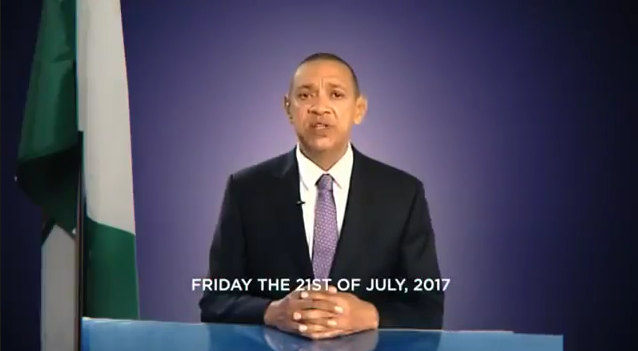
Nigerian Senator, Mr Ben Murray-Bruce, has said the 2018 appropriation bill recently presented by President Muhammadu Buhari to the parliament “is far from being a budget of consolidation.’

The lawmaker, who is very vocal on the popular social media platform, Twitter, made this disclosure on Monday while reacting to the appropriation bill.

According to the event promoter from Bayelsa State, a budget built with debt is nowhere near being described as a budget of consolidation.

Speaking via his verified official Twitter page yesterday, Mr Murray-Bruce said, “With due respect, the 2018 budget is far from being a budget of ‘consolidation’.

“A budget built with debt. We spend one quarter of our revenue on debt servicing. It is more realistically termed a budget of over active imagination divorced from reality.

“Nigeria now has $64.2 billion in foreign loans as of June 30, per the latest numbers from the Debt Office.

“Our debt to GDP ratio is now so high that even the World Bank is alarmed, yet we are carrying on as if all is well with parties here and owambe there.”

Last Tuesday, President Buhari presented a budget proposal of N8.61 trillion for 2018 to the National Assembly.

In December 2016, Mr Buhari presented a budget of N7.3 trillion for 2017 to the parliament, but the lawmakers increased it to N7.44 trillion when it passed it in May 2017 before it was signed into law a month later.

In the 2018 budget proposal, the President said his administration plans to spend over N2 trillion for debt servicing.

According to the Debt Management Office (DMO), the total domestic debt figure is currently in excess of N12 trillion.

The oil benchmark was pegged at $45 per barrel with the external reserves presently slightly over $34 billion.

During the budget presentation, President Buhari said the recurrent expenditure is N3.494 trillion, while capital expenditure is N2.428 trillion, excluding the capital component of Statutory Transfers, and debt service (N2.014 trillion).

Statutory Transfers was about N456 billion, while provision for a sinking fund was about N220 billion (subject to retired maturing bond to local contractors).


Modupe Gbadeyanka is a fast-rising journalist with Business Post Nigeria. Her passion for journalism is amazing. She is willing to learn more with a view to becoming one of the best pen-pushers in Nigeria. Her role models are the duo of CNN's Richard Quest and Christiane Amanpour.

Click to comment

Leave a Reply

Your email address will not be published. Required fields are marked *

Economy

Naira Strengthens to N1,381/$ at Official Market

Published

on

Official FX Market

By Adedapo Adesanya

The Naira further appreciated against the US Dollar in the Nigerian Autonomous Foreign Exchange Market (NAFEX) on Thursday, July 16, by 65 Kobo or 0.04 per cent to sell for N1,381.53/$1, in contrast to Wednesday’s closing value of N1,382.18/$1.

This was buoyed by improved FX liquidity to absorb the high demand for Dollars during the trading session.

However, the local currency depreciated against the Pound Sterling in the official market yesterday by N9.48 to close at N1,866.17/£1 versus the preceding day’s N1,856.69/£1, and lost N2.99 against the Euro to quote at N1,582.68/€1 compared with the midweek rate of N1,576.69/€1.

At the parallel market, the Nigerian currency maintained stability against its United States counterpart at N1,405/$1, and at the GTBank FX desk, it remained unchanged at N1,389/$1.

On Thursday, data from the Central Bank of Nigeria (CBN) showed a surge in interbank FX turnover and deal count. Interbank FX activities at the NFEM window increased sharply by 69 per cent to $205.366 million from $121.727 million reported the previous day.

Nigeria’s gross external reserves continue to rise, supported by steady foreign exchange inflows from hydrocarbon receipts, remittances and foreign portfolio investments, boosting market confidence. It settled at $51.893 billion from $51.867 billion the previous day.

The apex bank has also launched a new digital platform that will track every foreign exchange transaction involving Bureau De Change (BDC) operators, marking a major step in its efforts to improve transparency and strengthen oversight of Nigeria’s retail forex market.

In an operational guidance issued on July 15 to authorised dealer banks and licensed BDCs, the CBN introduced the FX BDC Purchase Tracker (FXBT), a centralised electronic portal that will monitor foreign exchange purchases by BDCs from the point of request through approval, settlement and eventual sale.

As for the crypto market, prices were down as the markets weighed fresh US airstrikes on Iran that boosted risk sentiment, with Ethereum (ETH) down by 4.7 per cent to $1,829.37.

Solana (SOL) decreased by 3.6 per cent to $77.49, Dogecoin (DOGE) depreciated by 3.1 per cent to $0.0718, Cardano (ADA) also crashed by 3.1 per cent to $0.1588, Bitcoin (BTC) slumped by 2.9 per cent to $62,820.21, Ripple (XRP) dipped by 2.6 per cent to $1.08, Binance Coin (BNB) fell by 2.3 per cent to $569.02, and TRON (TRX) shrank by 0.8 per cent to $0.3219, while the US Dollar Tether (USDT) and the US Dollar Coin (USDC) traded flat at $1.00 each.

Continue Reading

Economy

SEC Begins Campaign to Help Investors Recover N270bn Unclaimed Dividends

Published

on

Unclaimed Dividends

By Aduragbemi Omiyale

In a bid to help investors recover about N270 billion in unclaimed dividends in the capital market, a nationwide enlightenment campaign has been launched by the Securities and Exchange Commission (SEC).

This initiative involves town hall meetings that would go around the country to sensitise Nigerians on the need to claim these fallow funds.

The Director General of SEC, Mr Emomotimi Agama, speaking at a town hall meeting in Lagos, said the regulator is not happy that investors, who worked hard to purchase shares in the stock market, have not claimed their profits for many years, making unclaimed dividends pile up.

“The commission considers this situation unacceptable. Funds belonging to investors should ultimately find their way back to their rightful owners,” the SEC chief, represented at the event by the Director of Registration and Exchanges, Market Infrastructure Department, Ms Hafsat Rufai, stated.

He said during this campaign Nigerians would be informed of the unclaimed monies, the role of the National Investor Protection Fund (NIPF), and the procedures for verifying and recovering legitimate claims, stressing that SEC is committed to ensuring that investors’ funds are returned to their rightful owners.

The DG stated that unclaimed monies administered by the NIPF include return funds from public offers, scheme consideration arising from mergers, acquisitions and corporate restructuring transactions, as well as other capital market-related funds that have remained dormant.

He disclosed that the town hall meetings would be held in the six geopolitical zones and the Federal Capital Territory.

In addition, electronic and social media platforms would be used to broaden public awareness on this issue, with efforts to be made to address the transmission of securities following the death of an investor, noting that many families were either unaware that their deceased relatives owned shares or lacked knowledge of the legal and administrative procedures required to transfer such investments to rightful beneficiaries.

“As a result, valuable investments and returns on investments sometimes remain inaccessible for many years, thereby denying beneficiaries the financial benefits intended for them,” he said, urging investors to maintain proper records of their investments and encouraging families to take proactive steps to preserve inherited wealth.

Continue Reading

Economy

Mild Profit-taking by Investors Pulls Back Customs Street by 0.09%

Published

on

Customs Street Nigerian Stock Exchange

By Dipo Olowookere

The decision of investors to book profit after the previous session’s gains pulled back Customs Street by 0.09 per cent on Thursday.

The selling pressure was mainly on BUA Cement, which put the Nigerian Exchange (NGX) Limited off-balance during the session.

Analysis of the trading data showed that the industrial goods sector was the sole decliner, losing 2.85 per cent, as a result of the poor performance of BUA Cement at the market yesterday.

The other key sectors of the bourse were bullish, with the banking space up by 2.87 per cent. The consumer goods index appreciated by 0.30 per cent, the insurance counter improved by 0.16 per cent, and the energy segment rose by 0.08 per cent.

At the close of business, the All-Share Index (ASI) went down by 221.14 points to 242,145.61 points from 242,366.75 points, and the market capitalisation decreased by N32 billion to N156.207 trillion from N156.239 trillion.

Eunisell crashed by 10.00 per cent to N189.00, BUA Cement lost 9.99 per cent to quote at N275.60, CAP declined by 9.61 per cent to N142.45, Royal Exchange slipped by 9.55 per cent to N1.42, and Guinea Insurance tumbled by 5.38 per cent to 88 Kobo.

Conversely, First Holdco soared by 9.96 per cent to N87.25, McNichols gained 8.00 per cent to trade at N5.40, UBA appreciated by 7.93 per cent to N44.25, Veritas Kapital jumped by 6.85 per cent to N1.56, and Jaiz Bank chalked up 4.07 per cent to settle at N8.95.

It was observed that the market breadth index was positive after the exchange closed the session with 22 price losers and 27 price gainers, representing strong investor sentiment.

A total of 498.5 million shares valued at N34.9 billion were traded in 39,484 deals on Thursday, in contrast to the 476.3 million shares worth N29.6 billion transacted in 40,992 deals on Wednesday. This indicated that the trading volume grew by 4.66 per cent, the trading value increased by 17.91 per cent, and the number of deals depreciated by 3.68 per cent.

Japaul ended the day as the busiest equity after trading 77.7 million units for N231.5 million, Access Holdings sold 41.2 million units valued at N1.0 billion, First Holdco exchanged 38.8 million units worth N3.4 billion, UBA transacted 31.5 million units for N1.4 billion, and Fidelity Bank traded 23.8 million units worth N495.0 million.

Continue Reading