Connect with us

Economy

$30b Needed to Execute 30 Capital Projects in Five Years—Ambode

Published

on

By Dipo Olowookere

Governor Akinwunmi Ambode of Lagos State has disclosed that not less than $30 billion is required to carry out about 30 capital projects in the state in the next five years.

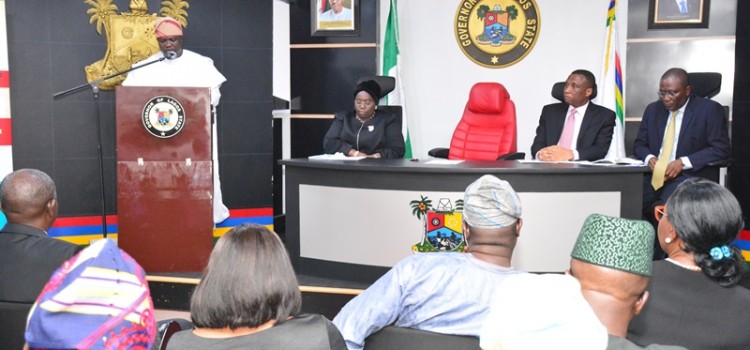
Mr Ambode made this disclosure on Monday when he spoke shortly before inaugurating a 12-member Economic Advisory Committee at the Lagos House, Ikeja.

He said the projected figure represents about $6 billion per annum,  whereas the provision for capital projects in the 2017 budget is pegged at N500 billion (about $1.6 billion).

Alluding to the fact that the projection clearly shows that government alone cannot address the infrastructure deficit, the Governor said the inauguration of the Economic Advisory Committee was therefore a step in the right direction.

“If Lagos was a country and we are the fifth largest economy in Africa, then we have to start thinking about the number five. In that regard, you must not think taxes of Lagos state citizens or IGR, you must create some kind of platform that would allow some other people who are outside to tell us how to run a country in a state.

“Let me crave your indulgence to present a picture of what we are confronted with. Our 2017 budget has earmarked about N500 billion (about $1.6 billion) as capital spend. Whereas our recent Infrastructure needs analysis shows that over $30 billion would be required to achieve the 30 most impactful projects for the state over the next five years (an average of $6 billion per annum).

“It is evident that Government cannot address this from current resources. A key task of this Committee is therefore to provide specific advice on the overall finance strategy to bridge the massive infrastructure gap. I am therefore glad and privileged that nine competent and well respected Lagosians have accepted our request to serve in the Committee,” he said.

Highlighting some of the key functions expected of the Economic Advisory Team, Governor Ambode said they would be expected to bring an independent perspective on economic and business issues with a primary role of offering advice to his administration under the four strategic 2012-2025 Lagos State Development Plan (LSDP) pillars of Economic Development; Infrastructural Development; Social Development and Security as well as Sustainable Development.

Mr Ambode said that whilst the Committee is independent and largely constituted by members from the private sector, the need for integration and collaboration to ensure that the views are taken on board necessitated in having three members of the State Executive Council, led by the Commissioner for Finance in the team.

He expressed optimism that the Economic team would further expand his administration’s all inclusive governance mantra and achieve the key objective of getting independent views on economic and business issues in delivering the mandate to the people.

Governor Ambode later inaugurated renowned economist and Founder of Agusto & Co, Mr Olabode Agusto as the Chairman, while Commissioners for Finance, Mr Akinyemi Ashade; Energy and Mineral Resources, Mr Olawale Oluwo and Commerce, Industry and Cooperatives, Mr Rotimi Ogunleye are members of the Committee.

Other members include former Managing Director, Skye Bank, Mr Kehinde Durosinmi-Etti; former Country Senior Partner, PwC, Mr Kenneth Igbokwe; Founder/CEO Bestman Games Ltd, Mrs Nimi Akinkugbe; Managing Partner, Dalmeida, Ogunlana & Co, Mrs Adenike Ogunlana; Managing Director, Vetiva Capital, Dr Laolu Mudashiru; former Minister of Science & Technology, Mrs Omobola Johnson; Deputy Managing Director, Wema Bank Plc, Mr Moruf Oseni and Mrs Yetunde Akinloye who doubles as Secretary of the Committee.

Responding on behalf of other members of the Committee, Mr Agusto assured that they would work diligently and focus on the priorities of the state government aimed at making life more comfortable for Lagosians.

He noted that one of the major reasons why Lagos is making steady progress was the fact that businesses are thriving, adding that the Committee would take into cognizance the important role the private sector plays in that regard.


Dipo Olowookere is a journalist based in Nigeria that has passion for reporting business news stories. At his leisure time, he watches football and supports 3SC of Ibadan. Mr Olowookere can be reached via [email protected]

Economy

APM Terminals to Invest $600m in Nigeria’s Maritime Sector

Published

on

apm terminals

By Modupe Gbadeyanka

The Nigerian maritime sector may soon witness the inflow of $600 million in investment from APM Terminals.

On the sidelines of the ongoing Africa CEO Forum in Kigali, Rwanda, the Regional President of APM Terminals for Africa-Europe, Mr Igor van den Essen, informed President Bola Tinubu that his company was interested in deepening its investment in Nigeria.

According to a statement issued by the Special Adviser to the President of Information and Strategy, Mr Bayo Onanuga, the investment would be deployed in Apapa port modernisation, logistics infrastructure, and long-term private-sector investment in Nigeria’s maritime sector.

President Tinubu welcomed the investments, emphasising that Nigeria is repositioning itself for greater competitiveness through ongoing economic reforms and infrastructure modernisation.

He said the country is determined to move beyond structural bottlenecks and outdated systems, stressing the need for advanced technology, faster cargo processing, and improved operational efficiency across the nation’s ports.

He emphasised that Nigeria possesses the market scale, talent base, and economic potential to support globally competitive maritime and logistics infrastructure investments and called on other investors to take advantage of Nigeria’s reform outcomes.

Earlier, Mr Igor van den Essen lauded President Tinubu’s reform agenda and policy direction, which had strengthened investor confidence and created renewed momentum for long-term infrastructure investments.

He described Nigeria as a strategic stronghold within its African operations, referencing over 20 years of collaboration and substantial existing investments in the country’s port ecosystem.

He reaffirmed his company’s commitment to expanding investments in Nigeria and disclosed plans to support the development of world-class terminal infrastructure and technology-driven port operations.

He also commended Mr Tinubu for establishing the National Single Window (NSW), which has streamlined trade procedures, improved Customs coordination, and reduced delays in cargo clearance.

Continue Reading

Economy

Dangote Sues FG Over Fuel Import Licences

Published

on

Fifth Crude Cargo Dangote Refinery

By Adedapo Adesanya

Dangote Petroleum Refinery has filed a new lawsuit against the federal government over the fuel import licences issued to ‌marketers and the Nigerian National Petroleum Company (NNPC) Limited.

Last week, the Nigerian Midstream and Downstream Petroleum Regulatory Authority (NMDPRA) issued licences to six marketers for the importation of 720,000 metric tonnes of Premium Motor Spirit, known as petrol.

The marketers are NIPCO, AA Rano, Matrix, Shafa, Pinnacle, and Bono. The development comes amid claims by the NMDPRA that the Dangote Petroleum Refinery now supplies over 90 per cent of Nigeria’s daily petrol consumption.

Dangote said in the filing that the licences issued undermine its operations and contravene the law, which it argues allows imports only when domestic supply falls short.

Named in the suit against the country is the Attorney General and Minister of Justice, Mr Lateef Fagbemi. The federal government can only be sued via his office.

The case signals renewed tensions almost a year after Dangote withdrew an earlier lawsuit challenging similar licences. That case sought to nullify import permits issued to the NNPC and several traders.

The new filing asks the Federal High Court in Lagos to set aside import permits issued or renewed by the NMDPRA, arguing they breach an earlier order to maintain the status quo.

Dangote ⁠ended the earlier lawsuit in July 2025 without explanation, leaving unresolved questions over competition and supply in one of Africa’s largest fuel markets.

Nigeria ⁠has long relied on petrol imports due to underperforming state refineries. However, Dangote’s 650,000 barrels ⁠per day capacity refinery was touted to end that dependence.

Despite the presence of the facility, imports have continued to cover supply gaps as the refinery ramps up output.

The NMDPRA did not issue a single import licence in the first quarter of 2026 because the Dangote refinery had the capacity to meet Nigeria’s petrol demand.

Business Post gathered that only upon intervention by President Bola Tinubu were the licenses granted for the second quarter by the NMDPRA.

Continue Reading

Economy

Nigeria’s Inflation Rises to 15.69% in April as Middle East Crisis Persists

Published

on

hedge against inflation

By Adedapo Adesanya

The Nigeria Bureau of Statistics (NBS) has revealed that Nigeria’s headline inflation rate in April 2026 rose to 15.69 per cent, beating analysts’ expectations of 15.95 per cent, as the fallout from the Iran war continued to affect the global economy.

The statistical office on Friday showed the headline inflation rate for April on a month-on-month basis was 2.13 per cent, while the food inflation rate in the review month was 16.06 per cent on a year-on-year basis.

The rise in prices comes as an energy price shock stemming from the continued conflict in the Middle East, which stoked food prices and affected relative exchange rate stability.

According to the NBS, “this can be attributed to the rate of change in the average prices of the following products: Millet whole grain, yam flour, ginger (Fresh), beef, garri, tam tuber, pepper (Fresh), cray fish, cassava tuber, Beans, Irish Potatoes, tomatoes (fresh), wheat grain (Sold loose), soya beans, guinea corn, plantain, carrots (Fresh) etc.”

“The average annual rate of food inflation for the twelve months ending April 2026, relative to the previous twelve-month average, was 17.55%, which was 17.05% points lower than the average annual rate of change recorded in April 2025 (34.60%),” the NBS said.

Analysts at Coronation Research had earlier projected that the inflation rate in Nigeria would be at 15.95 per cent on a year-on-year basis in April 2026. It added that the expected inflation rate signals a return toward the underlying disinflation trajectory and could be a pivotal data point in shaping Monetary Policy Committee (MPC) deliberations at the next policy meeting.

It also expects food inflation to further ease, as food and non-alcoholic beverages remain the dominant contributor to headline CPI, accounting for about 40 per cent of the Consumer Price Index (CPI) basket.

The MPC of the Central Bank of Nigeria (CBN) will meet this month, the first since the Iran War started in late February, to review core monetary policies and possibly make adjustments.

The committee reduced the Monetary Policy Rate (MPR) by 50 basis points from 27.0 per cent to 26.5 per cent at its 304th Monetary Policy Committee (MPC) meeting in February.

Continue Reading

Trending