Economy
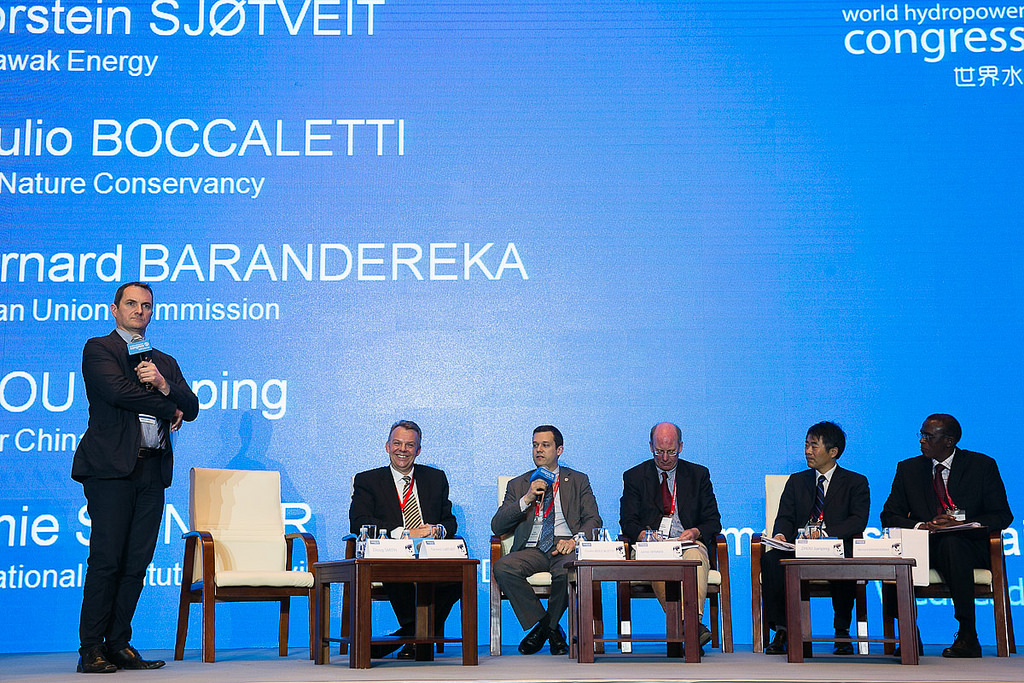
6th World Hydropower Conference Holds in Addis Ababa

By Dipo Olowookere
The 6th World Hydropower Congress (WHC), a multi-stakeholder forum bringing together leaders and specialists with hydropower-related responsibilities from government, industry, finance, United Nations agencies, academia and civil society, is to take place in Addis Ababa, Ethiopia, from May 9-11, 2017.
Organised by the International Hydropower Association (IHA) with the support of the Economic Commission for Africa (ECA), the African Union Commission (AUC) and other partners, this high-level event will chart the course for hydropower development and operation over the next 10 years, aiming to ensure reliable and resilient water and energy systems in the world and to spur sustainable development for all.
The biennial conference, which is coming to Africa for the first time, will emphasise environmental and social aspects to look into during hydroelectric project planning stages, and a commitment to better hydro in an age when resource management is more important than ever.
Acting ECA Executive Secretary Abdalla Hamdok says the ECA is delighted to co-organise the congress and offer a platform to accelerate the much-needed deployment of renewable energy across Africa.
“Achieving the African Union’s Agenda 2063 and fulfilling the Sustainable Development Goals will require that we demand more from an energy source that has historically been linked to economic growth on the continent,” said Mr Hamdok.
Ensuring universal access to affordable, reliable and modern energy services as called for in goal 7 of the SDGs will only be possible in a better-connected world, one where synergies and partnerships are sought among a large number of stakeholders, he added.
Richard Taylor, Chief Executive of IHA said the congress brings together a diversity of perspectives and examines how initiatives from governments, businesses, finance and civil society can converge to help deliver better hydropower and ultimately better development for all.
“Hydropower’s role is a dynamic that calls for an integrated approach, with a strongly connected sector, and a high level of collaboration,” he said.
Mr Taylor stressed that with the right commitments, better hydropower will play an even greater role in delivering modern energy and water services in the world.
Ethiopia’s Minister of Water, Irrigation and Electricity, Seleshi Bekele, says his country is the ideal host for the congress as hydropower is its major energy source.
“Ethiopia aims to transform lives by creating economic and social opportunities through access to energy, enabling industrialisation, managing water supply and enhancing agricultural productivity,” he said.
World Bank Group Vice President for Sustainable Development, Laura Tuck, says without secure power, development efforts the world over are at risk.
“Our mission at the World Bank Group is to help eliminate extreme poverty and boost shared prosperity. We can only achieve these goals if our clients have universal access to electricity and to a secure and stable power supply,” she said.
The Chair of the Global Energy Interconnection Development and Cooperation Organization (GEIDCO), Liu Zhenya of China, says accelerating the implementation of global energy interconnections will promote the development, allocation and utilisation of large-scale clean energy, like hydro, wind and solar power.
“It will also provide a new platform, create opportunities, and inject energy into Africa’s economic takeoff,” said Mr Zhenya.
The event seeks to build on a previous meeting held in 2015 in Beijing by bringing together leaders and specialists to examine how initiatives of governments, businesses, finances, civil society and academia can advance sustainable development.
Hydropower’s role as a global energy source cannot be overstated, with hydro supplying 70 percent of the world’s renewable energy to more than a billion people in 152 countries.
Economy
Meristem Projects Nigeria’s March 2026 Inflation at 13.59%
By Aduragbemi Omiyale
Analysts at Meristem Research have projected that the inflation rate in Nigeria for March 2026 should further moderate to 13.59 per cent on a year-on-year basis from the 15.06 per cent recorded in February 2026.
The company, in a note sighted by Business Post, explained that easing in the average prices of goods and services for last month would be impacted by a high base from the same period of 2025, but noted that on a month-on-month basis, the rate will spike.
Last month, energy prices soared after the price of crude oil on the global market soared as a result of the war in Iran, with prices of items growing in Nigeria.
“However, month-on-month pressures are likely to pick up, driven by the renewed increases in energy prices, which should nudge headline inflation higher.
“Core inflation is also likely to edge higher, reflecting second-round effects from higher transportation and production costs, although the relative stability of the Naira should help moderate the pace of increase.
“Food inflation is also expected to rise on a month-on-month basis, driven by higher logistics and distribution costs, as well as recent increases in staple food prices,” a part of the report noted.
The National Bureau of Statistics (NBS) is expected to release the inflation numbers later today.
Nigeria’s headline inflation rate moderated marginally by 0.04 per cent to 15.06 per cent in February 2026 from 15.10 per cent in January 2026, though on a month-on-month basis, inflationary pressures accelerated.
Economy
Nigeria’s Public Debt Nears N160trn
By Adedapo Adesanya
Nigeria’s total public debt rose from N153.29 trillion at the end of September 2025 to N159.28 trillion in December 2025, according to the latest data released by the Debt Management Office (DMO) on Tuesday.
The increase indicates a quarter-on-quarter increase of N5.98 trillion or 3.9 per cent.
The debt office noted that the December 2025 figures are provisional and were converted using the Central Bank of Nigeria’s official exchange rate of N1,435.25/$, while the September 2025 figures were converted using N1,474.85/$.
On a year-on-year basis, the debt profile marked an increase of N14.61 trillion or 10.1 per cent, from N144.67 trillion in December 2024 to N159.28 trillion in December 2025, representing a rise from $94.23 billion to $110.97 billion, an increase of $16.75 billion, in Dollar terms.
Domestic debt remained the largest, rising from N81.82 trillion in September 2025 to N84.85 trillion in December 2025.
This represents a quarter-on-quarter increase of N3.03 trillion or 3.7 per cent compared to December 2024, when domestic debt stood at N74.38 trillion – the figure increased by N10.47 trillion or 14.1 per cent year-on-year.
In Dollar terms, domestic debt rose from $55.47 billion in September 2025 to $59.12 billion in December 2025, and from $48.44 billion in December 2024. This highlights a sustained reliance on the domestic market for financing.
The federal government accounted for the bulk of domestic debt at N80.49 trillion, representing 50.53 per cent of total public debt, while states and the Federal Capital Territory (FCT) accounted for N4.36 trillion.
Nigeria’s external debt stood at N74.43 trillion as of December 2025, representing 46.73 per cent of total public debt.
This reflects a quarter-on-quarter increase of N2.95 trillion from N71.48 trillion in September 2025, and a year-on-year increase of N4.14 trillion from N70.29 trillion recorded in December 2024.
In Dollar terms, external debt rose from $48.46 billion in September 2025 to $51.86 billion in December 2025, and from $45.78 billion in December 2024.
The federal government continued to dominate external borrowing, accounting for N66.27 trillion of the total external debt, while states and the FCT accounted for N8.16 trillion.
However, the structure of Nigeria’s debt portfolio remained broadly stable despite the increase in overall debt.
While domestic debt accounted for 53.27 per cent of total debt in December 2025, compared to 53.37 per cent in September 2025 and 51.41 per cent in December 2024, external debt stood at 46.73 per cent in December 2025, compared to 46.63 per cent in September 2025 and 48.59 per cent a year earlier.
Economy
Daily Petrol Consumption in Nigeria Slips to 47.3 million Litres Amid Price Hike
By Dipo Olowookere
The volume of premium motor spirit (PMS), commonly known as petrol, consumed daily in Nigeria stood at 47.3 million litres in March 2026 compared with the 56.9 million litres recorded in February 2026.
This information was revealed by the Nigerian Midstream and Downstream Petroleum Regulatory Authority (NMDPRA) in its latest factsheet.
The decline in daily petrol consumption in Nigeria coincided with a hike in the price of the product, triggered by a rise in global crude oil prices as a result of the Middle East crisis.
The United States and Israel launched airstrikes in Iran in late February, with crude oil rising above $100 per barrel and even above $110 per barrel at one point.
The price is currently below $100 per barrel on the global market after the President of the United States, Mr Donald Trump, signalled his intention to negotiate with Iran amid the blockage of the Strait of Hormuz.
Data by NMDPRA also showed that diesel consumption eased to 14.5 million litres per day from the previous month’s 20.3 million litres per day, while aviation fuel stood at 2.1 million litres per day versus 2.9 million litres per day in February 2026.
It was also disclosed that PMS daily supply for the month under review increased to 40.1 million litres per day from the preceding month’s 39.5 million litres per day.
From this, domestic supply came down by 6.30 per cent to 34.2 million litres per day from 36.5 million litres per day, while imported petrol stood at 5.9 million litres per day versus 3.0 million litres per day a month earlier.
Business Post observed that Dangote Refinery supplied about 34.2 million litres per day of PMS into the Nigerian market from the 48.2 million litres per day it produced. The private refiner produced 16.5 million litres of diesel per day in March 2026, supplying 2.2 million litres per day into the domestic market.
In the period, the Warri and Kaduna refineries were totally shut down, while the Port Harcourt refinery, according to the report, though it was shut down, witnessed the evacuation of about 0.048 million litres of diesel per day while it was operational.
-
Feature/OPED6 years agoDavos was Different this year
-
Travel/Tourism10 years ago
Lagos Seals Western Lodge Hotel In Ikorodu
-
Showbiz3 years agoEstranged Lover Releases Videos of Empress Njamah Bathing
-
Banking8 years agoSort Codes of GTBank Branches in Nigeria
-
Economy3 years agoSubsidy Removal: CNG at N130 Per Litre Cheaper Than Petrol—IPMAN
-
Banking3 years agoSort Codes of UBA Branches in Nigeria
-
Banking3 years agoFirst Bank Announces Planned Downtime
-
Sports3 years agoHighest Paid Nigerian Footballer – How Much Do Nigerian Footballers Earn