
Economy
Accelerating Potential of Nigerian SMEs


By Timi Olubiyi, PhD
As businesses grow, many decisions come to bear, from marketing to funding, expansion, investments, operations, logistics, staffing, technology adoption, and so on, all to enhance business productivity. Without a doubt, just like individuals make poor choices and bad decisions, businesses do too.
Business leaders and entrepreneurs make bad decisions not because they are not clever or experienced but because they are humans. Certainly, humans are never perfect decision-makers at all; a bad decision can occur once in a while or repeatedly, and such is the case with business leaders, entrepreneurs, top management, and/or owner-managers of businesses around as well.
As important as decision-making is in business operations, the good news is that business failures have been identified largely to be due to poor decision-making by operators, owners, or business managers. Why is this good news? Understanding the major cause of past business failures could help restrain many entrepreneurs or businesses from repeating this error clearly. Since poor decision-making has been identified as a major concern for business sustainability, making a good choice most time is important for any business, though this can be argued.
In business, no matter the structure in place, decision-making is key and is one of the main indicators of a high-performing business or one of the indicators of how healthy a business is. Remember, not having a decision-making process is in itself a decision on its own.
I have observed keenly that a large number of businesses, be they large or small in Nigeria, particularly the ones in the industrialized States and areas, relish taking shortcuts as a normal practice, and they hardly ever have an articulated decision-making process within their businesses.
It is rather worse in small-scale businesses where decision-making could be the sole responsibility of the operators or business owners. In fact, in small-scale businesses, the most common cause of poor decision is that the operators are so dominant with excessive managerial control that they see decision-making as their sole right without any recourse to the ideas or opinions of employees or others. This is the big issue really.
Furthermore, no initiative or contributions from employees and subordinates are ever considered, key decision-making is never participatory, and this sometimes leads to business concerns. A decision-making responsibility before, during, and after any implementation of a task in a business should not be the entire decision of the business owners. Playing the obvious role of the sole expert in all departments, units, and concerns of the business operations by the owners is never sustainable but damaging; this action has been captured as one of the major causes of the incidence of widespread business failures amongst small -scale businesses in the country.
A good decision can enable a business to thrive and survive long-term, while a poor decision can lead a business into failure. A common behaviour of leaving things to chance when decisive action ought to be taken is also a poor decision, which can bring huge consequences on the business.
This worrying development amongst small-scale business operators has cost many their fortune, particularly with the advent of the coronavirus pandemic (COVID-19), which has been impacting the economy and businesses negatively. It should be a time for decision-making for businesses and not a time to operate aloof. The coronavirus pandemic has changed the world and also signalled a new era for businesses. Therefore, there is a need for business operators to take strategic decisions, most notably in the manufacturing, retail, and service sectors, due to technology disruptions.
Yet business operators in these mentioned sectors disregard this all-important activity. The failure of any business or venture to make good and quality decisions could be a result of many factors, such as inexperience, lack of time, stress, overwork, and pressure from stakeholders, among others. All these can lead to poor decision-making and the eventual failure of any business. The quality of decisions in any business directly impacts its performance and overall business outcomes.
Small business operators should understand that it is healthy for staff to disagree over decisions if the views defer. It only helps to make a proper and effective decision for the business at the end of the day. Leaders should purposefully create a culture where debate and disagreement are welcome.
Remember, decision-making is the action or process of thinking through possible options and uncertain outcomes and selecting the best option concerning the business. This decision-making could bother on marketing, financing, customer satisfaction, investment, and technology usage in the business.
It is often shocking that once-known and thriving businesses can suddenly go under and cease to operate as a result of what most times seem to be poor decision-making and mismanagement. In the case of big and widely known multinational businesses like Kodak, Nokia, Motion Blackberry, and Motorola, the management ignored the shift in technology and failed to be decisive in their decision making particularly on innovations, until it was too late despite the vantage position.
Though Nigeria has a tough operating environment and harsh economic factors, however, many of the small businesses and start-ups in the real estate, retail, manufacturing, corner shops, and service sectors, among others, have lost their relevancies due to poor or lack of prompt decision-making.
For instance, just on Ogudu road via Ojota in Lagos State, businesses that were once the toast of teeming residences and customers, such as Cherries superstore, Terminal 3 restaurant, CCD stores, and The Mr Biggs eatery Ogudu branch have all now remained permanently closed, failed, sold off or shut down to what seems to be poor decision making from the management. This is the fate of so many of the medium-small scale businesses in Lagos State and, indeed, Nigeria. They disappear after a few years of operations and never grow to become intergenerational businesses.
One of the worst things to do in business is to ignore customers’ preferences, revolutionary innovations and also fail to adapt to changes within the business environment as quickly as possible. The high business mortality rate in Nigeria is mainly due to these reasons. Entrepreneurs and operators try to protect what they already have going for them instead of having a decision-making process that can always suggest innovation and ways of doing things better to meet and surpass customers’ expectations.
Many businesses still follow this rigid path, particularly in the manufacturing, services, and retail businesses, lacking the foresight of the advent of online presence, e-commerce, and technological shift occasioned by COVID-19. In my view, businesses need to have a sound decision-making policy that is in tune with the current realities of aggressive social media and internet usage. We have experienced a major cultural shift in customers’ behaviour with COVID-19, and businesses need a decision-making process to review their activities from time to time. This will help to adapt to the economic and environmental changes accordingly.
Multiple studies have suggested that engaging employees in the decision-making process can impact businesses positively, make them more committed to business success, have stronger connections with the businesses, increase engagements and also help produce higher quality results.
Therefore, building a participatory decision-making culture is recommended for businesses, particularly small-scale businesses at this time. This strategy will more than likely improve the competitive position and effectiveness of the management, operators, and business owners. Because making decisions is a critical component of effective leadership, hence involving employees in the process will help businesses make better decisions.
Let the truth be told, inexpensive and reasonable businesses built around clothing, housing, potable water, medical care, education, home essentials, shopping and food items will always have economic demands. Thus, as much as the adequate and proper decision-making process or policy is in place, that should give the needed competitive advantage and make businesses not to ordinarily fail. Good luck!
How may you obtain advice or further information on the article?
Dr Timi Olubiyi is an Entrepreneurship & Business Management expert with a PhD in Business Administration from Babcock University Nigeria. He is a prolific investment coach, seasoned scholar, Chartered Member of the Chartered Institute for Securities & Investment (CISI), and Securities & Exchange Commission (SEC) registered capital market operator. He can be reached on the Twitter handle @drtimiolubiyi and via email: [email protected], for any questions, reactions, and comments.












By Adedapo Adesanya
The National Insurance Commission has issued new guidelines for the collection, management, and administration of the Insurance Policyholders’ Protection Fund.
In a circular issued to all insurance institutions on Tuesday, the regulator also set May 31, 2026, as the deadline for insurers to submit their assessment returns for the 2025 financial year.
Recall that on August 5, 2025, President Bola Tinubu signed into law the Nigerian Insurance Industry Reform Act ( NIIRA 2025).
This landmark legislation repeals the Insurance Act 2003, and consolidates related provisions, ushering in a modern regulatory framework. It lays a strong foundation for sustainable growth and increased investment in the country’s insurance sector.
The commission said the guidelines were issued in exercise of its powers under the 2025 Act and other existing insurance laws and regulations to provide regulatory clarity, improve guidance, and ensure ease of compliance across the industry.
According to NAICOM, the guidelines establish a comprehensive structure for the operation of the IPPF, which serves as a statutory safety net to protect insurance policyholders in the event of distress or insolvency of a licensed insurer or reinsurer. The framework also provides direction on the reimbursement of loans by insurers and reinsurers.
NAICOM stated, “The guidelines ensure regulatory clarity, guidance and ease of compliance, as it provides a comprehensive regulatory framework for the collection, management, and administration of the Fund, which serves as a statutory safety net designed to protect insurance policyholders against distress and insolvency of a licensed insurer or reinsurer, including guidance for the reimbursement of loans by an insurer or reinsurer.
“Please be informed that the IPPF Assessment Returns in respect of the year 2025 shall be submitted to the Commission not later than 31st May 2026, while subsequent submissions shall be in line with Section 4.3 of the Guideline on Insurance Policyholders Protection Fund.”

By Adedapo Adesanya
The Dangote Refinery on Wednesday returned the petrol price to N1,200 per litre, less than 24 hours after it increased it by 5 per cent.
The private refinery had raised the ex-depot price by N75 on Tuesday, citing pressure from volatile global oil markets, but quickly brought it back to N1,200 per litre from N1,275 per litre.
The swift downward review is directly linked to a sharp drop in international crude prices. Brent crude has plunged to $95.05 per barrel, after a 13 per cent decline, while the US West Texas Intermediate (WTI) crude closed at $97.18, recording nearly a 14 per cent drop.
This development comes after US President Donald Trump announced a conditional two-week ceasefire with Iran, which eased fears of immediate supply disruptions in the global oil market.
“This will be a double-sided CEASEFIRE!” Trump said on social media, marking a sharp reversal from his earlier warning that “a whole civilisation will die tonight” if Iran failed to comply with US demands.
Iran’s Foreign Minister, Mr Abbas Araqchi, confirmed that the country would halt attacks provided strikes against Iran cease and transit through the Strait of Hormuz is coordinated by Iranian forces.
Despite the breakthrough, tensions remain elevated across the region, with several Gulf states reporting missile launches, drone activity, or issuing civil defence warnings.
While oil prices have fallen back below $100, they remain significantly elevated after surging by a record amount in March. Market analysts noted that regardless of how successful the ceasefire is, geopolitical risk related to the Strait of Hormuz is likely to remain elevated for the foreseeable future under the control of Iran.
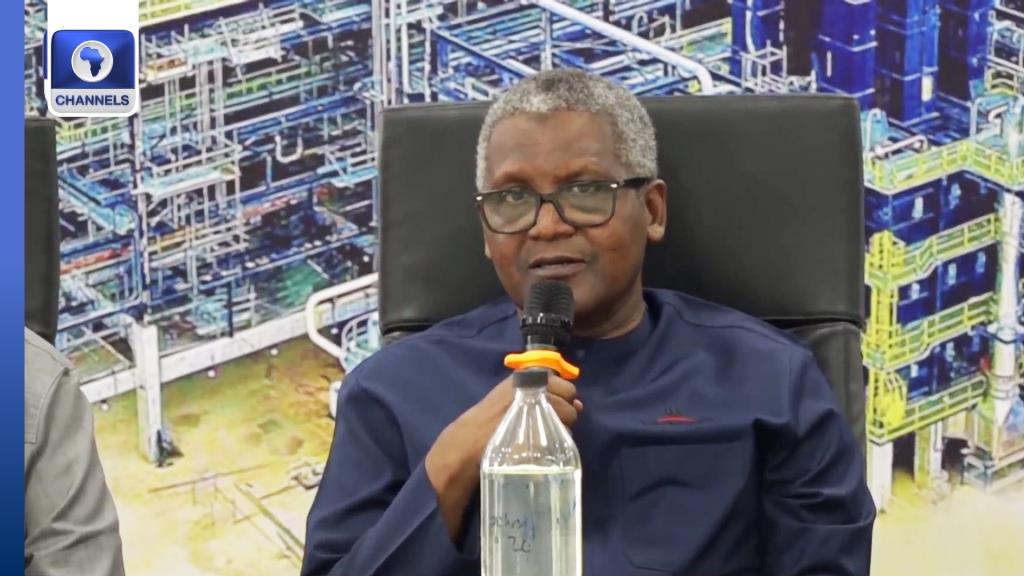
By Adedapo Adesanya
Crude oil deliveries from the Nigerian National Petroleum Company (NNPC) Limited to the Dangote Petroleum Refinery doubled in March, boosting prospects for improved fuel availability.
This was revealed by the chief executive of Dangote Industries Limited, Mr Aliko Dangote, on Tuesday, when he received the Deputy Secretary-General of the United Nations, Mrs Amina Mohammed, at the industrial complex in Ibeju-Lekki, Lagos.
While speaking on feedstock supply, Mr Dangote commended the NNPC for increasing crude deliveries to the refinery in March, noting that volumes rose to 10 cargoes—six supplied in Naira and four in Dollars—to support domestic fuel availability, according to a statement by the Refinery.
“Last month, they gave us six cargoes for Naira and four cargoes for Dollars,” he said.
Despite the improvement, Mr Dangote noted that the supply remains below the 19 cargoes required for optimal operations, with the refinery continuing to bridge the gap through imports from the United States and other African producers.
He also expressed concern over the unwillingness of international oil companies operating in Nigeria to sell to the refinery, stating that their preference for selling crude to traders forces it to repurchase at higher costs, with broader implications for the economy.
Mr Dangote added that the refinery is seeking increased access to domestically priced crude under local currency arrangements as part of efforts to moderate fuel costs and enhance long-term energy and food security across the continent.
On her part, Mrs Mohammed underscored the strategic importance of Dangote Industries Limited -particularly Dangote Fertiliser Limited—in addressing Africa’s mounting food security challenges, while calling for stronger global partnerships to scale its impact.
Mrs Mohammed said the United Nations would prioritise amplifying scalable solutions capable of mitigating the continent’s food crisis, describing Dangote’s integrated industrial model as a critical pathway.
“I think the UN’s job here is to amplify and to put visibility on the possibilities of mitigating a food security crisis, and this is one of them,” she said. “I hope that when we go back, we can continue to engage partners and countries that should collaborate with Dangote Industries.”
-
 Feature/OPED6 years ago
Davos was Different this year
-
Travel/Tourism10 years ago
Lagos Seals Western Lodge Hotel In Ikorodu
-

 Showbiz3 years ago
Estranged Lover Releases Videos of Empress Njamah Bathing
-
 Banking8 years ago
Sort Codes of GTBank Branches in Nigeria
-

 Economy3 years ago
Subsidy Removal: CNG at N130 Per Litre Cheaper Than Petrol—IPMAN
-

 Banking3 years ago
Sort Codes of UBA Branches in Nigeria
-

 Banking3 years ago
First Bank Announces Planned Downtime
-

 Sports3 years ago
Highest Paid Nigerian Footballer – How Much Do Nigerian Footballers Earn