Connect with us

Economy

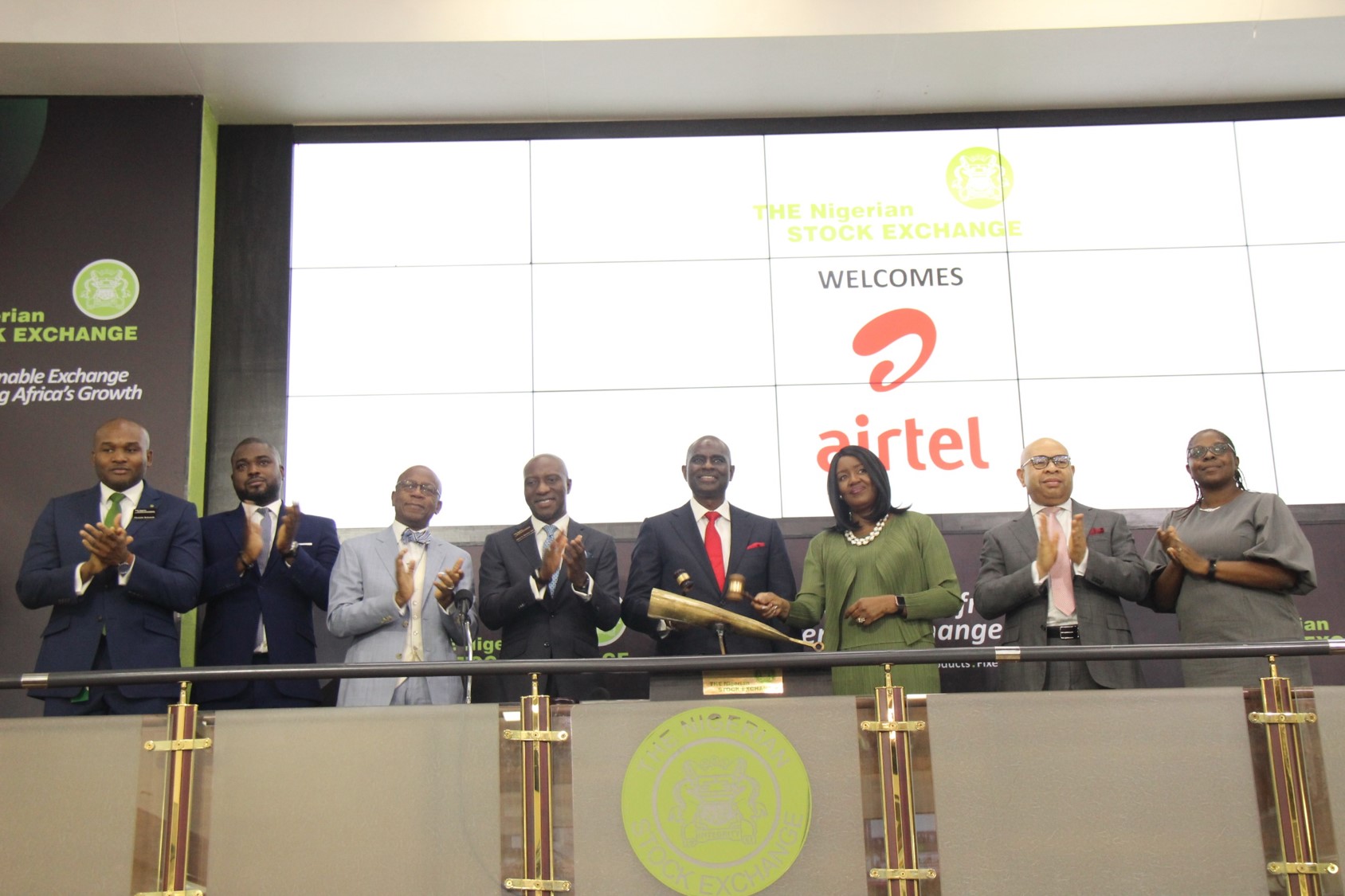
Airtel Africa Announces Double-Digit Revenue Growth amid Headwinds

Published

on

NSE lists Airtel Africa Shares

By Aduragbemi Omiyale

Despite the various headwinds it faced in Nigeria, its main market, Airtel Africa Plc managed to grow its revenue by double-digits in the first quarter of its 2023 financial year, which ended on June 30, 2022.

The earnings went up by 13.0 per cent in reported currency to $1.3 billion as total revenues for mobile services and mobile money services combined grew in Nigeria by 18.3 per cent, in East Africa by 14.1 per cent and in Francophone Africa by 11.7 per cent.

Further, voice revenue improved by 11.3 per cent, while data revenue inflated by 19.8 per cent.

These were influenced by the 8.9 per cent increase in the company’s total customer base to 131.6 million, with increased penetration across mobile data (customer base up 9.7 per cent) and mobile money services (customer base up 19.7 per cent).

In the period under review, EBITDA grew by 14.9 per cent to $614 million in reported currency, while the EBITDA margin was up by 48.8 per cent.

It was disclosed that operating profit grew by 20.6 per cent to $425 million in reported currency as the profit after tax jumped by 25.3 per cent to $178 million, with the earnings per share (EPS) increasing by 31.0 per cent to 4.4 cents.

“I am pleased to report that the Group has continued to post double-digit revenue growth, margin improvement and strong earnings growth.

“I am also particularly pleased with our ongoing strengthening of the balance sheet which continued after the period ended, with early repayment of $450 million of debt at Group level,” the group CEO of Airtel Africa, Mr Segun Ogunsanya said.

“As we flagged in our full year announcement, this quarter we have faced headwinds from outbound voice call barring for customers who had not yet registered their National Identification Numbers in Nigeria and the loss of site sharing revenue in those OpCos where we recently sold towers.

“Inflation is also having an impact on our cost base, particularly on energy costs, but our continued efficiency drives have ensured that we have still been able to increase our margins, albeit at a slightly slower rate.

After receiving the Payment Service Bank licence in Nigeria just a few months ago, it is a testament to our prior preparation that we have already managed to launch our mobile money operations in a few select locations without any operational issues.

“We are excited by the commercial developments and opportunities here. We also continued to invest for growth and have made a couple of major additional spectrum acquisitions recently in the DRC and Kenya in anticipation of continued strong data demand growth in these markets,” he added.

“We continue to target growth ahead of the market this year and, despite inflationary pressures, our continued focus on cost efficiencies should also support margin resilience. Longer term, the opportunities for sustainable profitable growth stemming from our underpenetrated markets for each of mobile voice, data and mobile money services remain hugely attractive, and we are confident of continuing to deliver on our growth strategy,” Mr Ogunsanya stated.


Dipo Olowookere is a journalist based in Nigeria that has passion for reporting business news stories. At his leisure time, he watches football and supports 3SC of Ibadan. Mr Olowookere can be reached via [email protected]

Economy

Profit-taking Sinks Nigeria’s Equity Market by 0.76% as Bears Take Control

Published

on

Nigerian equity market

By Dipo Olowookere

The bears overpowered the Nigerian Exchange (NGX) Limited on Friday, sinking it further by 0.76 per cent when the closing gong was struck by 4 pm.

The nation’s flagship equity market was under selling pressure during the session, as investors booked profits after the shares witnessed price appreciation in the past trading sessions.

The energy sector was the most impacted, as it shed 4.43 per cent. The consumer goods index declined by 0.90 per cent, the banking counter decreased by 0.15 per cent, and the industrial goods sector lost 0.08 per cent, while the insurance counter gained 2.42 per cent, which was not enough to salvage the situation.

Consequently, the All-Share Index (ASI) contracted by 1,912.19 points to 250,330.92 points from 252,243.11 points, and the market capitalisation moderated by 1.225 trillion to N160.444 trillion from N161.669 trillion.

Zichis was the worst-performing stock for the session after it gave up 9.97 per cent to close at N29.43, FTN Cocoa slipped by 9.95 per cent to N8.96, The Initiates slumped by 9.90 per cent to N32.30, LivingTrust Mortgage Bank tumbled by 9.88 per cent to N3.83, and International Energy Insurance dropped 9.71 per cent to trade at N2.79.

The best-performing stock was ABC Transport, which grew by 10.00 per cent to N6.27. May and Baker also appreciated by 10.00 per cent to N47.30, SCOA Nigeria surged by 9.98 per cent to N33.05, Trans-Nationwide Express expanded by 9.97 per cent to N7.06, and DAAR Communications jumped 9.76 per cent to N2.25.

Yesterday, investors traded 1.1 billion shares worth N44.3 billion in 65,744 deals compared with the 1.0 billion shares valued at N41.6 billion transacted in 74,822 deals a day earlier. This indicated a dip in the number of deals by 12.13 per cent, and a rise in the trading volume and value by 10.00 per cent and 6.49 per cent, respectively.

Chams was the busiest equity for the day, with 328.5 million units sold for N1.1 billion. UBA traded 61.6 million units worth N2.7 billion, First Holdco transacted 58.7 million units valued at N4.2 billion, Secure Electronic Technology exchanged 51.9 million units worth N45.0 million, and Access Holdings traded 51.8 million units valued at N1.3 billion.

Continue Reading

Economy

Naira Weakens to N1,371/$1 at Official Market

Published

on

Official FX Market

By Adedapo Adesanya

The last trading session of the week at the Nigerian Autonomous Foreign Exchange Market (NAFEX) ended on a negative note for the Naira on Friday, May 15, as it lost N15 Kobo or 0.1 per cent against the Dollar to trade at N1,371.04/$1 compared with the previous day’s N1,370.89/$1.

However, it further appreciated against the Pound Sterling in the same market segment yesterday by N20.77 to close at N1,830.61/£1 versus Thursday’s value of N1,851.38/£1, and gained N7.91 against the Euro to settle at  N1,595.07/€1 versus N1,602.98/€1.

At the GTBank FX desk, the Naira lost N2 against the US Dollar during the session to sell at N1,383/$1 compared with the preceding session’s N1,381/$1, and at the black market, it remained unchanged at N1,385/$1.

The Naira is forecast to be broadly stable, supported by Dollar sales by the Central Bank of Nigeria (CBN) amid steady, higher oil receipts, with the ‌market settling ⁠into a balance.

Policy direction is also expected to give the market some boost as the CBN said the new edition of the FX market guidelines will deepen liquidity, improve transparency and strengthen confidence in the country’s foreign exchange market.

According to the Governor of the CBN, Mr Yemi Cardoso, the update is due to changing global economic realities, domestic reforms and the need for a more coherent and forward-looking regulatory framework. According to him, the last edition of the FX manual was issued in 2018, making the latest review both timely and necessary.

Meanwhile, the cryptocurrency market plunged into the red zone as rising bond yields hit risk assets across markets, while traders are increasingly betting the Federal Reserve may need to raise rates again. Rising energy prices and resurging inflation could force central banks back into tightening mode.

Cardano (ADA) shrank by 4.4 per cent to $0.2557, Dogecoin (DOGE) slid by 3.7 per cent to $0.1104, Ripple (XRP) depreciated by 3.5 per cent to $1.41, Solana (SOL) crashed by 3.5 per cent to $87.81, and Binance Coin (BNB) slumped by 3.4 per cent to $659.64.

Further, Bitcoin (BTC) declined by 2.6 per cent to $78,547.49, Ethereum (ETH) lost 2.1 per cent to quote at $2,209.19, and TRON (TRX) tumbled by 0.7 per cent to $0.3509, while the US Dollar Tether (USDT) and the US Dollar Coin (USDC) traded flat at $1.00 each.

Continue Reading

Economy

Oil Prices Jump 3% as Trump, Iran FM’s Comments Raise Tensions

Published

on

Oil Prices fall

By Adedapo Adesanya

Oil prices gained ​more than 3 per cent on Friday, after comments by US President Donald Trump and Iran’s foreign minister further dented hopes of a ‌deal.

Brent crude settled at $109.26 a barrel after chalking up $3.54 or 3.35 per cent, and the US West Texas Intermediate (WTI) finished at $105.42 a barrel, up $4.25 or 4.2 per cent. Over the week, Brent has climbed 7.84 per cent and WTI 10.48 per cent on uncertainty over the shaky ceasefire in the Iran war.

President Trump said he ​was running out of patience with Iran and has agreed with Chinese President Xi Jinping that the Middle East nation cannot be allowed to have ​a nuclear weapon and must reopen the Strait of Hormuz, which is the waterway where about a fifth of the world’s oil and liquefied natural gas normally passes.

On his part, Iran’s Foreign ⁠Minister Abbas Araqchi said on Friday that it does not trust the US and is interested in negotiating only if the US is serious, adding that Iran is prepared to go back to fighting but also prepared for diplomatic solutions.

On the US-China front, while the Chinese President did not directly make a comment on Iran, a statement from the foreign ministry spoke out against the conflict.

Among the deals the market was looking for from ​the US-China summit, President Trump said China wants to buy oil from the US, also saying he could lift sanctions on Chinese companies that buy Iranian oil.

Iran’s Revolutionary Guards said 30 vessels had crossed the strait between Wednesday evening and Thursday, far from 140 a day that was typical before the war. Two of the 30 vessels that reportedly cleared the Strait of Hormuz earlier this week were tankers, one en route to Japan and the other headed to China.

A ⁠prolonged closure of the Strait of Hormuz points toward tighter physical markets, potential refined product shortages, and upward pressure on prices in the coming weeks and months.

Even though the Organisation of the Petroleum Exporting Countries and its allies (OPEC+) announced production increases in recent weeks, traders saw little immediate benefit because many barrels still cannot move efficiently through the Gulf region.

Continue Reading

Trending