Economy
Asian Markets Fall as Trump Threatens Fresh $325bn Tariffs on China
By Investors Hub
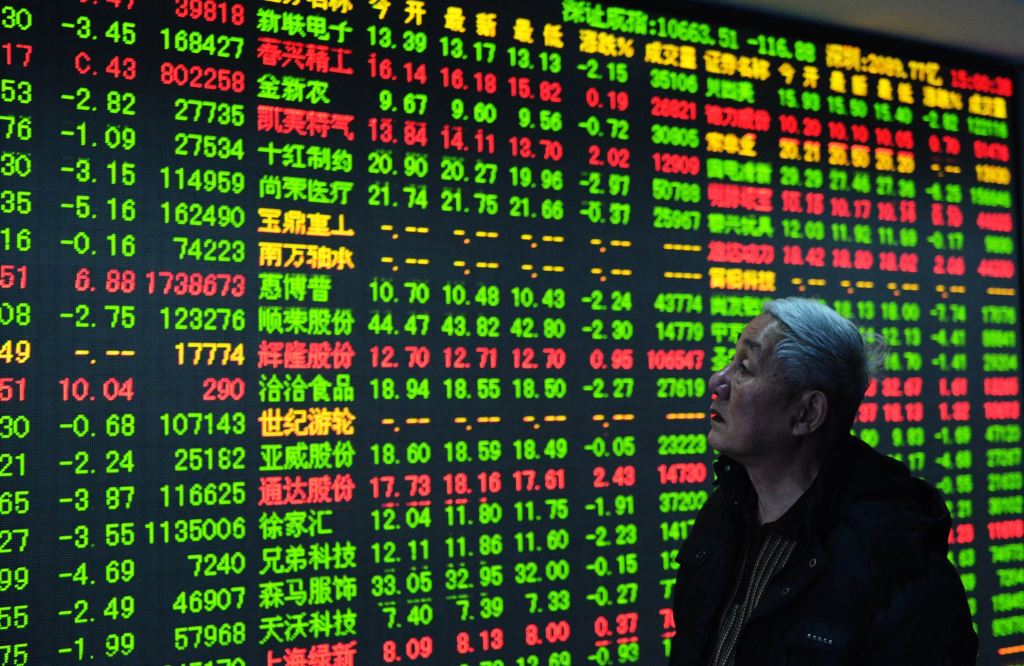
Asian stocks fell broadly on Wednesday after U.S. markets fell from record highs overnight on the back of mixed earnings reports and President Donald Trump’s latest comments about the ongoing U.S.-China trade war.
Trump threatened to impose tariffs on another $325 billion worth of Chinese goods, saying the U.S. still has a long way to go to conclude a trade deal with China.
Chinese shares edged lower in thin trading on worries over slowing growth and the impact of the trade dispute. The benchmark Shanghai Composite Index slipped 5.92 points or 0.2 percent to 2,931.69, while Hong Kong’s Hang Seng Index ended down 26.45 points or 0.1 percent at 28,593.17.
Japanese shares ended lower as tech stocks followed their U.S. peers lower, offsetting gains in the financial sector. The Nikkei 225 Index ended down 66.07 points or 0.3 percent at 21,469.18, while the broader Topix finished marginally lower at 1,567.41.
Tech stocks paced the declines, with TDK Corp losing 2.6 percent and Taiyo Yuden sliding 2.4 percent. Banks and insurers eked out modest gains after U.S. government debt yields rose slightly on Tuesday on the back of stronger than expected economic data.
Aeon Fantasy, which operates entertainment facilities in shopping centers, surged 11.6 percent after reporting a 13 percent jump in June same-store sales.
In economic news, Fitch Ratings retained Japan’s sovereign ratings at ‘A’ with a ‘stable’ outlook. The agency said the ?ratings balance the strengths of an advanced and wealthy economy, with high governance standards and strong public institutions, against weak medium-term growth prospects and high public debt.?
Meanwhile, Australian stocks advanced after BHP Group, the world’s biggest miner, reported a rebound in iron ore output for the fourth quarter. The benchmark S&P/ASX 200 Index rose 32.30 points or 0.5 percent to 6,673.30, while the broader All Ordinaries Index ended up 28.20 points or 0.4 percent at 6,764.
BHP shares advanced 1.4 percent, while rival Rio Tinto ended marginally lower and Fortescue Metals Group lost 2.1 percent. Banks ANZ, Commonwealth and NAB rose between 0.4 percent and 0.7 percent.
Energy stocks ended flat to slightly lower as oil prices steadied after falling to more than one-week lows overnight. Oil Search fell over 3 percent as Papua New Guinea’s new prime minister pressed the company and its oil major partners to pay more taxes.
Estia Health slumped 5.8 percent. The company has been hit with a class action suit that alleges the aged care provider deceived investors and breached market disclosure obligations in 2015 and 2016.
Seoul stocks fell sharply as Trump’s comments on trade talks with China dashed hopes of a deal anytime soon. The benchmark Kospi dropped 18.95 points or 0.9 percent to 2,072.92 ahead of the Bank of Korea’s rate decision on Thursday. Tech heavyweights Samsung Electronics and SK Hynix ended down 1.7 percent 2 percent, respectively.
Economy
Crude Oil Down as Trump Dials Down on Greenland, Iran
By Adedapo Adesanya
Crude oil slid about 2 per cent on Thursday after US President Donald Trump softened threats toward Greenland and Iran, with Brent futures down by $1.18 or 1.8 per cent to settle at $64.06 a barrel and the US West Texas Intermediate (WTI) futures depreciating by $1.26 or 2.1 per cent to $59.36 a barrel.
President Trump said he has secured total and permanent US access to Greenland in a deal with North Atlantic Treaty Organisation (NATO).
He disavowed military action against Greenland but reiterated his desire for US ownership, framing it as a global security imperative.
European Union leaders are rethinking ties with the US at an emergency summit after Mr Trump’s threat of tariffs and even military action badly shook confidence in the transatlantic relationship. The European Parliament announced it was freezing work on approval of the US-EU trade deal agreed in July 2025.
The American President also said he hoped there would be no further US military action in Iran, but added the US would act if Iran resumes its nuclear programme.
Iran, operating under sanctions, is the third-biggest crude producer in the Organization of the Petroleum Exporting Countries (OPEC) behind Saudi Arabia and Iraq. With less tension around Greenland and Iran, oil prices had to head south.
There was also pressure as there was some positive movement that could lead to a solution to end Russia’s war in Ukraine.
President Volodymyr Zelenskiy of Ukraine said on Thursday after talks with President Trump in Davos that terms of security guarantees for Ukraine had been finalized, but the vital issue of territory in its war with Russia remains unsolved.
The US President has pressured Ukraine to secure peace after nearly four years of war, despite few signs Russia wants to stop fighting.
A deal to bring peace to Ukraine and lift sanctions on Russia, the world’s third-biggest crude producer, could reduce oil prices by making more fuel available on global markets.
In Venezuela, another sanctioned OPEC member, trading houses Vitol and Trafigura were exporting fuel oil under a US-backed deal following capture of Venezuelan President.
The US Energy Information Administration (EIA) said energy firms added 3.6 million barrels of crude to storage during the week ended January 16.
Economy
Focus on Nigeria’s Reforms, Not Security Challenges—Tuggar to Investors
By Adedapo Adesanya
The Minister of Foreign Affairs, Mr Yusuf Tuggar, has urged international investors to look beyond the security challenges facing Nigeria, and instead focus on the reforms.
Speaking during an interview at the ongoing World Economic Forum (WEF) in Davos, Switzerland, Mr Tuggar noted that incidents of insecurity being recorded across the country are “isolated cases” and not the reality across the country.
According to him, instability in the Sahel had spilled into Nigeria.
“We are urging investors to treat us the same way they treat other countries. The fact that there were isolated incidents in some places in the country does not mean that it’s the entire country.
“Conversations that are taking place here also have to do with risk buyers, where the issue of geopolitical risk, in particular, is over-hyped when it comes to Africa, which doesn’t apply in other parts of the world.
“It’s very important to see the conflict for what it is. It’s a regional conflict that has spilled over into Nigeria. It is not removed from the conflict in the Sahel. It’s not removed from what happened in Libya many years ago,” he told CNN on Tuesday.
“It’s not removed from the proliferation of weaponry, of fighters, and climate change issues, and so many other complex issues.”
Mr Tuggar said the government is working with international partners, including the United States, to target bandits and terrorist groups in their hideouts.
The minister also said Nigeria is actively engaging investors and pushing back against an exaggerated risk narrative around Nigeria’s economy.
“We’re urging potential investors to treat us the same way, to look at us the way that they look at other countries. The fact that there is an incident in a country of 923,000 square kilometres does not mean you write off the entire country,” he said.
Mr Tuggar highlighted a number of macroeconomic and fiscal reforms under the Bola Tinubu administration aimed at improving investor confidence, including changes to the foreign exchange regime, tax reforms, and a reduction in corporate income tax.
The minister said Nigeria’s foreign reserves had risen to about $43 billion, while reforms had eased access to foreign exchange.
“It’s very important we look at the progress that the Tinubu administration has been making with macroeconomic reforms, with the tax reforms that make it easier for investors to come into Nigeria,” he said.
On security, he said Nigeria had recorded significant gains against Boko Haram through regional cooperation, particularly the multinational joint task force, which allowed cross-border pursuit of insurgents.
Mr Tuggar warned that persistent negative framing of Nigeria’s security situation could itself worsen insecurity by encouraging extremist groups to stage attacks for attention.
“So, let us look at Nigeria holistically. Let us not continue to dwell on some of these isolated incidents and define the entire country by it,” he said.
According to him, apart from working with security agencies to safeguard lives and properties, the country has also secured the services of forest guards to militate against terrorism.
Economy
Okonwo-Iweala Advises Nigeria to Move from Stabilisation to Job Creation
By Adedapo Adesanya
The Director-General of the World Trade Organisation, Mrs Ngozi Okonjo-Iweala, has advised the Nigerian government to position recent stabilisation results to drive job creation for Nigerians.
She made the remarks on Wednesday at Nigeria House during the ongoing World Economic Forum (WEF) in Davos.
The former Nigerian Minister, in her presentation at a panel discussion titled From Scale to Capital: Financing Nigeria’s Role as Africa’s Digital Trade and Infrastructure Anchor, stressed that rising geopolitical tensions, particularly between the United States and China, have accelerated supply chain diversification.
“Firms are increasingly adopting China+1 sourcing strategies to reduce single-country risk, although China remains deeply embedded in many global value chains.
“In addition, tariffs and trade restrictions have incentivised companies to reconsider reliance on dominant suppliers, prompting the relocation or diversification of production hubs,” she said.
According to her, these disruptions present an opportunity for Nigeria to capture a share of global supply chains.
She, however, noted that this would require aggressive marketing of the country to prospective investors.
“As you said, some good reforms are being pursued right now. I think they need to yield to job creation. That was what I said to His Excellency [President Bola Tinubu]—that we need to move from stabilisation to job creation, because that is where we are lacking. It is not going to be overnight, but they are moving in the right direction. What I think they need to do is map where the opportunities are.
“What I would like to see is a continued effort to attract investment into the country, because there is an opportunity now to attract these supply chains. If there is one thing I would say, it is that everything we can do to showcase Nigeria as a country worthy of investment is what we should be doing.
“And we should deliberately have strategies to go after those investments and investors, to go to China, the US, whatever it takes, to come and invest in our country. As companies seek to diversify supply chains, a lot of that movement is still within Asia.
“Diversification is moving from China but still within Asia, and India is another destination. We should attract a sizeable chunk of that. I’m not saying all.
“Let’s build solar panels in Nigeria. We are importing, but we can also manufacture. We have the renewable capacity. In fashion, let them come to invest. Every time I buy a piece of wax (textile), I check to see where it’s made.
“Let’s attract investment to make it at home rather than elsewhere. Many of the shiny new textiles we are wearing now are not made in Nigeria; a lot of them are imported,” she said.
-
Feature/OPED6 years agoDavos was Different this year
-
Travel/Tourism9 years ago
Lagos Seals Western Lodge Hotel In Ikorodu
-
Showbiz3 years agoEstranged Lover Releases Videos of Empress Njamah Bathing
-
Banking8 years agoSort Codes of GTBank Branches in Nigeria
-
Economy3 years agoSubsidy Removal: CNG at N130 Per Litre Cheaper Than Petrol—IPMAN
-
Banking3 years agoFirst Bank Announces Planned Downtime
-
Banking3 years agoSort Codes of UBA Branches in Nigeria
-
Sports3 years agoHighest Paid Nigerian Footballer – How Much Do Nigerian Footballers Earn