Economy
Asian Markets Finish Mixed as US Political Crisis Thickens
By Investors Hub
Asian stocks finished mixed on Monday after U.S. Senate Republicans narrowly passed a bill to overhaul the U.S. tax system and President Donald Trump said on Twitter he never asked former FBI director James Comey to stop investigating former National Security Adviser Michael Flynn.
China’s Shanghai Composite Index dipped 7.25 points or 0.2 percent to 3,310.37, while Hong Kong’s Hang Seng Index rose 64.04 points or 0.2 percent to 29,138.28.
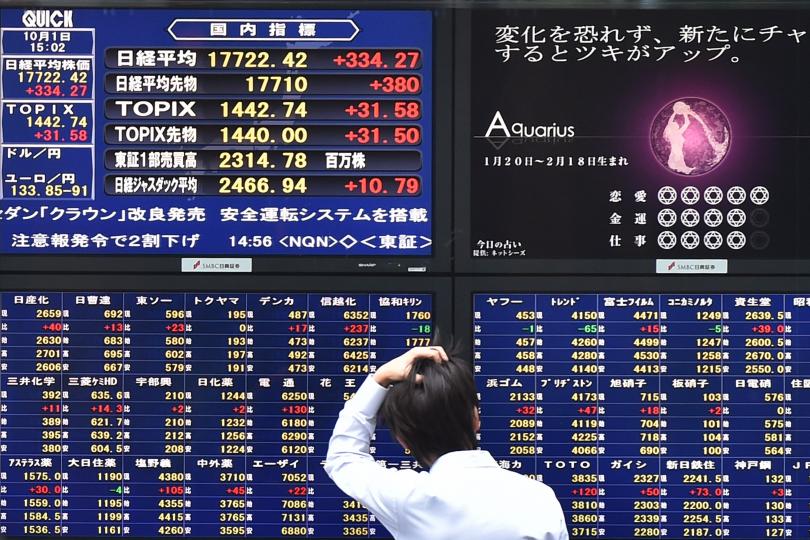
Japanese shares fell in cautious trade, dragged down by technology stocks. The Nikkei 225 Index slid 111.87 points or 0.5 percent to finish at 22,707.16 and the broader Topix Index closed 0.5 percent lower at 1,786.87.
Kobe Steel, Panasonic, Advantest and Fanuc lost 1-2 percent, while Canon edged up 0.2 percent and Sony added 1.4 percent. Retailers J. Front Retailing and Takashimaya gained around 1.7 percent each after reporting strong monthly sales in November.
SoftBank lost 1.1 percent after saying it has paid a total of 1.7 billion yen, or $15.2 million, in back taxes after underreporting its income by 6.2 billion yen over the three years through March of 2015.
Japanese consumer confidence improved as expected in November to the highest level in more than four years, survey data from the Cabinet Office showed today. The consumer confidence index climbed to 44.9 from 44.5 in the previous month.
Australian shares recovered from early losses to end roughly flat as gains in the material sector offset declines among financials. The benchmark S&P/ASX 200 Index edged down 4.17 points or 0.1 percent to finish at 5,985.60, while the broader All Ordinaries Index ended about 5 points lower at 6,070.60.
Strong base metal prices helped lift mining stocks, with BHP Billiton, Fortescue Metals Group and South32 closing up between 1.5 percent and 1.6 percent. Rio Tinto advanced 1.2 percent after appointing Simon Thompson as its new chairman.
Banks ANZ and Westpac fell around 1 percent amid the uncertainty surrounding the royal commission inquiry. Energy stocks posted modest gains after crude oil prices jumped on Friday.
Meanwhile, G8 Education shares plunged 23 percent after the childcare center operator slashed its earnings forecast for the 2017 financial year.
Economy
FrieslandCampina, Food Concepts Weaken NASD OTC Exchange by 0.57%
By Adedapo Adesanya
The duo of FrieslandCampina Wamco Nigeria Plc and Food Concepts Plc weakened the NASD Over-the-Counter (OTC) Securities Exchange by 0.57 per cent on Thursday, November 13.
FrieslandCampina Wamco Plc dropped N5.95 to N54.00 per share from N59.95 per share and Food Concepts lost 3 Kobo to end at N3.50 per unit compared with the previous day’s N3.53 per unit.
In the ensuing melee, the market capitalisation lost N12.42 billion in value to close at N2.180 trillion compared with the N2.193 trillion it finished a day earlier, and the NASD Unlisted Security Index (NSI) went down by 20.75 points to 3,644.61 points from 3,665.36 points.
Yesterday, the volume of securities traded by investors plunged by 99.5 per cent to 119,329 units from the previous day’s 22.1 million units, the value of securities slumped by 99.9 per cent to N1.9 million from N1.3 billion, and the number of deals depreciated by 26.3 per cent to 14 deals from 19 deals.
At the close of transactions, Infrastructure Credit Guarantee Company (InfraCredit) Plc remained the most traded stock by value with a year-to-date sale of 5.8 billion units valued at N16.4 billion, followed by Okitipupa Plc with 170.3 million units transacted for N8.0 billion, and Air Liquide Plc with 507.4 million units worth N4.2 billion.
InfraCredit Plc was also the most traded stock by volume on a year-to-date basis with 5.8 billion units traded for N16.4 billion, trailed by Industrial and General Insurance (IGI) Plc with 1.2 billion units sold for N419.7 million, and Impresit Bakolori Plc with the sale of 536.9 million units for N524.9 million.
Economy
Naira Appreciates to N1,441/$1 as FX Pressure Eases
By Adedapo Adesanya
Recent foreign exchange (FX) pressure on the Naira eased on Thursday as its against the US Dollar closed stronger in the Nigerian Autonomous Foreign Exchange Market (NAFEM) by N1.64 or 0.11 per cent to N1,441.44/$1 from the N1,443.08/$1 it was exchanged a day earlier.
Equally, the Nigerian Naira improved its value against the Pound Sterling in the official market by N2.44 to sell for N1,898.96/£1 versus the previous day’s N1,901.40/£1. However, it depreciated against the Euro by 99 Kobo to close at N1,674.96/€1, in contrast to Wednesday’s closing price of N1,673.97/€1.
At the GTBank forex counter, the domestic depreciated against the Dollar yesterday by N3 to settle at N1,450/$1 versus the preceding session’s rate of N1,447/$1, and in the black market, the exchange rate of the Naira to the Dollar remained unchanged at N1,455/$1.
The local currency is trying to claw back some losses recorded this week as unmet demand from thin US dollar supply has invited pressure across key segments.
However, positive signals like Nigeria’s gross external reserves rising by more than $30 million day on day to close at $43.427 billion as of November 11, 2025, gives the Central Bank of Nigeria (CBN) enough power to make significant intervention.
In recent weeks, the apex bank FX injection has been minimal and erratic due to increasing FX inflows from foreign portfolio investors and exporters. FX inflow into currency market has fallen from peaked of $1.37 billion to $899 million.
In the cryptocurrency market, there were significant declines on Thursday as short and long-term investors liquidated their positions. More than $1 billion in leveraged crypto positions were wiped out over 24 hours, with roughly $887 million coming from longs.
Ethereum (ETH) slumped by 10.9 per cent to $3,160.25, Solana (SOL) went south by 10.3 per cent to $140.65, Cardano (ADA) depreciated by 9.6 per cent to $0.5146, Ripple (XRP) fell by 9.2 per cent to $2.27, Dogecoin (DOGE) slipped by 8.2 per cent to $0.1620, Bitcoin (BTC) dropped 6.9 per cent to $96,351.91, Binance Coin (BNB) shrank by 6.1 per cent to $909.83, and Litecoin (LTC) went down by 5.4 per cent to $95.57, while the US Dollar Tether (USDT) and the US Dollar Coin (USDC) remained unchanged at $1.00 apiece.
Economy
Oil Rises Amid Global Oversupply Concerns, Lukoil Sanctions
By Adedapo Adesanya
Oil gained on Thursday as investors weighed concerns about global oversupply with looming sanctions against Russia’s Lukoil.
The price of the Brent crude grade chalked up 30 cents or 0.5 per cent to $63.01 a barrel, and the US West Texas Intermediate (WTI) crude increased by 20 cents or 0.3 per cent to $58.69 a barrel.
The US has imposed sanctions on Lukoil as part of its efforts to bring the Russian government to peace talks with Ukraine. The sanctions prohibit transactions with the Russian company after November 21.
According to JPMorgan, nearly a third of Russia’s current seaborne oil export potential is now stuck in tankers as the US sanctions upend crude flows and Russia’s top buyers, China and India, are still struggling to assess the implications of the sanctions.
“Russia’s oil exports are entering a new phase of disruption as sanctions targeting Rosneft and Lukoil are set to take effect, prompting its two largest customers — India and China — to sharply reduce their December purchases,” the Wall Street bank said in a note.
JPMorgan estimates that as many as 1.4 million barrels per day of Russian crude oil or nearly a third of its exporting potential are on tankers at present, amid re-routing and slowed unloading as buyers are hesitant following the US sanctions on Russia’s top oil producers and exporters, Rosneft and Lukoil.
Also, the US Energy Information Administration (EIA) showed a larger-than-expected rise in US crude stocks, while gasoline and distillate inventories fell less than expected last week. Crude inventories rose by 6.4 million barrels to 427.6 million barrels in the week ended November 7, the EIA said.
The Organisation of the Petroleum Exporting Countries (OPEC) said global oil supplies would slightly exceed demand in 2026, a further shift from the group’s earlier projections of a deficit.
It also said it expected the supply surplus next year because of wider production increases by OPEC+, a group of producers that includes OPEC members and allies like Russia.
The International Energy Agency (EIA) raised its global oil supply growth forecasts for this year and next in its monthly oil market report on Thursday, signaling a bigger surplus in 2026.
The US EIA also said in its Short-Term Energy Outlook on Wednesday that U.S. oil production is expected to set a larger record this year than previously forecast.
Global oil inventories will grow through 2026 as production increases faster than demand for petroleum fuels, adding to pressure on oil prices, the EIA added.
-
Feature/OPED6 years agoDavos was Different this year
-
Travel/Tourism9 years ago
Lagos Seals Western Lodge Hotel In Ikorodu
-
Showbiz3 years agoEstranged Lover Releases Videos of Empress Njamah Bathing
-
Banking7 years agoSort Codes of GTBank Branches in Nigeria
-
Economy2 years agoSubsidy Removal: CNG at N130 Per Litre Cheaper Than Petrol—IPMAN
-
Banking3 years agoFirst Bank Announces Planned Downtime
-
Sports3 years agoHighest Paid Nigerian Footballer – How Much Do Nigerian Footballers Earn
-
Banking3 years agoSort Codes of UBA Branches in Nigeria