Economy
Cardoso Sees End to Naira Volatility
By Adedapo Adesanya
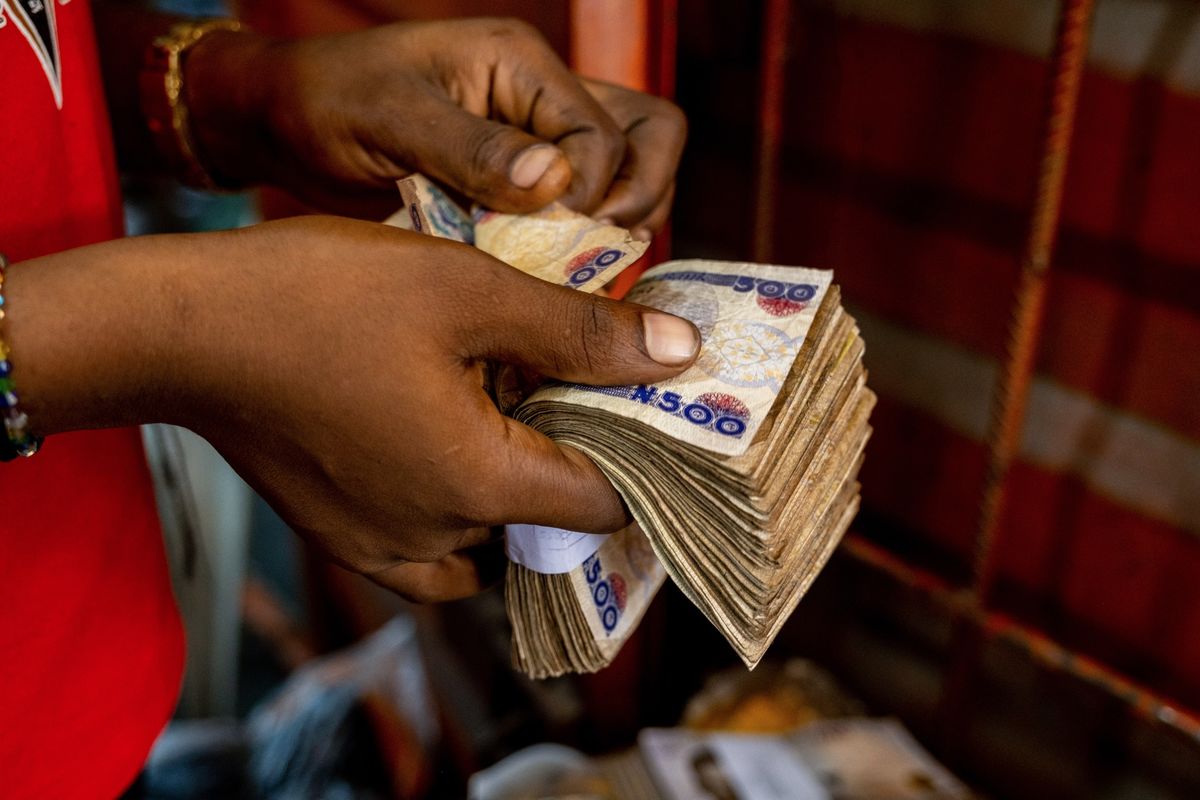
The Governor of the Central Bank of Nigeria (CBN), Mr Yemi Cardoso, believes the excessive volatility witnessed by the Naira in the foreign exchange (FX) market may be over based on recent reforms and continued intervention in the market.
Speaking in his latest interview with Bloomberg TV on Tuesday, the CBN governor said, “I do believe that we have more or less seen the worst in terms of volatility.”
The Naira has seen high volatility this year with the local currency going from being the best-performing currency in the world in March to facing serious headwinds in the last two months.
“We are also very alive to observing the way and manner in which that market operates and ensuring that it gives the best value that can be accomplished using certain tools,” he further said.
However, Mr Cardoso claims that his administration, which commenced in September 2023, had witnessed some development, noting that, “We’re relatively pleased with where we are.”
He stated that the central bank was not resting on its oars, adding that it would do more, saying, “It’s a continuous work in progress and we will do everything possible to ensure that we continue to manage the macroeconomic fundamentals that affect that.”
Under Mr Cardoso, the interest rates have been increased by 750 basis points this year to 26.25 per cent as part of efforts to tackle a 28-year high inflation near 34 per cent in the country.
He noted that the possibility of easing rate hikes was slim, adding that the Monetary Policy Committee (MPC) was set to use instruments available to it to tackle inflation.
“Data will direct whether they see further hikes or not,” he said.
“The MPC has been very clear in stating that they see inflation as a major impediment for the future of Nigeria, and they will do everything possible to ensure that they keep inflation in check and bring it down as reasonably as they can and I don’t see that changing,” he added.
The CBN governor also told Bloomberg TV that the apex bank would support further measures to build the country’s reserves including issuing a Eurobond and others.
“We should have a diversity of sources,” Mr Cardoso said. “It shouldn’t just be the Eurobond market, it shouldn’t just be foreign portfolio investors, it should be a hodgepodge of different things.”
Economy
Naira Strengthens to N1,343/$1 on Improved FX Liquidity
By Adedapo Adesanya
The Naira continued its appreciation against the Dollar in the Nigerian Autonomous Foreign Exchange Market (NAFEX) on Tuesday, April 14, by N12.42 or 0.92 per cent to close at N1,343.77/$1 compared with the preceding day’s N1,356.19/$1.
In the same vein, the local currency gained 58 Kobo against the Pound Sterling in the spot market during the session to settle at N1,824.57/£1 versus Monday’s closing value of N1,825.15/£1, and appreciated against the Euro by N2.18 to N1,585.51/€1 from N1,587.69/€1.
Similarly, the Naira strengthened its value against the US Dollar at the GTBank forex counter yesterday by N2 to quote at N1,371/$1, in contrast to the previous session’s N1,373/$1, and at the black market, it improved by N5 to trade at N1,380/$1 compared with the N1,385/$1 it was transacted a day earlier.
Interbank liquidity increased sharply to N141.315 million across 175 deals, according to the FX update published by the Central Bank of Nigeria (CBN), a 260 per cent surge from N38.256 million the previous day.
High FX inflows, boosted by foreign portfolio investors’ funds channelled into OMO bills, increased demand for Naira.
Credit rating agency, Fitch, projected that Nigeria’s FX reserves may fall to $47 billion over mounting fiscal pressures, predicting that Nigeria’s budget deficit could widen to nearly five per cent of Gross Domestic Product (GDP).
The forecast comes amid continued reforms by the central bank aimed at stabilising the FX market, including measures to ease restrictions on the repatriation of oil export proceeds by international oil companies.
According to Fitch, these reforms have supported a “gradual normalisation” of the FX market and improved investor confidence, although structural weaknesses continue to weigh on the economy.
As for the cryptocurrency market, profit-taking by investors occurred amid signals of renewed US-Iran talks and growing expectations of Federal Reserve rate cuts later this year, which are projected to add liquidity and support risk assets, including digital currencies.
Optimism that the US and Iran will enter a second round of talks in the coming days has kept crude oil below $100 a barrel, easing the inflationary overhang that weighed on markets through March.
Solana (SOL) slumped by 3.1 per cent to $83.03, Ethereum (ETH) declined by 1.8 per cent to $2,318.70, Cardano (ADA) fell by 1.1 per cent to $0.2393, Ripple (XRP) dropped 0.7 per cent to $1.35, and Bitcoin (BTC) depreciated by 0.5 per cent to $74,019.75.
However, TRON (TRX) appreciated by 0.6 per cent to $0.3232, Dogecoin (DOGE) added 0.3 per cent to trade at $0.0933, and Binance Coin (BNB) rose by 0.1 per cent to $613.93, while the US Dollar Tether (USDT) and the US Dollar Coin (USDC) traded flat at $1.00 each.
Economy
Nigeria’s Stock Exchange Year-to-Date Gain Now 32.27% After 0.67% Rise
By Dipo Olowookere
The bulls consolidated their dominance on the Nigerian Exchange (NGX) Limited on Tuesday after closing higher by 0.67 per cent, stretching the year-to-date return to 32.27 per cent.
It was observed that the key sectors of Nigeria’s stock exchange witnessed buying pressure, with the energy space expanding by 4.35 per cent, the banking index growing by 1.97 per cent, the industrial goods counter rising by 0.71 per cent, the insurance segment increasing by 0.65 per cent, and the consumer goods landscape up by 0.14 per cent.
Consequently, the All-Share Index (ASI) advanced by 1,372.52 points to 205,831.38 points from 204,458.86 points, and the market capitalisation chalked up N883 billion to close at N132.492 trillion compared with Monday’s N131.609 trillion.
There were 40 price gainers and 20 price losers yesterday, indicating a positive market breadth index and bullish investor sentiment.
Stanbic IBTC appreciated by 10.00 per cent to N161.70, Ecobank gained 10.00 per cent to sell for N50.60, NGX Group improved by 9.97 per cent to N168.75, Cornerstone Insurance added 9.94 per cent to quote at N5.64, and Mecure soared by 9.92 per cent to N67.60.
On the flip side, Fortis Global Insurance lost 8.20 per cent to trade at N1.12, McNichols depreciated by 8.17 per cent to N6.52, Academy Press slipped by 6.96 per cent to N7.35, International Energy Insurance dipped by 6.88 per cent to N3.25, and Guinea Insurance contracted by 5.83 per cent to N1.13.
During the session, market participants transacted 569.3 million shares valued at N32.3 billion in 45,777 deals versus the 470.0 million shares worth N32.5 billion traded in 60,793 deals the previous session, implying a jump in the trading volume by 21.13 per cent, and a slip in the trading value and number of deals by 0.62 per cent and 24.70 per cent, respectively.
The most active stock for the day remained Access Holdings with 67.5 million units sold for N1.8 billion, Zenith Bank traded 39.7 million units worth N4.5 billion, VFD Group transacted 37.6 million units valued at N423.0 million, GTCO exchanged 30.6 million units for N3.8 billion, and Lasaco Assurance transacted 26.3 million units worth N52.6 million.
Economy
Brent, WTI Falls on Hopes of Advanced US, Iran Talks
By Adedapo Adesanya
Crude prices dropped on Tuesday on hopes Iran will resume talks with the US and Israel to end the conflict that has shut the Strait of Hormuz.
Brent crude futures settled at $94.79 a barrel after losing $4.57 or 4.6 per cent, and the US West Texas Intermediate crude finished at $91.20 per barrel after it shed $7.80 or 7.87 per cent.
Talk of a resumption in US-Iran discussions put downward pressure on prices, ignoring the loss of physical barrels of oil that are not moving.
Reuters reported that negotiating teams from the US and Iran could return to Islamabad, Pakistan, this week amid continued engagement on trying to achieve an agreement.
The International Energy Agency said in its monthly report that attacks on energy infrastructure in the Middle East and Iran’s effective closure of the Strait of Hormuz have led to the largest oil supply disruption in history. It said over 10 million barrels per day were lost in March.
The IEA said resuming flows through the Strait of Hormuz remains the single most important variable in easing the pressure on energy supplies, prices and the global economy. The waterway is used for transporting crude and refined products, largely to Asia.
The IEA sharply cut its forecasts for global oil supply and demand growth, with the demand growth forecast for 2026 trimmed by 80,000 barrels per day and supply now expected to decline by 1.5 million barrels per day.
The US military said on Monday that its blockade of the Strait of Hormuz would extend east to the Gulf of Oman and the Arabian Sea. With two ships reportedly turned around in the strait as the blockade started. However, three Iran-linked tankers entered the Gulf and were allowed to pass because their destinations were not Iranian ports.
Iran threatened to respond to the blockade by attacking ports in nations bordering the Gulf.
Before the outbreak of the US-Iran war in late February, around 130 vessels transited the Strait daily. Traffic has since slowed to a trickle, and ships must now navigate both US naval oversight and Iranian directives.
The American Petroleum Institute (API) estimated that crude oil inventories in the US rose 6.10 million barrels in the week ending April 10. In the week prior, US crude oil inventories rose by 3.719 million barrels. Official data from the Energy Information Administration (EIA) will be released later on Wednesday.
-
Feature/OPED6 years agoDavos was Different this year
-
Travel/Tourism10 years ago
Lagos Seals Western Lodge Hotel In Ikorodu
-
Showbiz3 years agoEstranged Lover Releases Videos of Empress Njamah Bathing
-
Banking8 years agoSort Codes of GTBank Branches in Nigeria
-
Economy3 years agoSubsidy Removal: CNG at N130 Per Litre Cheaper Than Petrol—IPMAN
-
Banking3 years agoSort Codes of UBA Branches in Nigeria
-
Banking3 years agoFirst Bank Announces Planned Downtime
-
Sports3 years agoHighest Paid Nigerian Footballer – How Much Do Nigerian Footballers Earn