Economy
CBN to Sanction Banks Issuing Bad Naira Notes via ATM
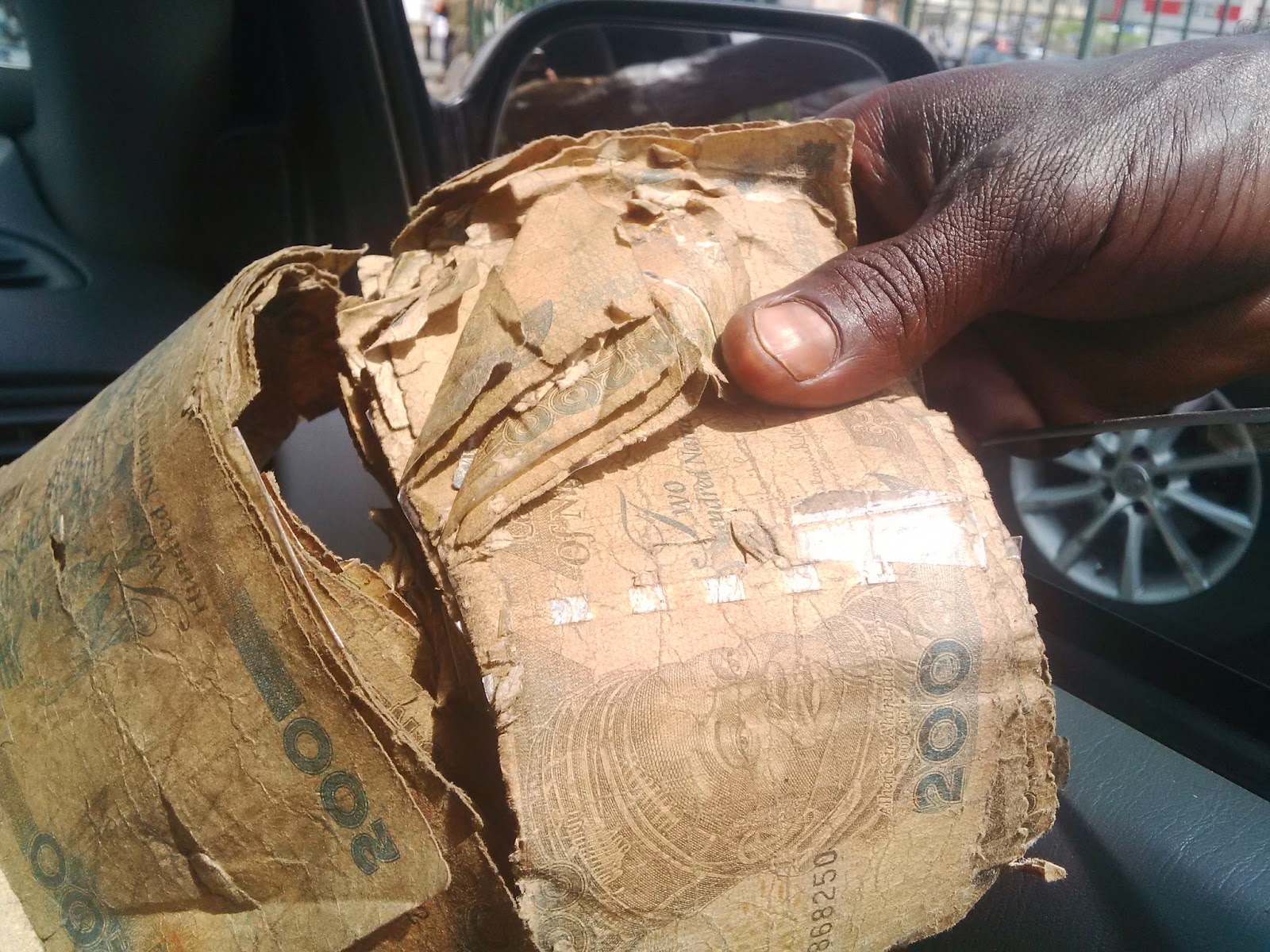
The Central Bank of Nigeria (CBN) has told bank operating in the country to continue to accept mutilated Naira notes from members of the public.
This information was stated in the Clean Note Policy recently released by the apex bank.
The CBN described a mutilated Naira as a “poor quality banknote that requires a special examination to determine its value.
“The note could be partially/permanently damaged by fire, water, dye, insects, rodents, or destroyed by natural disasters.
“The Central Bank of Nigeria and deposit money banks (DMBs) shall continue to receive mutilated notes from the public.
“The procedures for the treatment of mutilated notes and the notes for exchange are as enshrined in the Central Bank Operational Manual for the Operation of Mutilated Notes.
“The manual provides uniform guidelines for receiving, processing and replacement of mutilated notes in the Bank.”
The CBN said a currency can be considered mutilated when “torn parts of the banknote are re-joined with adhesive tape in a manner which tries to preserve as nearly as possible the original design and size of the note.
“The original size of the note has been reduced/lost through wear/tear or has been damaged by fire, rodents, insects, chemicals, defaced or perforated through other causes.
“It is scorched or burnt to such an extent that although recognisable as such, it has become frail and brittle as to render further handling impossible.
“More than half of the original size of the banknote is missing.”
The apex bank said to ensure that the banknotes in circulation are clean and of good quality, DMBs shall ensure that they process their banknotes using registered processing companies and classify them into fit and unfit.
“Any counterfeit notes discovered are to be returned to CBN. Only the banknotes which have been authenticated (i.e. verified free from counterfeit and unfit notes according to CBN standard) will be issued over the counter by banks or through their cash dispensing machines.
“Unfit banknotes shall not be re-circulated by DMBs and CPCs. However, a penal charge of N12,000 per box, or any amount determined by the management of the bank, shall apply for the deposit of unsorted banknotes. In addition, penalties as may be determined by the Bank, shall apply for the recirculation of unfit banknotes,” it said.
In the same document, the CBN advised banks not to load their Automated Teller Machines (ATMs) with unfit banknotes, warning that those who contravene this directive would be punished.
“The [apex] bank shall ensure that the Automated Teller Machines (ATMs) deployed by DMBs and other service providers are configured to dispense and accept only genuine banknotes in all denominations.
“The ATMs shall dispense notes that have been duly checked for authenticity and fitness according to the [central] bank’s standard and operators whose ATMs contravene this provision shall be sanctioned in line with the existing guideline,” it said.
The central bank explained that it came up with this Clean Note Policy to ensure that the banknotes in circulation were clean and of high quality.
It noted that, “The policy will however, remain open for future amendments in tandem with emerging currency management issues.”
Economy
Unlisted Securities Close Flat at Midweek
By Adedapo Adesanya
The NASD Over-the-Counter (OTC) Securities Exchange closed flat on Wednesday, August 5, as the market witnessed weaker trading activity with only two deals executed.
In the midweek session, the volume of securities exchanged by investors dropped 99.9 per cent to 802 units from the 1.6 million units recorded on Tuesday. The value of securities further decreased by 99.6 per cent to N208,240 from the preceding session’s N47.6 million, and the number of deals significantly went down by 93.9 per cent to two deals from the 33 deals recorded a day earlier.
Great Nigeria Insurance (GNI) Plc remained the most traded stock by value on a year-to-date basis, with 3.4 billion units worth N8.4 billion, followed by Infrastructure Credit Guarantee (Infracredit) Plc with 2.3 billion units sold for N6.5 billion, and Central Securities Clearing System (CSCS) Plc with 76.9 million units transacted for N5.5 billion.
GNI Plc was also the most active stock by volume on a year-to-date basis, with 3.4 billion units exchanged for N8.4 billion, followed by Infracredit Plc with 2.3 billion units traded for N6.5 billion, and Resourcery Plc with 1.1 billion units valued at N415.7 million.
There were no price gainers or losers yesterday.
As a result, the market capitalisation stood unmoving at N2.739 trillion, while the NASD Security Index (NSI) remained unchanged at 4,563.96 points.
Economy
Naira Crashes to N1,363/$1 at Official Market
By Adedapo Adesanya
The Naira slid against the US Dollar by N2.28 or 0.17 per cent in the Nigerian Autonomous Foreign Exchange Market (NAFEX) on Wednesday, August 5, to N1,363.85/$1 from N1,362.55/$1.
The local currency also declined against the Pound Sterling in the official market during the session by N5.97 to close at N1,837.38/£1 compared with Tuesday’s closing rate of N1,831.41/£1, and against the Euro, it crashed by N6.54 to quote at N1,575.25/€1 versus the preceding session’s N1,568.71/€1.
But at the black market, the Nigerian Naira traded flat against the greenback yesterday at N1,400/$1, and also remained unchanged at the GTBank FX desk at N1,373/$1.
The Central Bank of Nigeria (CBN) says rates have narrowed to below two per cent, while the country’s external reserves have risen above $52.5 billion, reflecting the impact of its ongoing monetary and foreign exchange reforms.
CBN Governor Yemi Cardoso, represented by the Acting Director of Corporate Communications and Investor Relations, Mrs Hakama Sidi-Ali, disclosed this on Tuesday during the CBN Fair in Gombe. He noted that reforms introduced since 2023 had significantly reduced the disparity between the official FX market and the parallel market.
“The Naira continues to strengthen, with the spread between official and Bureau de Change rates now below two per cent,” he said, adding that reserves at $52.5 billion were supported by sustained inflows and renewed investor confidence in the economy.
Interbank FX transactions slid as weaker market activities dropped total Dollar volume exchanged to $75.35 million, a 51.8 per cent decline from $156.23 million in turnover quoted at the previous close.
The deals at the NFEM window also fell as data from the central bank put Wednesday’s quote at 82 from 139.
In the cryptocurrency market, major were down as global risk sentiment softened as a key world equity index slipped and chipmakers fell.
The MSCI All Country World Index snapped a five-day run to fall 0.2 per cent as chipmakers retreated on both sides of the Pacific. South Korea’s Kospi, a bellwether for the AI trade, dropped 4.4 per cent.
Ripple (XRP) depleted by 1.7 per cent to $1.05, Binance Coin (BNB) decreased by 1.0 per cent to $594.87, Cardano (ADA) depreciated by 0.9 per cent to $0.1884, TRON (TRX) shrank by 0.2 per cent to $0.3261, Solana (SOL) crumbled by 0.1 per cent to $74.00, and Dogecoin (DOGE) went down by 0.1 per cent to $0.0697.
On the flip side, Ethereum (ETH) gained 2.3 per cent to trade at $1,911.41, and Bitcoin (BTC) rose by 0.8 per cent to $64,759.28, while the US Dollar Tether (USDT) and the US Dollar Coin (USDC) remained unchanged at $1.00 apiece.
Economy
Stock Exchange Gains N71bn on Renewed Bargain-hunting
By Dipo Olowookere
The domestic stock exchange rebounded by 0.05 per cent on Wednesday on the back of renewed bargain-hunting by investors, though the level of activity waned.
After bleeding for a few days, the Nigerian Exchange (NGX) Limited heaved a sigh of relief yesterday, as the All-Share Index (ASI) gained 109.41 points to close at 244,912.24 points compared with the previous day’s 244,802.83 points, and the market capitalisation garnered N71 billion to settle at N158.087 trillion versus Tuesday’s N158.016 trillion.
Business Post reports that despite the rebound recorded by Customs Street at midweek, the market breadth index remained negative, as there were 20 price advancers and 29 price decliners, implying bearish investor sentiment.
Linkage Assurance appreciated by 9.94 per cent to N1.77, AVA Capital rose by 9.55 per cent to N10.90, Fortis Global Insurance advanced by 7.69 per cent to N2.80, McNichols gained 7.34 per cent to finish at N5.85, and Coronation Insurance surged by 5.51 per cent to N2.49.
Conversely, Honeywell Flour depreciated by 9.94 per cent to N16.30, PZ Cussons gave up 9.94 per cent to trade at N74.75, Zichis crashed by 9.74 per cent to N20.76, Learn Africa slipped by 9.62 per cent to N9.40, and Neimeth tumbled by 8.33 per cent to N8.25.
The busiest equity was FCMB, with a turnover of 369.2 million units valued at N4.1 billion. Chams transacted 46.7 million units worth N201.8 million, First Holdco transacted 43.5 million units for N5.7 billion, Access Holdings sold 29.8 million units worth N778.0 million, and Linkage Assurance exchanged 19.6 million units valued at N33.5 million.
At the close of transactions, market participants bought and sold 824.1 million units worth N25.5 billion in 48,114 deals, in contrast to the 1.6 billion units sold for N28.7 billion in 54,160 deals a day earlier, showing a shortfall in the trading volume, value, and number of deals by 48.49 per cent, 11.15 per cent, and 11.16 per cent, respectively.