Economy
Compliance with Corporate Governance Code Very Low in Nigeria—SEC
By Dipo Olowookere
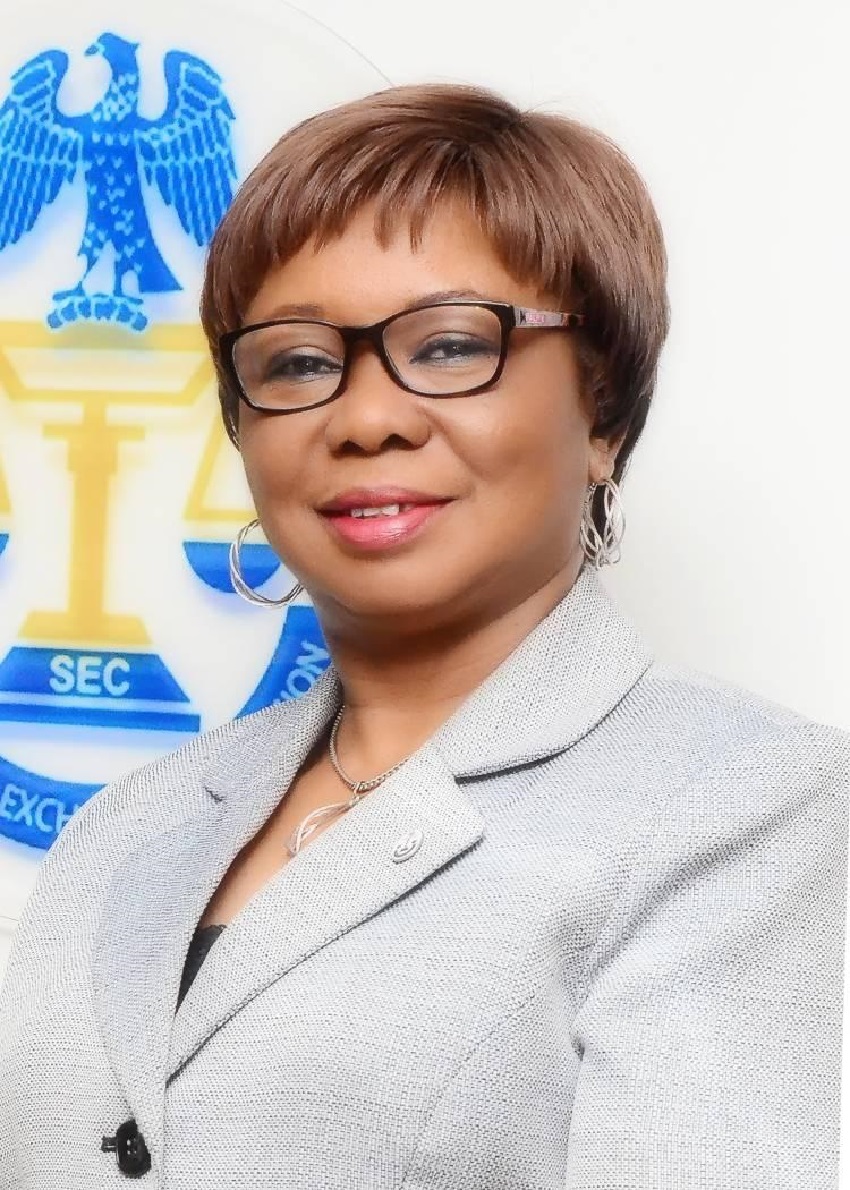
Acting Director General of Securities and Exchange Commission (SEC), Ms Mary Uduk, has lamented the low level of compliance with corporate governance code in Nigeria.
Speaking at a function in Lagos on Thursday, the SEC boss said some companies listed on the Nigerian Stock Exchange (NSE) lacked understanding of the SEC Code 2011, which talked about code of corporate governance for public companies in the country.
According to SEC Code 2011, the rules were not intended to be rigid, but to “be viewed and understood as a guide to facilitate sound corporate practices and behaviour.”
The code stipulated that the Board is accountable and responsible for the performance and affairs of the company and should define its strategic goals and ensure that its human and financial resources are effectively deployed towards attaining those goals.
Also, the board was mandated to ensure that the company was properly managed, overseeing the effective performance of the management in order to protect and enhance shareholder value and to meet the company’s obligations to its employees and other stakeholders.
But Ms Uduk said some boards were not performing these and other roles expected of them by the corporate governance code.
“We observed that most of the issues covered in the SEC Code 2011 have remained difficult for some entities to observe in terms of fairness, independence, accountability and transparency requirements by their boards.
“The Code of corporate governance talks about how companies are run and managed.
“Looking at the scorecard as a follow up to the code, we have been able to see areas of weaknesses and strength across companies and these areas are very germane to having strong corporate governance.
“For example, the Boards are expected to have a deep understanding of the business and the environment to which the business is run.
“They are supposed to understand the blueprint, they are supposed to speak out, they are supposed to be innovative and they are supposed to have a little bit of financial experience so they could be able to interpret financial statements,” Ms Uduk said at the Alliance Law Firm’s Maiden Lecture Series, Luncheon and Book Presentation.
At the lecture themed ‘Contemporary Corporate Governance Issues in Nigeria,’ the SEC DG, who was represented by a Director at the agency, Mr Edward Okolo, pointed out that access to critical indices by which companies’ compliance with the SEC Code could be measured remained difficult.
She stressed that experiences globally have demonstrated that enterprises with commitment to corporate governance principles perform better and have continued to enjoy investors and other stakeholders’ confidence in building their brands.
Ms Uduk urged publicly listed companies to do more to strengthen their boards so as to have better corporate governance system.
Business Post reports that the SEC Code 2011 stipulates that The CEO/MD should be knowledgeable in relevant areas of the company’s activities. He should demonstrate industry, credibility and integrity and should have the confidence of the Board and management.
Also, executive directors should be involved in the day-to-day operations and management of the company. In particular, they should be responsible for the departments they head and should be answerable to the Board through the CEO/MD.
Furthermore, non-executive directors are expected to be key members of the Board. They should bring independent judgment as well as necessary scrutiny to the proposals and actions of the management and executive directors especially on issues of strategy, performance evaluation and key appointments.
For independent directors, they should have no significant contractual relationship with the company or group and must be free from any business or other relationship which could materially interfere with their capacity to act in an independent manner and “every public company should have a minimum of one independent director on its Board.”
Economy
FrieslandCampina Wamco, Three Others Raise NASD OTC Exchange by 1.41%
By Adedapo Adesanya
The NASD Over-the-Counter (OTC) Securities Exchange closed higher by 1.41 per cent on Friday, May 15, supported by four securities on the platform.
During the session, FrieslandCampina Wamco Plc added N14.24 to its share price to sell for N159.00 per unit, in contrast to the previous day’s N144.76 per unit.
Further, Central Securities and Clearing System (CSCS) Plc appreciated by N1.34 to N72.34 per share from N71.00 per share, Geo-Fluids Plc improved its price by 4 Kobo to N2.94 per unit from N2.90 per unit, and Industrial and General Insurance (IGI) Plc gained 1 Kobo to trade at 61 Kobo per share compared with Thursday’s closing price of 60 Kobo per share.
As a result, the NASD Unlisted Security Index (NSI) rose by 58.20 points to 4,188.41 points from 4,130.21 points, and the market capitalisation soared by N34.82 billion to N2.506 trillion from N2.471 trillion on Thursday.
During the session, the volume of trades went up by 180.8 per cent to 1.2 million units from 417,349 units, and the value of transactions increased by 29.8 per cent to N29.8 million from N23.2 million, while the number of deals fell by 22.6 per cent to 24 deals from 31 deals.
Great Nigeria Insurance (GNI) Plc ended the day as the most traded stock by value on a year-to-date basis with 3.4 billion units sold for N8.4 billion, followed by CSCS Plc with 60.8 million units exchanged for N4.1 billion, and Okitipupa Plc with 27.9 million units valued at N1.9 billion.
GNI Plc also closed the session as the most traded stock by volume on a year-to-date basis with 3.4 billion units worth N8.4 billion, followed by Resourcery Plc with 1.1 billion units transacted for N415.7 million, and Infrastructure Guarantee Credit Plc with 400 million units traded for N1.2 billion.
Economy
Profit-taking Sinks Nigeria’s Equity Market by 0.76% as Bears Take Control
By Dipo Olowookere
The bears overpowered the Nigerian Exchange (NGX) Limited on Friday, sinking it further by 0.76 per cent when the closing gong was struck by 4 pm.
The nation’s flagship equity market was under selling pressure during the session, as investors booked profits after the shares witnessed price appreciation in the past trading sessions.
The energy sector was the most impacted, as it shed 4.43 per cent. The consumer goods index declined by 0.90 per cent, the banking counter decreased by 0.15 per cent, and the industrial goods sector lost 0.08 per cent, while the insurance counter gained 2.42 per cent, which was not enough to salvage the situation.
Consequently, the All-Share Index (ASI) contracted by 1,912.19 points to 250,330.92 points from 252,243.11 points, and the market capitalisation moderated by 1.225 trillion to N160.444 trillion from N161.669 trillion.
Zichis was the worst-performing stock for the session after it gave up 9.97 per cent to close at N29.43, FTN Cocoa slipped by 9.95 per cent to N8.96, The Initiates slumped by 9.90 per cent to N32.30, LivingTrust Mortgage Bank tumbled by 9.88 per cent to N3.83, and International Energy Insurance dropped 9.71 per cent to trade at N2.79.
The best-performing stock was ABC Transport, which grew by 10.00 per cent to N6.27. May and Baker also appreciated by 10.00 per cent to N47.30, SCOA Nigeria surged by 9.98 per cent to N33.05, Trans-Nationwide Express expanded by 9.97 per cent to N7.06, and DAAR Communications jumped 9.76 per cent to N2.25.
Yesterday, investors traded 1.1 billion shares worth N44.3 billion in 65,744 deals compared with the 1.0 billion shares valued at N41.6 billion transacted in 74,822 deals a day earlier. This indicated a dip in the number of deals by 12.13 per cent, and a rise in the trading volume and value by 10.00 per cent and 6.49 per cent, respectively.
Chams was the busiest equity for the day, with 328.5 million units sold for N1.1 billion. UBA traded 61.6 million units worth N2.7 billion, First Holdco transacted 58.7 million units valued at N4.2 billion, Secure Electronic Technology exchanged 51.9 million units worth N45.0 million, and Access Holdings traded 51.8 million units valued at N1.3 billion.
Economy
Naira Weakens to N1,371/$1 at Official Market
By Adedapo Adesanya
The last trading session of the week at the Nigerian Autonomous Foreign Exchange Market (NAFEX) ended on a negative note for the Naira on Friday, May 15, as it lost N15 Kobo or 0.1 per cent against the Dollar to trade at N1,371.04/$1 compared with the previous day’s N1,370.89/$1.
However, it further appreciated against the Pound Sterling in the same market segment yesterday by N20.77 to close at N1,830.61/£1 versus Thursday’s value of N1,851.38/£1, and gained N7.91 against the Euro to settle at N1,595.07/€1 versus N1,602.98/€1.
At the GTBank FX desk, the Naira lost N2 against the US Dollar during the session to sell at N1,383/$1 compared with the preceding session’s N1,381/$1, and at the black market, it remained unchanged at N1,385/$1.
The Naira is forecast to be broadly stable, supported by Dollar sales by the Central Bank of Nigeria (CBN) amid steady, higher oil receipts, with the market settling into a balance.
Policy direction is also expected to give the market some boost as the CBN said the new edition of the FX market guidelines will deepen liquidity, improve transparency and strengthen confidence in the country’s foreign exchange market.
According to the Governor of the CBN, Mr Yemi Cardoso, the update is due to changing global economic realities, domestic reforms and the need for a more coherent and forward-looking regulatory framework. According to him, the last edition of the FX manual was issued in 2018, making the latest review both timely and necessary.
Meanwhile, the cryptocurrency market plunged into the red zone as rising bond yields hit risk assets across markets, while traders are increasingly betting the Federal Reserve may need to raise rates again. Rising energy prices and resurging inflation could force central banks back into tightening mode.
Cardano (ADA) shrank by 4.4 per cent to $0.2557, Dogecoin (DOGE) slid by 3.7 per cent to $0.1104, Ripple (XRP) depreciated by 3.5 per cent to $1.41, Solana (SOL) crashed by 3.5 per cent to $87.81, and Binance Coin (BNB) slumped by 3.4 per cent to $659.64.
Further, Bitcoin (BTC) declined by 2.6 per cent to $78,547.49, Ethereum (ETH) lost 2.1 per cent to quote at $2,209.19, and TRON (TRX) tumbled by 0.7 per cent to $0.3509, while the US Dollar Tether (USDT) and the US Dollar Coin (USDC) traded flat at $1.00 each.
-
Feature/OPED6 years agoDavos was Different this year
-
Travel/Tourism10 years ago
Lagos Seals Western Lodge Hotel In Ikorodu
-
Showbiz3 years agoEstranged Lover Releases Videos of Empress Njamah Bathing
-
Banking8 years agoSort Codes of GTBank Branches in Nigeria
-
Economy3 years agoSubsidy Removal: CNG at N130 Per Litre Cheaper Than Petrol—IPMAN
-
Banking3 years agoSort Codes of UBA Branches in Nigeria
-
Banking3 years agoFirst Bank Announces Planned Downtime
-
Sports3 years agoHighest Paid Nigerian Footballer – How Much Do Nigerian Footballers Earn