Connect with us

Economy

CSCS, Afriland Push Unlisted Securities Index Higher by 0.34%

Published

on

unlisted securities index

By Adedapo Adesanya

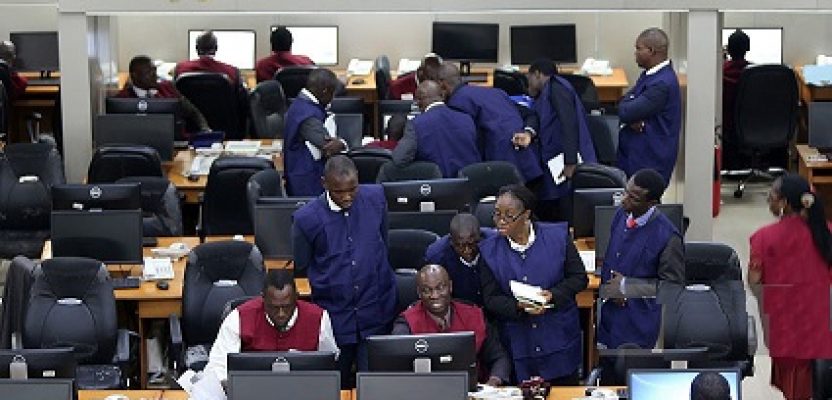
The unlisted securities index of the NASD Over-the-Counter (OTC) Securities Exchange continued its stay in the positive zone on Thursday, May 4 after it appreciated 0.34 per cent or 2.44 points to wrap the session at 726.12 points compared with 723.68 points in the previous session.

The improvement was driven by the upward movements in the share prices of two companies, which pressed down the loss reported by a price loser.

During the session, Central Securities Clearing System (CSCS) Plc gained 87 Kobo to trade at N13.20 per unit versus Wednesday’s N12.33 per unit, Afriland Properties Plc improved by 10 Kobo to quote at 2.40 per unit, in contrast to the preceding session’s N2.30 per unit, while FrieslandCampina Wamco Nigeria Plc depreciated by 57 Kobo to close at N73.97 per share as against the previous day’s closing price of N74.54 per share.

At the end of the trading session, the market capitalisation of the bourse moved up by N3.38 billion to settle at N1.004 trillion compared with the N1.001 trillion it finished a day earlier.

Business Post reports that the volume of securities traded at the bourse by investors increased by 47.7 per cent to 161,804 units from 109,552 units, the value of shares traded at the session ballooned by 5.7 per cent to N8.6 million from the N8.2 million posted on Wednesday, and the number of deals went up by 62.5 per cent to 13 deals from the eight deals executed in the midweek session.

Geo-Fluids Plc closed the day as the most traded stock by volume (year-to-date) with 820.8 million units worth N1.3 billion, IGI Plc stood in second place with 627.7 units valued at N49.4 million, while UBN Property Plc was in third place with 379.8 million units valued at N321.6 million.

VFD Group Plc ended the session as the most traded stock by value (year-to-date) with 10.4 million units valued at N2.4 billion, Geo-Fluids Plc has sold 820.8 million units worth N1.3 billion, and FrieslandCampina Wamco Nigeria Plc has exchanged 5.0 million units valued at N349.5 million.


Adedapo Adesanya is a journalist, polymath, and connoisseur of everything art. When he is not writing, he has his nose buried in one of the many books or articles he has bookmarked or simply listening to good music with a bottle of beer or wine. He supports the greatest club in the world, Manchester United F.C.

Economy

Stock Investors Recover N93bn after Previous Day’s Loss

Published

on

Attract Stock Investors

By Dipo Olowookere

The Nigerian Exchange (NGX) Limited returned to green territory on Tuesday after it chalked up 0.09 per cent on the back of renewed buying pressure.

The market regained strength yesterday despite profit-taking in the banking space, which caused its index to close lower by 0.69 per cent.

Business Post reports that insurance counter was up by 2.80 per cent, the energy sector appreciated by 2.40 per cent, the commodity segment grew by 1.22 per cent, and the consumer goods industry improved by 0.03 per cent, while the industrial goods counter closed flat.

At the close of transactions, the All-Share Index (ASI) went up by 144.32 points to 166,256.82 points from 166,112.50 points and the market capitalisation gained N93 billion to finish at N106.436 trillion compared with the N106.343 trillion it settled on Monday.

During the session, investors transacted 795.5 million equities valued at N20.0 billion in 45,410 deals versus the 629.6 million equities worth N14.8 billion executed in 57,858 deals a day earlier, indicating a rise in the trading volume and value by 26.35 per cent and 35.14 per cent apiece and a decline in the number of deals by 21.52 per cent.

Tantalizers was the busiest stock yesterday with a turnover of 87.0 million units valued at N300.9 million, Secure Electronic Technology traded 74.2 million units worth N87.6 million, a new member of the NGX, Zichis Agro Allied Industries, transacted 69.6 million units for N138.5 million, Zenith Bank sold 49.1 million units valued at N3.5 billion, and GTCO exchanged 39.1 million units worth N3.8 billion.

On Tuesday, the market breadth index was positive after Customs Street ended with 39 appreciating shares and 25 depreciating shares, representing a bullish investor sentiment.

Deap Capital, NPF Microfinance Bank, and Red Star Express gained 10.00 per cent each to sell for N5.39, N4.73, and N15.95 apiece, as NCR Nigeria soared by 9.97 per cent to N155.50, and Morison Industries also increased by 9.97 per cent to N6.84.

Conversely, Aluminium Extrusion lost 9.95 per cent to settle at N17.20, Jaiz Bank declined by 9.88 per cent to N7.21, FTN Cocoa shrank by 8.44 per cent to N7.05, UPDC decreased by 8.06 per cent to N5.70, and Caverton slumped by 5.59 per cent to N7.60.

Continue Reading

Economy

Kazakh Supply Disruptions, Positive Economic Data Buoy Oil Prices

Published

on

Kazakh Supply

By Adedapo Adesanya

Oil prices rose on Tuesday on the temporary suspension of output at Kazakhstan’s oil fields and expectations of firmer global economic growth that could drive fuel demand.

Brent futures chalked up 98 cents or 1.53 per cent to trade at $64.92 a barrel and the US West Texas Intermediate (WTI) crude contract for February, which expired on Tuesday, gained 90 cents or 1.51 per cent to close at $60.34 per barrel.

Kazakh oil producer Tengizchevroil said on Monday it had temporarily halted production at the Tengiz and Korolev oilfields after an issue affected power distribution systems.

The Chevron-operated joint venture operating the supergiant 700,000 barrels per day Tengiz field onshore Kazakhstan stated that it had suspended production as a “precautionary measure” after a fire broke out at the field’s power distribution systems.

Tengiz could be halted for another seven to 10 days, cutting crude exports via the Caspian Pipeline Consortium (CPC).

Market analysts noted that Tengiz is amongst the largest fields in the world and so the outage is certainly disruptive for crude flows.

The oil market also drew support from better-than-expected fourth-quarter Chinese gross domestic product data released on Monday as data showed that the economy of the world’s largest oil producer grew by 5 per cent last year and the country’s refinery throughput in 2025 climbed 4.1 per cent on a year-over-year basis, data showed on Monday. China’s crude oil output also grew 1.5 per cent.

Prices also gained on an upward revision of this year’s global economic growth estimate by the International Monetary Fund (IMF).

The IMF in its World Economic Outlook update forecast global GDP growth at 3.3 per cent in 2026, up ‌0.2 percentage point from its last estimate in October. That’s even with 3.3 per cent growth in 2025, which will also beat the October estimate by 0.1 percentage point.

The lender said that globally, inflation was forecast to continue to decline, ​from 4.1 per cent in 2025 to 3.8 per cent in 2026 and 3.4 per cent in 2027.

Investors continued to monitor US President Donald Trump’s tariff threats against European states that oppose his push to acquire Greenland.

The American president said he would impose additional 10 per cent levies from February 1 on goods imported from EU members Denmark, Finland, France, Germany, Sweden and the Netherlands, as well as Britain and Norway, rising to 25 per cent on June 1 if no deal on Greenland was reached.

President Trump’s tariff threats have a negative bearing on crude prices as the levies could lead to lower global economic growth and therefore reduce oil demand growth.

Continue Reading

Economy

Eyesan Targets Shut-in Barrels to Optimise Nigeria’s Oil Production

Published

on

oritsemeyiwa Eyesan nuprc

By Adedapo Adesanya

The chief executive of the Nigerian Upstream Petroleum Regulatory Commission (NUPRC), Mrs Oritsemeyiwa Eyesan, has identified the recovery of shut-in oil and gas volumes as a central strategy for optimising Nigeria’s upstream production and stabilising revenue.

She said the oil and gas sector remains critical to Nigeria’s economic stability, stressing that effective regulation must be anchored on a strong, efficiently run upstream industry.

According to Mrs Eyesan, the commission’s agenda for the sector under her leadership, is built on three core pillars, with production and revenue optimisation taking priority.

“Our agenda rests on optimising production and revenue by recovering shut-in volumes,” she said. Shut-in volumes refer to the amount of oil or gas that is currently capable of being produced but is not being extracted because the wells have been deliberately closed off.

The NUPRC head explained that unlocking idle production requires closer collaboration between regulators and operators, supported by transparent and accountable industry practices.

Mrs Eyesan added that regulatory efficiency is another key enabler of production optimisation, noting that speed and predictability in approvals are essential to sustaining upstream operations.

“We are focused on ensuring regulatory speed and predictability through clear rules and digital processes,” she said.

The NUPRC chief further said that optimising output must go hand-in-hand with safe and sustainable operations, including effective governance of assets and improved host community outcomes.

“Strengthening safe, governed and sustainable operations, including host community outcomes and decarbonisation, is part of our broader objective,” Mrs Eyesan said.

She noted that a stable regulatory environment, combined with production recovery efforts, would support industry confidence and improve Nigeria’s ability to maximise value from its hydrocarbon resources.

Continue Reading

Trending