Economy
Dangote To Help Nigeria Out of Recession

By Modupe Gbadeyanka
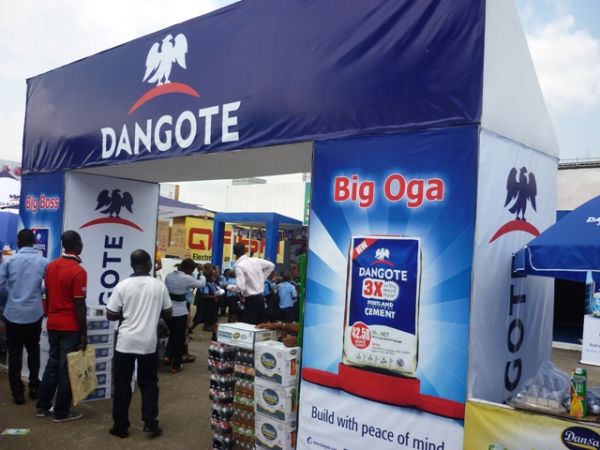
Dangote Group has expressed its readiness to partner with the Federal Government and the Kano State government in exploring ways to help Nigeria out of its current economic downturn.
A statement issued by the Chief Corporate Communication Officer of Dangote Group, Mr Anthony Chiejina, noted that the company will look into key sectors of the economy and see how it would help cushion effect of the recession.
Among the sectors highligted to explore by Dangote Group are agriculture, mining and infrastructure through partnership with the levels of government.
As part of this, the Group has re-opened the Dangote flour mill in Kano.
It also said the Tomato factory processing project would have been fully operational in Kadawa area of Kano State if not for the hitches caused by Tomato disease and some technicalities.
Mr Chiejina quoted the Executive Director, Commercial, DFM, Hajiya Halima Dangote in the statement to have said that the challenges of the recession have rather presented opportunities to explore areas of development and bring back lost glory of Nigeria’s economy.
She said this at the Dangote Special Day ceremony at the Kano International Trade Fair on recently, where she represented President/Chief Executive of the group, Mr Aliko Dangote.
Economy
Guinness Nigeria, Others Drown Stock Exchange by 0.07%
By Dipo Olowookere
The Nigerian Exchange (NGX) Limited lost its footing by 0.07 per cent on Friday as a result of renewed profit-taking by investors.
The fall happened after Thomas Wyatt and Guinness Nigeria led other price losers group comprising 27 stocks at the market yesterday due to selling pressure.
Thomas Wyatt Nigeria shed 10.00 per cent to quote at N2.70, Guinness Nigeria drowned by 9.99 per cent to close at N329.00, Ikeja Hotel slipped by 9.96 per cent to N42.50, Zichis shed 9.94 per cent to trade at N26.37, and McNichols depreciated by 9.91 per cent to N5.00.
On the flip side, International Breweries gained 9.92 per cent to finish at N13.30, NEM Insurance appreciated by 9.61 per cent to N27.95, Jaiz Bank grew by 6.36 per cent to N9.20, UPDC expanded by 6.33 per cent to N4.20, and Livestock Feeds increased by 6.32 per cent to N9.25.
Business Post reports that investor sentiment remained bullish despite the loss recorded during the session, as there were 27 price decliners and 30 price advancers, representing a positive market breadth index.
Yesterday, market participants transacted 441.3 million equities for N19.4 billion in 44,938 deals compared with the 1.7 billion equities worth N112.0 billion traded in 44,780 deals a day earlier. This showed that the trading volume contracted by 74.04 per cent, the trading value declined by 82.68 per cent, and an uptick in the number of deals by 0.35 per cent.
Access Holdings led the activity chart on Friday after selling 40.2 million shares valued at N1.0 billion, Sterling Holdco traded 30.3 million stocks worth N228.8 million, Fidelity Bank sold 26.3 million equities for N505.6 million, Zenith Bank transacted 22.3 million shares valued at N2.5 billion, and First Holdco exchanged 19.0 million stocks worth N1.3 billion.
During the last trading session of the week, the consumer goods sector rose by 0.49 per cent, the insurance counter increased by 0.06 per cent, and the industrial goods index closed flat, while the banking and energy indices lost 0.78 per cent and 0.52 per cent, respectively.
As a result, the All-Share Index (ASI) shrank by 159.97 points to 243,798.76 points from 243,958.73 points, and the market capitalisation moderated by N103 billion to N156.445 trillion from N156.548 trillion.
Economy
Naira Closes Weaker at N1,379/$1 in Official Market
By Adedapo Adesanya
The Naira performed poorly against the United States Dollar in the Nigerian Autonomous Foreign Exchange Market (NAFEX) on Friday, July 10, losing N1.19 or 0.09 per cent to close at N1,379.62/$1, in contrast to Thursday’s exchange rate of N1,378.43/$1.
It also depreciated against the Pound Sterling in the official market during the trading session by N3.80 to trade at N1,850.62/£1 compared with the previous day’s N1,846.82/£1, but gained 43 Kobo on the Euro to sell at N1,575.66/€1 versus the preceding day’s N1,576.09/€1.
At the GTBank FX desk, the Naira weakened against the Dollar yesterday by N1 to quote at N1,386/$1 compared with the previous session’s N1,835/$1, and maintained stability in the black market at N1.400/$1.
Data showed that interbank FX turnover fell by about 10 per cent on Friday to $71.044 million from $78.708 million the previous day. Also, interbank forex market deals reduced to 87 from 106 trades executed at the window on Thursday.
The total forex inflows into the Nigerian foreign exchange market have been fluctuating, with about $1 billion in total inflows reported last week.
Total FX inflows settled at $0.99 billion last week, according to the research subsidiary of Coronation Merchant Bank, with Foreign Portfolio Investors (FPIs) accounting for the largest share at 35.81 per cent, or $0.35 billion.
Exporters accounted for 28.72 per cent or $0.28 billion, while the CBN contributed 11.15 per cent or $0.11 billion. Non-Bank Corporations also made up a notable 10.92 per cent of total inflows, reflecting continued support from both market-driven and official sources.
In the cryptocurrency market, Bitcoin rose above $64,100, retesting the price level that rejected it on Monday, with a clean break above, opening the path toward the June 15 high of $67,250. It gained 0.3 per cent to sell at $64,114.16.
Ethereum (ETH) appreciated by 1.6 per cent to $1,798.81, Dogecoin (DOGE) grew by 0.6 per cent to $0.0742, Binance Coin (BNB) added 0.6 per cent to sell for $576.47, Cardano (ADA) also grew by 0.6 per cent to $0.1674, and Ripple (XRP) jumped by 0.4 per cent to $1.10.
But Solana (SOL) lost 1.1 per cent to settle at $77.95, and TRON (TRX) declined by 0.2 per cent to $0.3296, while the US Dollar Tether (USDT) and the US Dollar Coin (USDC) remained unchanged at $1.00 apiece.
Economy
Crude Oil Market Slips as Strait of Hormuz Shipping Outlook Improves
By Adedapo Adesanya
The crude oil market fell on Friday after the latest round of US-Iran fighting as traders grew hopeful that shipping would eventually resume in the Strait of Hormuz.
Brent futures settled at $76.01 a barrel, down 29 cents or 0.38 per cent, while the US West Texas Intermediate (WTI) crude finished at $71,41 a barrel, down 67 cents or 0.93 per cent. However, for the week, Brent gained about 5.50 per cent and WTI nearly 4 per cent.
With the end of tit-for-tat air strikes and the promise of renewed talks between the US and Iran next week, traders looked forward to the Strait of Hormuz reopening.
Market analysts noted that oil prices are coming down after a spike near $76 a barrel, even as the Strait of Hormuz was effectively shut down once again, mainly on confidence that the US’ military strength will not allow the Strait of Hormuz to be shut down for an extended period of time.
On Thursday, Iranian armed forces launched attacks on US military infrastructure in Gulf states after U.S. strikes on Iran’s southern coastal and eastern provinces. However, prices eased after it was reported that Qatari negotiators were in Iran to meet with officials in an effort to de-escalate tensions and create conditions for broader negotiations to continue.
Separately, Iranian media reported multiple explosions across southern Iran. The area included Bushehr, where one of the country’s nuclear plants is located.
The recent escalation in hostilities between the US and Iran could upend the International Energy Agency’s forecast of a significant oil market surplus next year, the agency said. The developments have delayed a full reopening of the Strait of Hormuz, which carried about 20 per cent of daily global oil and gas supplies before the start of the war on February 28.
However, the lack of any new US strikes on Iran overnight is probably weighing on oil prices, though a drop in flows through the Strait of Hormuz is limiting the downside.
The IEA also downgraded its projections on Russian oil production because of Ukrainian attacks on the country’s energy infrastructure.
Traders added a larger risk premium to crude prices as renewed geopolitical tensions in the Middle East raised questions about the security of oil shipments through the Strait of Hormuz. Those concerns outweighed bearish pressure from another production increase by the Organisation of the Petroleum Exporting Countries (OPEC) and an unexpected build in US crude inventories.