Connect with us

Economy

Dangote to Unveil Rice Outgrower Scheme in Sokoto

Published

on

By Dipo Olowookere

A subsidiary of Dangote Group, Dangote Rice, is set for launch in Sokoto State before the end of 2017, a statement by the company has revealed.

The multi-million Naira 25,000 hectares of rice outgrower scheme is projected to provide hundreds of thousands of employment opportunities for inhabitants of the rural communities in the state.

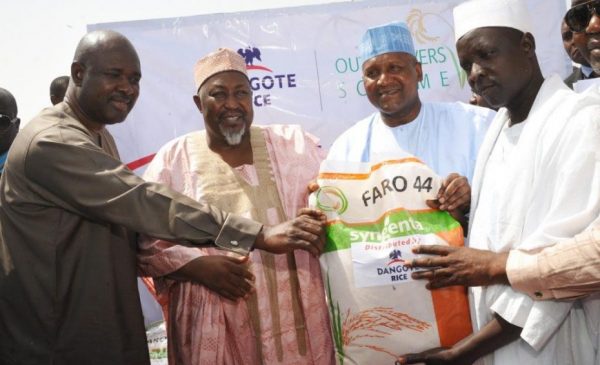
President of the Group, Mr Aliko Dangote, said at the weekend that the company will on Wednesday, flag off with a pilot project of 500 ha by Gonroyo dam, in Goronyo community.

Gonroyo dam is the second largest in the country, after Kainji.

The flag off ceremony, which will be performed by Governor of the state, Mr Aminu Tambuwal, will witness seedlings being distributed to the primary local farmers who will in turn plant the seed after which Dangote Rice company will purchase from them for milling and final processing.

Sokoto State is the second after Jigawa out of the 14 states spread across the state where Dangote Rice plans to operate outgrower scheme to empower local farmers and create job opportunities for community dwellers and reduce migration to the cities.

Dangote Rice projects in the 14 states, when, operational, will generate a significant number of jobs and increase take-home income for smallholder farmers, all while diversifying Nigeria’s economy and reducing the nation’s food import bill.

Statistics from the Federal Ministry of Agriculture and Rural Development (FMARD) estimates that rice demand in Nigeria reached 6.3 million MT in 2015, with only 2.3 million MT of that demand satisfied by local production.

This local production shortfall leaves a gap of 4.0 million MT that is currently being filled through formal importation of rice or illegal imports over land borders.

By year-end 2017, Dangote Rice plans to produce 225,000 MT of parboiled, milled white rice. This will allow us to satisfy 4 percent of the total market demand within one year.

The firm said its model can then be successfully scaled to produce 1,000,000 MT of milled rice in order to satisfy 16 percent of the domestic market demand for rice over the next five years.

Due to the current economic crisis, domestic prices for agro-commodities have risen dramatically over the last 12 months, making local agriculture an attractive investment.

Dangote Rice Limited seeks to take advantage of this economic trend and the favourable policies laid out in the FMARD’s Agricultural Transformation Agenda.

Dangote Rice has a mandate to locally high-quality milled, parboiled rice for the Nigeria market. This goal will be achieved by sourcing the raw material (paddy) required from the Dangote Rice Outgrower Scheme.

Through the Dangote Rice Outgrower Scheme, DRL will partner with outgrowers (smallholder and contract rice farmers) to cultivate and grow rice paddy. Specifically, DRL will provide inputs, technical assistance, extension services and land preparation services and equipment directly to farmers.

At harvest, DRL will recoup the costs of inputs and services in-kind and will act as a guaranteed offtaker for paddy that meets certain pre-agreed quality standards. Smallholder farmers will provide land and labour.

The centralized outgrower model enables a high level of control over product quality and quantity. The purchasing price given to farmers will reflect each season’s market price and will be set after an extensive market price survey and consultation with all stakeholders.

In the short-term, Dangote Rice will be responsible for importing all of the inputs needed for cultivation and making them available to the outgrowers.

By end of 2017, Dangote Rice will have 25,000 Ha under rice cultivation across three sites in Northern Nigeria having identified rice-growing communities in Jigawa State (5,000 Ha), Sokoto State (10,000 Ha) and Zamfara State (10,000 Ha).

The 25,000 Ha will be farmed by nearly 50,000 outgrowers in the selected site areas. These outgrowers are already organized into cooperative associations. We will engage with these organizations to register and sign contracts with each farmer.

In addition to the outgrowers, an additional ~260 jobs will be created by year-end 2017. These individuals will serve as agronomists, credit officers and staff of the mill.

Upon harvest, Dangote Rice will offtake rice paddy and transport the paddy to be processed. One centralized mill will mill the stored paddy rice from all 3 sites.

Dangote Rice plans to produce one million MT of rice from 150,000 Ha in the next 5 years over. They intend to accomplish this by scaling the business model described above to more sites and rice growing communities. These communities have been identified and relationship building and sensitization has already begun. In addition to scaling the above model, DRL will establish and manage a high-quality seed development farm at Numan in Adamawa to reduce the costs of seeds.

Dangote Rice will establish raw material reception, drying, hulling, parboiling units and silos in strategic areas throughout the country near our additional outgrower communities. Each site will store dried, hulled, parboiled bran rice. DRL will then transport this bran rice to a mill, where finished rice will be produced.


Dipo Olowookere is a journalist based in Nigeria that has passion for reporting business news stories. At his leisure time, he watches football and supports 3SC of Ibadan. Mr Olowookere can be reached via [email protected]

Click to comment

Leave a Reply

Your email address will not be published. Required fields are marked *

Economy

Four Securities Erase N51.17bn from NASD Exchange

Published

on

NASD Exchange

By Adedapo Adesanya

Four securities weakened the NASD Over-the-Counter (OTC) Securities Exchange by 1.95 per cent on Friday, erasing N41.17 billion from the bourse, which had its market capitalisation at N2.567 trillion compared with the previous session’s N2.618 trillion.

In the same vein, the NASD Unlisted Security Index (NSI) decreased at the close of business by 85.28 points to 4,277.07 points from 4,362.32 points.

The price decliners were led by 11 Plc, which gave up N20.50 to sell at N200.50 per share compared with the preceding day’s N221.00 per share, FrieslandCampina Wamco Nigeria Plc dropped N16.94 to close at N155.20 per unit versus Thursday’s closing price of N172.14 per unit, Central Securities Clearing System (CSCS) Plc went down by N2.11 to N84.68 per share from N86.79 per share, and Afriland Properties Plc lost 11 Kobo to end at N16.74 per unit, in contrast to the N16.85 per unit it closed a day earlier.

During the trading day, the value of transactions jumped by 172.1 per cent to N29.9 million from the preceding session’s N10.9 million, and the volume of trades soared by 136.5 per cent to 955,096 units from the previous 403,901 units, while the number of deals went down by 11.4 per cent to 31 deals from 35 deals.

Great Nigeria Insurance (GNI) Plc remained the most active stock by value on a year-to-date basis, with 3.4 billion units valued at N8.4 billion, followed by Infrastructure Credit Guarantee (Infracredit) Plc with 2.3 billion units worth N6.5 billion, and CSCS Plc with 68.6 million units sold for N4.7 billion.

GNI Plc also ended the session as the most traded stock by volume on a year-to-date basis, with 3.4 billion units exchanged for N8.4 billion, trailed by Infracredit Plc with 2.3 billion units traded for N6.5 billion, and Resourcery Plc with 1.1 billion units transacted for N415.7 million.

Continue Reading

Economy

Cautious Trading, Profit-taking Weaken Nigeria’s Stock Exchange by 0.66%

Published

on

Nigeria's stock exchange

By Dipo Olowookere

The last trading session of this week on the floor of the Nigerian Exchange (NGX) Limited ended on a negative note, with a 0.66 per cent loss on Friday.

This was influenced by sustained selling pressure and cautious trading, which forced investors into profit-taking.

Data obtained by Business Post showed that the energy sector fell by 4.66 per cent, the insurance counter dipped by 2.23 per cent, the consumer goods index depreciated by 0.96 per cent, and the banking segment shed 0.28 per cent, while the industrial goods space remained unchanged.

At the close of business, the All-Share Index (ASI) of Nigeria’s stock exchange went down by 1,531.81 points to 232,049.02 points from 233,580.83 points, and the market capitalisation dropped N983 billion to settle at N148.905 trillion compared with Thursday’s N149.888 trillion.

Aradel was the worst-performing equity after it lost 10.00 per cent to close at N1,417.50. International Energy Insurance slipped by 9.95 per cent to N5.79, Trans-Nationwide Express depreciated by 9.89 per cent to N3.28, eTranzact crashed by 9.79 per cent to N14.75, and UPDC slumped by 9.72 per cent to N28.12.

The best-performing equity for the day was Universal Insurance, which gained 6.32 per cent to close at N1.01, McNichols grew by 5.52 per cent to N8.60, Linkage Assurance expanded by 4.67 per cent to N1.57, NGX Group appreciated by 4.35 per cent to N120.00, and Transcorp increased by 3.62 per cent to N41.50.

As look at the activity level indicated that investors traded 388.7 million stocks worth N18.4 billion in 44,631 deals compared with the 393.7 million stocks valued at N19.2 billion executed in 45,813 deals a day earlier, representing a decline in the trading volume, value, and number of deals by 1.27 per cent, 4.17 per cent, and 2.58 per cent, respectively.

Continue Reading

Economy

Official FX Market Sees Naira Dip to N1,380.93/$1

Published

on

naira official market

By Adedapo Adesanya

The Naira recorded a loss of 82 Kobo or 0.06 per cent against the United States Dollar in the Nigerian Autonomous Foreign Exchange Market (NAFEX) on Friday, June 26, exchanging at N1,380.93/$1, in contrast to the previous day’s rate of N1,380.11/$1.

Equally, the domestic currency further weakened against the Pound Sterling in the official FX market yesterday by N6.06 to settle at N1,824.90/£1 versus the preceding session’s N1,818.84/£1, and lost N10.74 on the Euro to sell at N1,577 .58/€1 versus N1,566.84/€1.

At the GTBank forex counter, the Naira depreciated against the greenback during the session by N4 to close at N1,387/$1, in contrast to Thursday’s value of N1,383/$1, and at the parallel market, it was unchanged at N1,395/$1.

Interbank FX activity among financial institutions has fluctuated amid a sharp slowdown in forex market interventions by the Central Bank of Nigeria (CBN), as it allows demand and supply to move the market.

Also, a stronger greenback has generally put significant pressure on emerging-market currencies.

Nigeria has accessed the first tranche of a proposed $5 billion derivatives financing arrangement with First Abu Dhabi Bank PJSC, the largest lender in the United Arab Emirates (UAE).

The $5 billion facility, approved by the National Assembly earlier this year, is part of the federal government’s plan to diversify external financing sources and reduce borrowing costs. Structured as a Total Return Swap with First Abu Dhabi Bank, proceeds are earmarked for refinancing debt and supporting infrastructure financing.

If the proceeds are brought into the country through the official FX market, the transaction will increase the currency reserves or Dollar liquidity.

At the cryptocurrency market, Solana (SOL) grew by 2.2 per cent to $71.92, Cardano (ADA) gained 1.1 per cent to trade at $0.1474, Ripple (XRP) also appreciated by 1.1 per cent to $1.05, Dogecoin (DOGE) expanded by 0.9 per cent to $0.0755, and Ethereum (ETH) improved by 0.4 per cent to $1,578.84.

On the flip side, TRON (TRX) slid 0.6 per cent to $0.3203, Binance Coin (BNB) slumped by 0.3 per cent to $564.33, and Bitcoin fell by 0.2 per cent to $60,219.37, while the US Dollar Tether (USDT) and the US Dollar Coin (USDC) traded flat at $1.00 each.

Continue Reading

Trending