

Economy
Entertainment as Payments Stress-Test: What High-Volume Microtransactions Teach Nigerian Fintechs
Nigeria’s payment rails are being shaped in places many bankers rarely look. Music livestreams, casual games, creator tips, and fan tokens create dense bursts of tiny transactions that look chaotic at first glance yet are ideal for testing scale, speed, and reliability. When a live event or a tournament peaks, thousands of payments try to clear at once. That is exactly when systems reveal their true limits.
For Nigerian fintechs (which are not always satisfactory), entertainment offers a natural lab where volumes are high, values are small, and user tolerance for friction is low. The lessons are very practical: Reduce steps, cut latency, and design for retries that do not double charge.
Why slots-led crypto play became the template for frictionless micro-payments
The best way to see how entertainment pushed payment design forward is to look at online games which are a significant part of modern entertainment. Now, digital gaming is massive, but one particular category (and we’re talking about online gambling games) includes probably the most amount of payments and transactions.
Today’s slot games live on a rhythm of quick spins and small stakes, so they need payments that feel invisible. A player tops up a wallet, scans a QR code, or approves a push request, and credit lands almost at once. Because games refresh results every few seconds, payment confirmation has to keep pace. Operators solve this with clear balances, instant authorisations against pre-funded value, and near-real-time settlement. The experience is simple, predictable, and always on.
Online Bitcoin slots stand out within crypto games for two practical reasons. First is scale. Slots attract broad, casual audiences that play in short sessions, which creates heavy streams of tiny transactions. Second is repeatability. Every spin has the same shape, so systems can optimize for the same call pattern again and again. That repeatable flow makes it easier to tune idempotency keys, queue priorities, and timeouts without confusing users.
The design choices that emerged here in digital casino games are now widely copied. Wallet connections avoid forms. QR prompts cut typing errors. Clear balance indicators remove doubt about what has been paid and what remains. Fast receipts build trust for the next spin or tip. Because settlement is digital wallet to digital wallet, there is less breakage, fewer hops, and fewer points of failure. The lesson for any Nigerian fintech working with microtransactions is straightforward. Keep the path short, show state clearly, and make each payment feel as fast as a screen tap. Do that, and you meet user expectations shaped by slots, streams, and other always-on entertainment.
What entertainment volumes reveal about Nigeria’s payments stack
High-volume streams of tiny payments expose weak links in seconds. That is why entertainment data is so useful for Nigerian providers planning peak loads, instant reversals, and real-time risk checks.ALT: Taylor Swift during a concert.
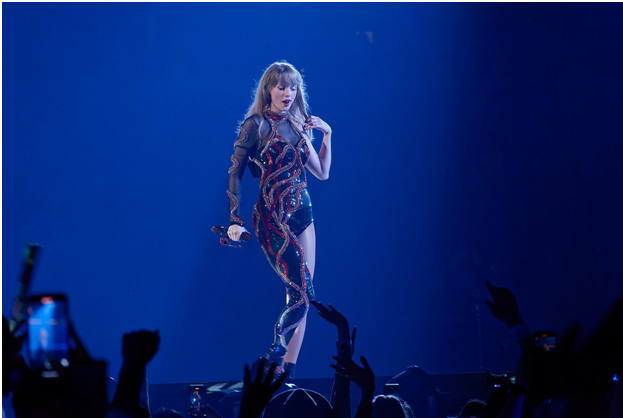
Taylor Swift’s Eras Tour presale in November 2022 turned into a payments flashpoint. Millions tried to buy at once, the site queued and crashed, and many customers saw failed checkouts and authorization holds before Ticketmaster cancelled the general on-sale. Image: Here
The country’s rails are ready for this kind of tempo. Real-time payments already account for a growing share of digital transactions, and overall e-payments have hit record value. At the same time, mobile reach is wide, which helps front-end reliability at the moments that matter most.
| Metric | Nigeria figure | Period |
| Instant money transfers completed | Over 12 billion | 2024 |
| Share of all transactions that were real-time | 27.7 percent | 2023 |
| Forecast share of transactions that will be real-time | 50.1 percent | 2028 |
| Total e-payment value | N1.07 quadrillion | 2024 |
| Active telecom subscriptions | 169.3 million | July 2025 |
| Broadband penetration | 48 percent | July 2025 |
Data is taken from the following sources: NIBSS, ACI Worldwide, Telecom Review Africa
For builders, these numbers translate into clear tasks. Plan for short spikes that mimic a popular stream or in-game tournament. Use asynchronous confirmation with clear on-screen states so users keep playing while the ledger finalises. Design retries and reconciliation around idempotency to avoid duplicates during bursts. Split risk checks so most payments clear in milliseconds, while a small fraction routes to deeper review without blocking the rest. Finally, treat receipts as a product. Users will keep paying when receipts are instant, readable, and stored.
Design cues fintechs can borrow from always-on entertainment
The reliability bar in entertainment is high because the session is the product. If a payment screen feels heavy, the user leaves. Nigeria’s real-time growth shows that consumers already expect taps to turn into balances almost at once, and providers are racing to match that feel across use cases. It is worth noting that smartphone access still shapes what is possible, so lightweight, data-thrifty flows help close the gap and grow volumes. As the GSMA puts it, “Handset affordability is often recognised as the most significant barrier to get people online.” That single constraint makes clean, low-bandwidth payment screens a competitive edge.
Two practical patterns stand out. First, event-driven architecture. Queue every request, give each one a unique key, and make the UI reflect real states like pending, paid, or refunded. This removes confusion during spikes and prevents user double taps from creating duplicates. Second, graceful degradation. When network conditions dip, fall back to cached balances, offer a timed retry, and display a short countdown that reassures the user. These small touches came from entertainment because sessions cannot pause.
The macro trends support this direction. Real-time’s share of transactions in Nigeria is set to rise strongly through 2028, and overall e-payment value is already at historic highs. That momentum encourages merchants to accept more tiny payments, which in turn rewards providers that can clear thousands of them in a few seconds without noise or errors. Entertainment has shown the path. Build for speed that users can feel, and make every confirmation instant and obvious.
Economy
NGX Chief Seeks More Involvement of Women in Capital Market Ecosystem
By Dipo Olowookere
The chief executive of the Nigerian Exchange (NGX) Limited has stressed the need to broaden women’s involvement in the capital market.
Speaking on Tuesday at the closing gong ceremony to commemorate International Women’s Day 2026 in Lagos, he submitted that, “When more women participate in the market as investors and professionals, we deepen the market and strengthen the foundation for sustainable growth.”
The NGX Group Plc partnered with the Central Securities Clearing System (CSCS) Plc, and the Women in Management, Business and Public Service (WIMBIZ) to observe the global Ring the Bell for Gender Equality initiative in alignment with the UN Women theme Rights, Justice, Action – For All Women and Girls.
Also addressing participants at the event, the chief executive of NGX Group, Mr Temi Popoola, emphasised the critical role capital markets must play in shaping inclusive economic growth.
“Capital markets are powerful engines for economic transformation. When women participate fully as leaders, entrepreneurs, and investors, markets become stronger, deeper, and more resilient.
“At NGX Group, we remain committed to advancing policies, partnerships, and platforms that expand opportunities for women and accelerate inclusive prosperity,” he said.
On her part, the Minister of State for Foreign Affairs, Mrs Bianca Odumegwu-Ojukwu, commended NGX Group and its partners for advancing gender inclusion through the initiative.
“I congratulate NGX Group and its partners for sustaining this important global movement and for championing gender equality within our financial ecosystem. Together, let us continue to open the doors of opportunity, so the next generation of women can lead with confidence and help transform our world,” she said.
Also, the First Lady of Imo State, Mrs Chioma Uzodimma, called for collective action to expand opportunities for women and girls.
“As we sound the NGX Gong today, let it symbolise our shared pledge to protect every girl child, expand opportunities for every woman, and build an inclusive economy where every woman and girl can flourish,” she said.
The Regional Industry Manager for Financial Institutions at the International Finance Corporation (IFC) for Central Africa and Anglophone West Africa, Ms Claude Owona, underscored the role of capital markets in translating gender equality commitments into real economic outcomes.
“Ring the Bell for Gender Equality is both symbolic and practical, because capital markets do not just reflect economies, they shape them. When women have equitable access to finance, leadership opportunities, and safe, inclusive workplaces, companies perform better, and economies grow stronger.
“At IFC, we are proud to partner with NGX Group on market‑driven solutions that expand women’s participation as leaders, entrepreneurs, and employees, recognising that inclusive growth is not aspirational, it is investable, and it is essential for long‑term resilience and shared prosperity,” she said.
Media entrepreneur and founder of EbonyLife Media, Ms Mo Abudu, encouraged women to pursue their ambitions with clarity and confidence.
“For me, it comes down to four things: purpose, passion, progress, and power. Find your purpose, let passion fuel your journey, stay consistent even when challenges arise, and most importantly, stand firmly in your power. Do not shrink,” she said.
Award-winning actor and filmmaker, Ms Funke Akindele, urged women to pursue their ambitions with discipline and courage, saying, “To every woman out there, you can do it.
“But beyond the words, we must put in the hard work, build structure into our businesses, and do things the right way. It takes courage to take the first step even when you’re not ready, courage to stay consistent when no one is clapping, and courage to hold firmly to your vision.”
Economy
Plateau, Bank of Industry Provide N4bn Cheap Loans to MSMEs
By Modupe Gbadeyanka
A significant step has been taken to ensure Micro, Small and Medium Enterprises (MSMEs) in Plateau State have access to cheap loans.
The state government has partnered with the Bank of Industry (BoI) to create a N4 billion matching fund for small business operators across the state.
Each of the parties will provide N2 billion to provide affordable financing for equipment acquisition and working capital, enabling businesses to expand operations, create jobs, and strengthen local value chains.
Business Post gathered that the loans would be given at a single-digit interest rate to eligible businesses, with a maximum offer of N100 million per beneficiary over a tenor of up to five years, including a moratorium period of up to 12 months after disbursement.
The Director of Press and Public Affairs to Governor Caleb Mutfwang, Mr Gyang Bere, in a statement on Wednesday, said the state government collaborated with the lender to lift citizens out of poverty and stimulate economic growth across the 17 Local Government Areas of Plateau State.
“This is a significant milestone in our efforts to build a resilient and inclusive economy that aligns with the vision of Mr President (Bola Tinubu) to grow Nigeria into a one-trillion-dollar economy,” the governor was quoted to have said in the statement.
“Plateau State has significant potential and will continue to contribute meaningfully to the growth and development of the national economy,” Mr Mutfwang added.
He noted that the initiative would serve as seed capital capable of generating sustainable economic returns and driving entrepreneurship across the state.
“We want to increase Plateau State’s contribution to the national GDP, and the most effective way to achieve this is by stimulating business growth,” he stated.
“We will identify innovative and enterprising businesses across the state, with particular focus on women and young people, ensuring that no part of Plateau is left behind.”
On his part, the Managing Director of BoI, Mr Olasupo Olusi, commended the governor for what he described as a visionary initiative aimed at empowering entrepreneurs and fostering sustainable economic development.
Mr Olusi explained that the partnership would not only provide funding but also offer training and capacity-building programmes for beneficiaries through accredited Entrepreneurship Development Centres, ensuring that MSMEs are equipped with the necessary skills to grow and remain competitive.
According to him, the BOI–PLSG Matching Fund is designed to expand access to affordable, long-term financing for MSMEs operating across Plateau State.
Economy
Linkage Assurance N16.3bn Rights Issue Opens
By Aduragbemi Omiyale
Shareholders of Linkage Assurance Plc who intend to increase their stake in the company can now begin to do so through a rights issue window.
The organisation on Wednesday, March 6, 2026, commenced its N16.3 billion rights issue days after securing approval from the Securities and Exchange Commission (SEC).
Through the exercise, Linkage Assurance is selling to investors a total of 12,320,000,000 ordinary shares of 50 Kobo each at N1.32 per share.
It would be issued to shareholders on the basis of two new ordinary shares for every three ordinary shares held as of Thursday, January 22, 2026.
According to a notice issued by the Nigerian Exchange (NGX) Limited today, the rights issue will close on Thursday, April 23, 2026.
“Trading licence holders are hereby notified that trading in Linkage Assurance Plc’s rights issue of 12,320,000,000 ordinary shares of 50 Kobo each at N1.32 per share on the basis of two new ordinary shares for every existing three ordinary shares held as at the close of business on Thursday, January 22, 2026, opened today, Wednesday, March 11, 2026,” the statement signed by the Head of Issuer Regulation Department of the NGX, Mr Godstime Iwenekhai, said.
Proceeds from the rights issue would be used by Linkage Assurance to meet the required minimum capital introduced by the Nigeria Insurance Industry Reform Act, 2025, and to expand into key areas of insurance business.
-
Feature/OPED6 years agoDavos was Different this year
-
Travel/Tourism10 years ago
Lagos Seals Western Lodge Hotel In Ikorodu
-
Showbiz3 years agoEstranged Lover Releases Videos of Empress Njamah Bathing
-
Banking8 years agoSort Codes of GTBank Branches in Nigeria
-
Economy3 years agoSubsidy Removal: CNG at N130 Per Litre Cheaper Than Petrol—IPMAN
-
Banking3 years agoSort Codes of UBA Branches in Nigeria
-
Banking3 years agoFirst Bank Announces Planned Downtime
-
Sports3 years agoHighest Paid Nigerian Footballer – How Much Do Nigerian Footballers Earn



