Economy
FG Denies IMF Allegation of 2% GDP Off-Budget Expenditure
By Adedapo Adesanya
The Nigerian government has dismissed claims by the International Monetary Fund (IMF) that it spent about two per cent of Nigeria’s Gross Domestic Product (GDP) outside the approved budget.
The widely reported claim was made by the IMF’s Resident Representative in Nigeria, Mr Christian Ebeke, last week. He alleged that the country failed to record public spending equivalent to about two per cent of its GDP in recent official budgets, amounting to about N8 trillion.
But in a statement issued on Sunday, the Minister of Finance and Coordinating Minister of the Economy, Mr Taiwo Oyedele, said the federal government does not operate a “shadow budget” or spend public funds outside the constitutional and statutory framework governing public finance, and described the reports as a misrepresentation of Mr Ebeke’s comments.
He explained that sections 80–83 and 162 of the 1999 Constitution (as amended) provide that public funds can only be withdrawn and spent in accordance with the Constitution and laws enacted by the National Assembly.
According to him, all FG spending is backed by duly enacted Appropriation Acts, Supplementary Appropriation Acts or other statutory authorisations approved by the National Assembly.
Mr Oyedele added that multi-year capital projects, which span several budget cycles, are implemented in line with existing laws and approved capital rollover provisions where applicable.
“These are recognised features of public financial management and should not be misconstrued as expenditures outside the budget,” he said.
He described as inaccurate suggestions that trillions of naira were secretly spent without legislative approval, arguing that such allegations should identify the specific projects allegedly executed without appropriation or legal authority and provide credible evidence to support the claims.
“To be meaningful, assertions of this magnitude must be supported by verifiable facts rather than conjecture.
“For the purpose of public education, it is important to distinguish between appropriation, expenditure authorisation, financing and fiscal reporting,” he added.
Mr Oyedele said Nigeria’s public finance framework includes several statutory transfers, first-line charges and intervention mechanisms established by Acts of the National Assembly.
These, he said, include statutory allocations to development commissions and other agencies created by law, cost of collection and administration retained by designated revenue-collecting agencies, capital expenditure approved under separate budgets for some agencies and the Federal Capital Territory, special interventions for national priorities such as security, infrastructure and disaster response, as well as debt service obligations and other statutory transfers.
The minister maintained that the expenditures are neither secret nor illegal, stressing that they are established by law, disclosed in official fiscal reports and subject to oversight, audit and accountability mechanisms.
“Their treatment for reporting purposes may differ from their presentation in the annual Appropriation Act, particularly under international statistical and reporting standards adopted by the Federal Government. Such classification differences should not be misrepresented as evidence of unlawful expenditure,” he said.
Mr Oyedele also rejected claims that the reported amount represented an increase in Nigeria’s budget deficit.
“A fiscal deficit is determined by the relationship between total government revenues and total government expenditures. Whether a capital project is financed through annual appropriations, supplementary appropriations, statutory transfers, approved intervention mechanisms, or other lawful financing arrangements does not, by itself, increase the fiscal deficit,” he said.
He further explained that the IMF’s observation related primarily to the comprehensiveness, timing and presentation of Nigeria’s fiscal reporting rather than the legality of government expenditure.
According to him, Nigeria, like many other countries, is working to improve the alignment between its budget presentation and international fiscal reporting standards as part of ongoing public financial management reforms.
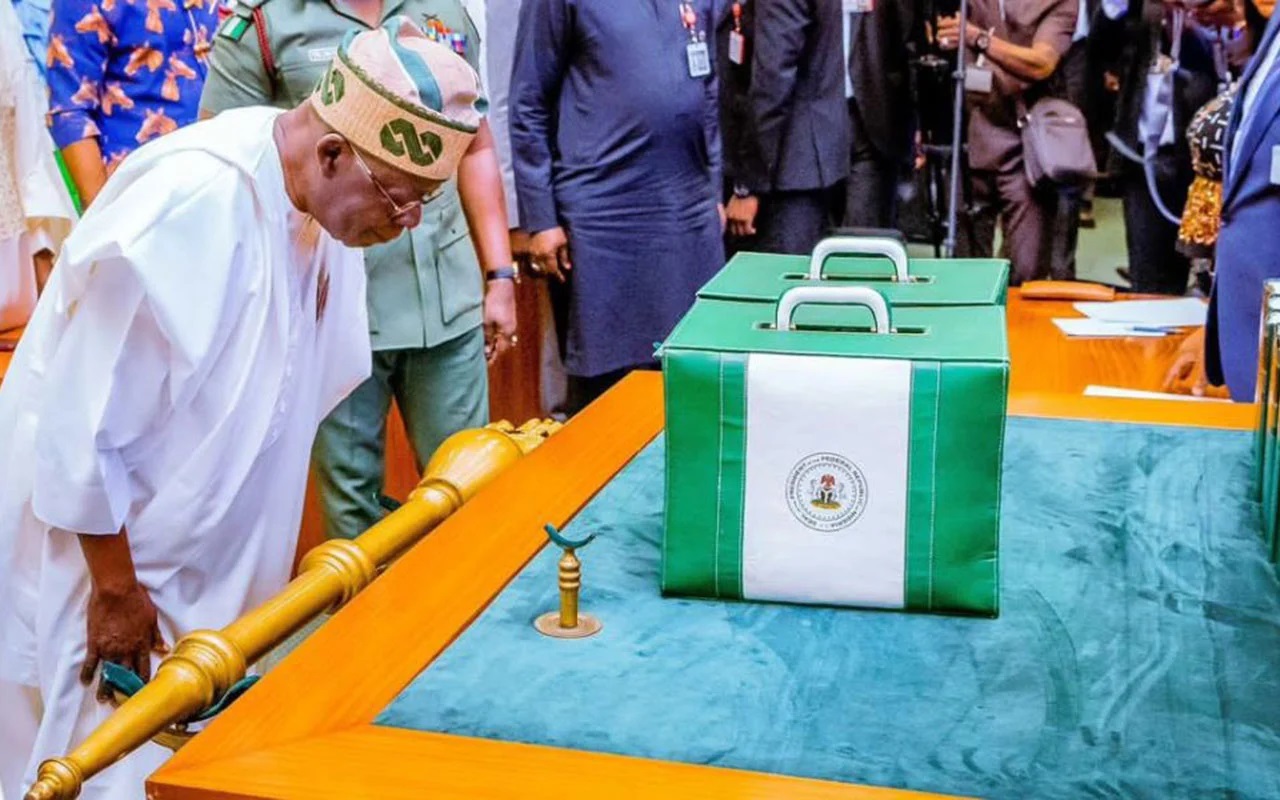
Mr Oyedele recalled that President Bola Tinubu had, during the presentation of the 2026 Appropriation Bill to a joint session of the National Assembly on December 19, 2025, urged lawmakers to end the practice of operating multiple and overlapping budgets and instead adopt a single, harmonised budget framework.
He said the federal government remains committed to prudent fiscal management, transparency and accountability, adding that recent reforms have strengthened budget credibility, revenue administration, treasury management and the digitalisation of government financial processes.
According to him, these reforms have been acknowledged by the IMF, other multilateral institutions, international credit rating agencies, investors and major global media organisations.
While describing public debate as essential in a democracy, Mr Oyedele urged commentators to base their arguments on facts and a proper understanding of Nigeria’s constitutional and fiscal framework.
“Mischaracterising technical observations as evidence of unlawful expenditure neither advances informed public discourse nor strengthens democratic accountability,” he said.
He added that the federal government would continue to uphold the rule of law, ensure transparency in the management of public resources and work with the National Assembly, oversight institutions, development partners and Nigerians to further strengthen fiscal governance in line with international best practices
Economy
Heavy Sell-Offs Weaken NASD Index by 0.64%, Erase N16.5bn from Market
By Adedapo Adesanya
NASD Over-the-Counter (OTC) Securities Exchange remained in the negative territory after it further depreciated by 0.64 per cent on Friday, July 24, despite recording four price gainers.
The NASD Security Index (NSI) dropped 27.4 points at the close of business to settle at 4,294.75 points versus the previous day’s 4,383.48 points, while the market capitalisation gave up N16.49 billion to end at N2.577 trillion, in contrast to the N2.594 trillion it ended a day earlier.
The bourse was down during the session amid heavy sell-offs, with the volume of transactions skyrocketing by 693.9 per cent to 2.99 million units from Thursday’s 377,635 units.
Equally, the value of trades went up by 71.6 per cent to N69.4 million from N40.4 million, and the number of deals increased by 41.0 per cent to 55 deals from the preceding day’s 39 deals.
Great Nigeria Insurance (GNI) Plc remained the most active stock by value on a year-to-date basis, with 3.4 billion units worth N8.4 billion, trailed by Infrastructure Credit Guarantee (Infracredit) Plc with 2.3 billion units sold for N6.5 billion, and Central Securities Clearing System (CSCS) Plc with 75.6 million units traded for N5.4 billion.
GNI Plc was also the most active stock by volume on a year-to-date basis, with 3.4 billion units exchanged for N8.4 billion, trailed by Infracredit Plc with 2.3 billion units transacted for N6.5 billion, and Resourcery Plc with 1.1 billion units valued at N415.7 million.
The market ended the session with four price gainers and two price losers, led by FrieslandCampina Wamco Nigeria Plc, which lost N7.44 to trade at N136.19 per share compared with the previous day’s N143.63 per share, and CSCS Plc, which declined by N1.64 to N93.63 per unit from N95.27 per unit.
But MRS Oil gained N13.50 to sell at N148.50 per share versus N135.00 per share, Afriland Properties Plc advanced by 56 Kobo to N17.41 per unit from N16.85 per unit, UBN Property Plc surged by 18 Kobo to N1.93 per share from N1.75 per share, and Food Concepts Plc climbed by 1 Kobo to N2.50 per unit from N2.49 per unit.
Economy
Profit-taking Crashes Nigeria’s Stock Exchange by 0.19%
By Dipo Olowookere
Nigeria’s stock exchange succumbed to profit-taking on Friday, losing 0.19 per cent when the closing gong was hit at 4 pm.
Shares in the banking and energy sectors influenced the decline suffered by the Nigerian Exchange (NGX) Limited during the session, as they respectively closed lower by 0.40 per cent and 0.04 per cent.
The industrial goods index was flat yesterday, while the insurance counter gained 0.68 per cent and the consumer goods space chalked up 0.25 per cent. The gains by these two segments could not keep Customs Street in the green territory at the close of business.
As a result, the All-Share Index (ASI) retreated by 474.00 points to 247,357.40 points from 247,831.40 points, and the market capitalisation decreased by N306 billion to N159.588 trillion from N159.894 trillion.
Presco dropped 10.00 per cent during the trading day to close at N2,070.00, Thomas Wyatt crumbled by 9.93 per cent to N3.63, Trans-Nationwide Express plunged by 8.44 per cent to N2.82, Royal Exchange slipped by 7.86 per cent to N1.29, and LivingTrust Mortgage Bank shrank by 7.32 per cent to N3.80.
On the flip side, C&I Leasing improved by 9.48 per cent to N6.35, Cornerstone Insurance rose by 9.09 per cent to N6.00, RT Briscoe jumped by 8.61 per cent to N13.25, Honeywell Flour expanded by 7.38 per cent to N17.45, and Africa Prudential increased by 6.98 per cent to N13.80.
Despite the poor performance, the local bourse recorded a positive market breadth index after finishing with 35 price gainers and 25 price losers, representing strong investor sentiment.
It was a relatively quiet market on Friday, as the activity level dropped, with the trading volume down by 27.72 per cent to 565.5 million units from 782.4 million units, and the trading value contracted by 46.89 per cent to N29.9 billion from N56.3 billion, while the number of deals executed by investors soared by 16.03 per cent to 53,688 deals from 46,273 deals.
Access Holdings was the busiest stock for the session, with a turnover of 128.0 million units sold for N3.8 billion, First Holdco transacted 35.4 million units worth N4.3 billion, Chams exchanged 34.8 million units valued at N154.3 million, Zenith Bank traded 30.4 million units for N3.9 billion, and UBA sold 30.4 million units worth N1.5 billion.
Economy
Naira Trades N1,362/$1 at Official FX Market, as Bitcoin Falls
By Adedapo Adesanya
The Naira marked a whole week of appreciation against the United States Dollar on Friday, July 24, further gaining N5.67 or 0.41 per cent to close at N1,362.09/$1 in the Nigerian Autonomous Foreign Exchange Market (NAFEX) compared with N1,367.76/$1 it ended on Thursday.
Equally, the local currency appreciated against the Pound Sterling in the official FX market yesterday by N10.83 to trade at N1,813.62/£1 versus the preceding day’s N1,824.45/£1, and improved against the Euro by N7.68 to settle at N1,549.10/€1, in contrast to the N1,556.78/€1 it was exchanged a day earlier.
However, at the parallel market and GTBank forex counter, the Nigerian currency remained unchanged against the greenback during the session at N1,400/$1 and N1,379/$1, respectively.
The Central Bank of Nigeria (CBN) buffer has been strengthened with sustained foreign portfolio inflows and robust foreign reserves, which stand above $52 billion.
The apex bank’s policy signals that the Naira will be stronger in the near term, with Nigeria clearing hurdles with FX reforms and settlement of all backlogs.
However, some traders expect that pressure may come due to foreign-currency buying from fuel importers as they make Dollar purchases to build inventories.
Meanwhile, Bitcoin (BTC), in the digital currency landscape, trimmed recent gains as it fell by 2.3 per cent to $63,787.73.
The weak action in the AI momentum trade is feeding through to crypto as well.
Further, Cardano (ADA) dropped 3.7 per cent to close at $0.1615, Solana (SOL) dipped by 2.8 per cent to $73.71, Ripple (XRP) crashed by 2.3 per cent to $1.08, Ethereum (ETH) slid by 1.9 per cent to $1,851.58, Dogecoin (DOGE) retreated by 0.8 per cent to $0.0694, Binance Coin (BNB) contracted by 0.7 per cent to $564.18, and TRON (TRX) lost 0.5 per cent to trade at $0.3292, while the US Dollar Tether (USDT) and the US Dollar Coin (USDC) traded flat at $1.00 each.