Connect with us

Economy

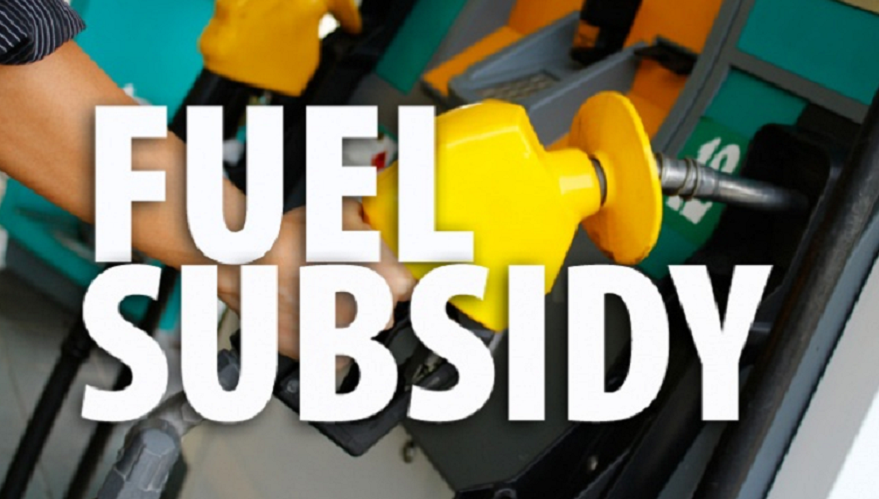
Fuel Subsidy Gulps N774m Daily Due to Smuggling—NNPC

Published

on

fuel subsidy

By Dipo Olowookere

Group Managing Director of the Nigerian National Petroleum Corporation (NNPC), Mr Maikanti Baru, has raised an alarm over the huge amount of debt the agency incurs daily as payment for subsidy for Premium Motor Spirit (PMS) otherwise known as petrol.

He said on a daily basis, the state-owned firm incurs an under-recovery of N774 million in order to allow citizens of Nigeria buy petrol at the regulated rate of N145 per litre.

Mr Baru explained that the huge amount paid is as a result of the product being smuggled from Nigeria to other neighbouring countries like Benin Republic, Niger Republic, Ghana, Cameroon and others, where fuel is sold higher than N145 per litre.

According to him, the smuggling the commodity to these countries was made possible with the proliferation of fuel stations in communities with international land and coastal borders across the country, making it difficult to sanitize the fuel supply and distribution matrix in the country.

Leading a top management team of the corporation on a visit to the Comptroller General of the Nigerian Customs Service (NCS), Mr Hameed Ali, the GMD said he got his information from detailed study conducted by NNPC.

He said that the activities of the smugglers had led to recent observed abnormal surge in the evacuation of petrol from less than 35 million litres per day to more than 60 million litres per day which is in sharp contrast with established national consumption pattern.

Providing a detailed presentation of the findings, the NNPC GMD informed that 16 states, having amongst them 61 Local Government Areas with border communities, account for 2,201 registered fuel stations.

The fuel tank, he noted, had a combined capacity of 144 million litres of petrol, while eight states with coastal border communities spread across 24 LGAs amongst the states account for 866 registered fuel outlets with combined petrol tank capacity of 73.4 million litres.

A further breakdown of the finding shows that among the states with land border, three LGA’s in Ogun State account for 633 fuel stations with combined petrol tankage of 40.5 million litres while nine LGA’s in Borno State have 337 fuel outlets with combined petrol storage capacity of 21 million litres.

He said also that with one LG as border community has 235 registered fuel stations with total petrol storage facility of 19.9 million litres, while on the coastal front, Lagos with six LGA’s leads with 487 registered fuel stations with combined in-built storage capacity of 50.2 million litres.

Akwa Ibom with five LGA’s has 134 registered retail outlets with capacity to store 8.3 million litres, while Ondo State with two LGA’s has 110 fuel stations with capacity to store 3.9 million litres.

Mr Baru explained that because of the obvious differential in petrol price between Nigeria and other neighbouring countries, it had become lucrative for the smugglers to use the frontier stations as a veritable conduit for the smuggling of products across the border, saying this had resulted in a thriving market for Nigerian petrol in all the neighbouring countries of Niger Republic, Benin Republic, Cameroun, Chad and Togo and even Ghana which has no direct borders with Nigeria.

“NNPC is concerned that continued cross-border smuggling of petrol will deny Nigerians the benefit of the Federal Government’s benevolence of keeping a fix retail price of N145 per litre despite the increase in PMS open market price above N171 per litre,” he said.

Welcoming the NNPC GMD and his team to the Customs headquarters, Mr Ali said the NCS would work with the corporation to stem the tide of cross-border smuggling of petroleum products, noting that all hands must be on deck to ensure the economic survival of the country.

The Customs boss thanked NNPC GMD for the elaborate data he provided on the fuel supply situation, noting that this would enable the service fashion out the appropriate architecture to combat the menace.

He called on the authorities to tackle the issue of price differentials which is the underlying motivation for smuggling activities.


Dipo Olowookere is a journalist based in Nigeria that has passion for reporting business news stories. At his leisure time, he watches football and supports 3SC of Ibadan. Mr Olowookere can be reached via [email protected]

Economy

NRS Launches Unified Tax ID System

Published

on

tax guidelines

By Adedapo Adesanya

The Nigeria Revenue Service (NRS) has unveiled a unified Taxpayer Identification (Tax ID) system for all taxable persons across the country as part of efforts to strengthen tax administration and improve transparency.

The agency announced the development in a public notice issued jointly with the Joint Revenue Board (JRB) on Monday.

According to the notice, the initiative is backed by Sections 6, 7, and 8 of the Nigeria Tax Administration Act, 2025, which mandate every taxable person in Nigeria to obtain a Tax ID, in a wider move to expand the country’s tax base.

The NRS said the new framework is designed to create a centralised and harmonised taxpayer database that would enhance interactions between taxpayers and revenue authorities at both federal and sub-national levels.

“The Tax ID will serve as a single, unified identity for all taxpayers, enabling seamless interaction with tax authorities at both federal and sub-national levels. It is designed to consolidate taxpayer records, eliminate duplication, and ensure more efficient management of tax-related information,” the agency stated.

The revenue agency explained that the new system would simplify tax compliance procedures, including taxpayer registration, filing of returns, and payment processes.

According to the NRS, the framework is also expected to improve accountability and reduce leakages in tax collection by creating better visibility and tracking of taxpayer information nationwide.

“The initiative will simplify tax compliance processes, including registration, tax filing, and payment procedures. The system will improve transparency by enabling better visibility and tracking of taxpayer records while reducing leakages and improving accountability in tax collection. The framework will also harmonise taxpayer information across all levels of government,” the notice added.

The agency further disclosed that the new Tax ID system would replace the existing Tax Identification Number (TIN) Validation API currently used by Ministries, Departments and Agencies (MDAs), financial institutions, and other organisations for taxpayer verification.

Continue Reading

Economy

OTC Securities Exchange Falls 1.31% as Key Stocks Decline

Published

on

NASD OTC securities exchange

By Adedapo Adesanya

Three bellwether stocks weakened the NASD Over-the-Counter (OTC) Securities Exchange by 1.31 per cent on Monday, May 18.

This brought the NASD Unlisted Security Index (NSI) by 54.71 points to 4,133.70 points from 4,188.41 points, and shrank the market capitalisation by N32.73 billion to N2.473 trillion from N2.506 trillion.

Yesterday, FrieslandCampina Wamco Plc contracted by N12.45 to sell at N146.55 per share compared with last Friday’s closing price of N159.00 per share, Central Securities and Clearing System (CSCS) Plc declined by N2.34 to N70.00 per unit from N72.34  per unit, and NASD Plc lost 50 Kobo to trade at N34.50 per share versus N35.00 per share.

The trio overpowered the N5.56 gained Newrest Asl Plc. This stock ended the trading session at N61.15 per unit, in contrast to the previous session’s N55.59 per unit.

During the trading day, the volume of securities traded by investors slid by 56.1 per cent to 514,142 units from 1.2 million units, and the value of securities dropped 29.8 per cent to close at N17.4 million versus N29.8 million, while the number of deals jumped 12.5 per cent to 27 deals from 24 deals.

Great Nigeria Insurance (GNI) Plc remained the most traded stock by value on a year-to-date basis, with 3.4 billion units sold for N8.4 billion, followed by CSCS Plc with 60.8 million units exchanged for N4.1 billion, and Okitipupa Plc with 27.9 million units traded for N1.9 billion.

GNI Plc also ended the day as the most traded stock by volume on a year-to-date basis with 3.4 billion units worth N8.4 billion, trailed by Resourcery Plc with 1.1 billion units valued at N415.7 million, and Infrastructure Guarantee Credit Plc with 400 million units transacted for N1.2 billion.

Continue Reading

Economy

FX Pressure Pushes Naira Lower to N1,373/$1 at Official Market

Published

on

naira official market

By Adedapo Adesanya

It was a horrible day for the Nigerian Naira in the different segments of the foreign exchange (FX) market on Monday, May 15, as its value further weakened against the United States Dollar.

In the black market window, the Naira lost N5 against the Dollar yesterday to sell for N1,390/$1 compared with the previous value of N1,385/$1, but at the GTBank forex counter, it remained unchanged at N1,383/$1.

In the Nigerian Autonomous Foreign Exchange Market (NAFEX), the Nigerian currency depreciated against the greenback by N2.66 or 0.19 per cent to sell for N1,373.70/$1 compared to last Friday’s rate of N1,371.04/$1.

Equally, it fell against the Pound Sterling in the same market segment by N9.05 to trade at N1,839.66/£1 versus N1,830.61/£1, and lost N5.42 on the Euro to close at  N1,600.49/€1 versus N1,595.07/€1.

The performance of the local currency during the session indicates early worries despite all signals pointing to stability, amid improved  Dollar sales by the Central Bank of Nigeria (CBN), with steady, higher oil receipts to bolster the nation’s reserves.

Activity at the market showed that turnover rose 57.3 per cent to $76.29 million on Monday from $48.49 million posted on Friday.

Over the weekend, S&P raised Nigeria’s credit ratings for the first time since 2012 and highlighted improved FX market liquidity and $10 billion turnover recorded in April 2026 as one of the major gains of the CBN-led FX reforms.

The agency said the liberalisation of the exchange rate has bolstered access to foreign currency and enabled a market-driven exchange-rate environment while supporting investor and consumer confidence.

Meanwhile, the cryptocurrency market was bullish on Monday as investors monitored developments in the Iran conflict and weighed the impact of surging oil prices on inflation and US interest-rate expectations.

Ethereum (ETH) gained 0.7 per cent to trade at $2,134.10, Cardano (ADA) rose by 0.6 per cent to $0.2515, Solana (SOL) expanded by 0.3 per cent to $85.11, Binance Coin (BNB) jumped 0.2 per cent to $643.29, TRON (TRX) increased by 0.03 per cent to $0.3565, and Bitcoin (BTC) advanced by 0.02 per cent to $76,912.12.

On the flip side, Dogecoin (DOGE) slid by 1.5 per cent to $0.1044, and Ripple (XRP) decreased by 0.5 per cent to $1.38, while the US Dollar Tether (USDT) and the US Dollar Coin (USDC) traded flat at $1.00 apiece.

Continue Reading

Trending