
Economy
Here Today, Gone Tomorrow: 60 Causes of Small Business Failure in Nigeria


By Timi Olubiyi, PhD
Despite the significance of small and medium enterprises (SMEs) to the economy and national development, Africa has a high rate of business failures and short-lived businesses.
In Nigeria SMEs account for 48 per cent of the national gross domestic product (GDP), 96 per cent of businesses, and 84 per cent of employment in the country, according to a PricewaterhouseCoopers (PwC) report.
In contrast, due to the country’s dire economic circumstances, at least 1.9 million SMEs have been lost since 2017, according to the report, yet business closures persist at an alarming rate.
Why do so many businesses fail so quickly, be they structured or unstructured? It can be attributed to many challenges, and this is the focus of this piece.
In the context of this article, the word “failure” refers to any kind of closure, including bankruptcy, liquidation, stopping further losses, giving up and starting a new business, and/or closing by choice (like retiring early or shutting down).
According to the author’s observations, small businesses, especially those with one to nine staff, are prevalent, mostly unstructured, and largely operating informally throughout the country.
Convenience shops and grocery stores, dry cleaning and laundromat services, taxi services, trucking and transportation businesses, beauty salons, local restaurants, and several other small businesses operate with no data sets or registration databases.
For instance, in Lagos State, most of these small businesses are overwhelmingly dominated by people moving in from other states of the country, largely due to the fact that barriers to entry into the business ecosystem are low, and there is no compulsion for registrations or certifications, and the start-up capital is usually low.
The worry is that many of these business operators are inexperienced and pay no attention to business structure, technology, skill sets, accountability, or the importance of business continuity. Therefore, business failures keep getting worse without any known help.
In fact, it is hard to see how the sector can make a big difference or impact in creating jobs, growing the economy, and reducing poverty. Business failure is the last stage of the business life cycle. However, it is so prevalent that it happens within the first five years of a significant number of SMEs in Nigeria and the rate is alarming.
Even though the environment is a key part of how easy it is to do business, it is still harsh and hard in the country, with or without post-COVID-19 consequences. Truly, there are many problems with the economy’s supply chain and infrastructures, such as the price of diesel, problems with the foreign exchange market, and regulations that hurt businesses.
Many of the business failure factors are frequently categorized as “poor management or lack of access,” though the failure predictors are in two broad categories: internal factors (controllable) and external factors (uncontrollable).
Without a systematic outline and identification of the many challenges faced by small businesses, here are the most common business failure factors in the country that operators need to pay attention to low quality or low level of education and qualification of operators and workforce; lack of manpower, loss of seasoned personnel and management due to social mobility and relocation (Japa), resulting in skill shortages within the business and inability to attract and retain new highly qualified personnel; lack of an appropriate corporate governance structure and organogram in the case of the few structured SMEs; Customer dissatisfaction due to a low product or service quality; poor customer experience and declining patronage.
A variety of funding issues are also relevant to business failures, including no or low business capital or profitability, revenue erosion (in some cases referred to as undercapitalization), insufficient cash flow or cash reserve, and excessive reliance on borrowed funds (high leverage).
Poor accounting practice, teeming, and lading can also result in business failures. The absence of adequate marketing channels, poor market knowledge, outdated services and products, and not being in touch with customer needs (for illustration, dealing in Nokia 3310-related accessories or phone sales when the market demand is for Android phones).
Poor and negative customer relations; poor pricing techniques; lack of innovative drive, ignoring product or service innovations and new ideas; ignoring competitors’ pressure and offerings; resource mismanagement; undue family influence and control in the business operations can kill businesses.
Further to this, poor internal communication, lack of free flow of business information, and fraudulent acts by employees, including legal tussles, can also be contributory to the failures.
Others are ineffective and reckless leadership tendencies, a high cost of running the business, huge overhead, and an inability to control expenses, inappropriate response to new external and/or internal challenges, lack of strategic and business planning (competitor analysis, marketing analysis, risk analysis, opportunity and threat analysis). under-estimating or over-estimating risks in the marketplace, among others.
There is also the failure to recognise and capitalise on new market opportunities, intense competition, and adherence to ineffective competitive formulas or strategies. Another is being outwitted by competitors or even former employees; and relying too heavily on one or a few clients’ patronages are also attributable.
Leadership tussles and conflicts within management, business owners, and/or power struggles cannot be ignored. Failure to provide value for money can make customers disgruntled and avoid patronage.
Poor inventory management, and failure to differentiate products and services in a highly competitive environment. and the strong bargaining power of buyers can cause business failure. In the era of globalization, e-commerce, and high adoption of technology, any old equipment, machinery, or technology issues can make a business fail. Low or no online visibility, inadequate technological adoption, or failure to take advantage of new technological advances can also adversely affect businesses.
Largely unforeseen mishaps can happen, failing to learn from this or one’s errors, and the repetition of such errors and poor decision-making can have huge consequences. Overlapping responsibilities in the case of one-man businesses where the owner claims to be an expert in all departments and business functions can make the business fail. Where there is no distinction between ownership and management and there is an excessive concentration of authority, including excessive administrative rule imposition on subordinates and employees, it can ruin a business.
From the government side, unanswered macroeconomic challenges, economic instability, multiple taxation, no ease of doing business, regulatory hurdles and multiple permits, and a harsh economic climate are just some of the negative factors. Poor infrastructure, bad roads, erratic power supply, limited access to government grants and support, and much more, particularly power and the cost of generating alternative power are also some factors.
Further to this, the rising costs of doing business, inflation, irregular policies, the judicial system where disputes linger for several years, and political influence and interest, including corruption, are all part of the factors attributable to business failure.
Even common macroeconomic factors like recessions, insecurity, government debt, exchange rates, and high-interest rates, are just a few. The power (electricity) situation in Nigeria has been a great cause for concern for businesses, investors, and citizens at large and is equally significant in the overall performance of the economy.
These infrastructure gaps and weak macroeconomic factors can be blamed on the depressed economy and prevalence of business failure in Nigeria. The turn-around time at the ports, and congestion on the roads, are all imperative causes of business failures in the country and cannot be controlled by entrepreneurs and SME operators.
Consequently, it poses a big risk to businesses unless the government intervenes decisively and gives the needed policy responses. This is the big prayer of all SMEs and entrepreneurs in the country.
Above all, the culture of not seeking expert opinion, advice, and consultation for problem-solving is the overall bane of SME operators or owner-managers.
One or more of the above-mentioned factors are warning indications of business failure. SMEs must pay close attention to these indicators as soon as they appear, in order to avoid a crisis. Maintaining an appropriate structure, adequate capital, and having contingency plans are some of the best strategies to control and reduce business failure that these factors can cause. Further prerequisites for small business success may just be the next article from the author. Good luck!
How may you obtain advice or further information on the article?
Dr Timi Olubiyi is an Entrepreneurship & Business Management expert with a PhD in Business Administration from Babcock University Nigeria. He is also a prolific investment coach, author, seasoned scholar, Chartered Member of the Chartered Institute for Securities & Investment (CISI), and Securities & Exchange Commission (SEC) registered capital market operator. He can be reached on the Twitter handle @drtimiolubiyi and via email: [email protected], for any questions, reactions, and comments.
The opinions expressed in this article are that of the author- Dr Timi Olubiyi and do not necessarily reflect the views of others.




By Adedapo Adesanya
The National Insurance Commission has issued new guidelines for the collection, management, and administration of the Insurance Policyholders’ Protection Fund.
In a circular issued to all insurance institutions on Tuesday, the regulator also set May 31, 2026, as the deadline for insurers to submit their assessment returns for the 2025 financial year.
Recall that on August 5, 2025, President Bola Tinubu signed into law the Nigerian Insurance Industry Reform Act ( NIIRA 2025).
This landmark legislation repeals the Insurance Act 2003, and consolidates related provisions, ushering in a modern regulatory framework. It lays a strong foundation for sustainable growth and increased investment in the country’s insurance sector.
The commission said the guidelines were issued in exercise of its powers under the 2025 Act and other existing insurance laws and regulations to provide regulatory clarity, improve guidance, and ensure ease of compliance across the industry.
According to NAICOM, the guidelines establish a comprehensive structure for the operation of the IPPF, which serves as a statutory safety net to protect insurance policyholders in the event of distress or insolvency of a licensed insurer or reinsurer. The framework also provides direction on the reimbursement of loans by insurers and reinsurers.
NAICOM stated, “The guidelines ensure regulatory clarity, guidance and ease of compliance, as it provides a comprehensive regulatory framework for the collection, management, and administration of the Fund, which serves as a statutory safety net designed to protect insurance policyholders against distress and insolvency of a licensed insurer or reinsurer, including guidance for the reimbursement of loans by an insurer or reinsurer.
“Please be informed that the IPPF Assessment Returns in respect of the year 2025 shall be submitted to the Commission not later than 31st May 2026, while subsequent submissions shall be in line with Section 4.3 of the Guideline on Insurance Policyholders Protection Fund.”

By Adedapo Adesanya
The Dangote Refinery on Wednesday returned the petrol price to N1,200 per litre, less than 24 hours after it increased it by 5 per cent.
The private refinery had raised the ex-depot price by N75 on Tuesday, citing pressure from volatile global oil markets, but quickly brought it back to N1,200 per litre from N1,275 per litre.
The swift downward review is directly linked to a sharp drop in international crude prices. Brent crude has plunged to $95.05 per barrel, after a 13 per cent decline, while the US West Texas Intermediate (WTI) crude closed at $97.18, recording nearly a 14 per cent drop.
This development comes after US President Donald Trump announced a conditional two-week ceasefire with Iran, which eased fears of immediate supply disruptions in the global oil market.
“This will be a double-sided CEASEFIRE!” Trump said on social media, marking a sharp reversal from his earlier warning that “a whole civilisation will die tonight” if Iran failed to comply with US demands.
Iran’s Foreign Minister, Mr Abbas Araqchi, confirmed that the country would halt attacks provided strikes against Iran cease and transit through the Strait of Hormuz is coordinated by Iranian forces.
Despite the breakthrough, tensions remain elevated across the region, with several Gulf states reporting missile launches, drone activity, or issuing civil defence warnings.
While oil prices have fallen back below $100, they remain significantly elevated after surging by a record amount in March. Market analysts noted that regardless of how successful the ceasefire is, geopolitical risk related to the Strait of Hormuz is likely to remain elevated for the foreseeable future under the control of Iran.
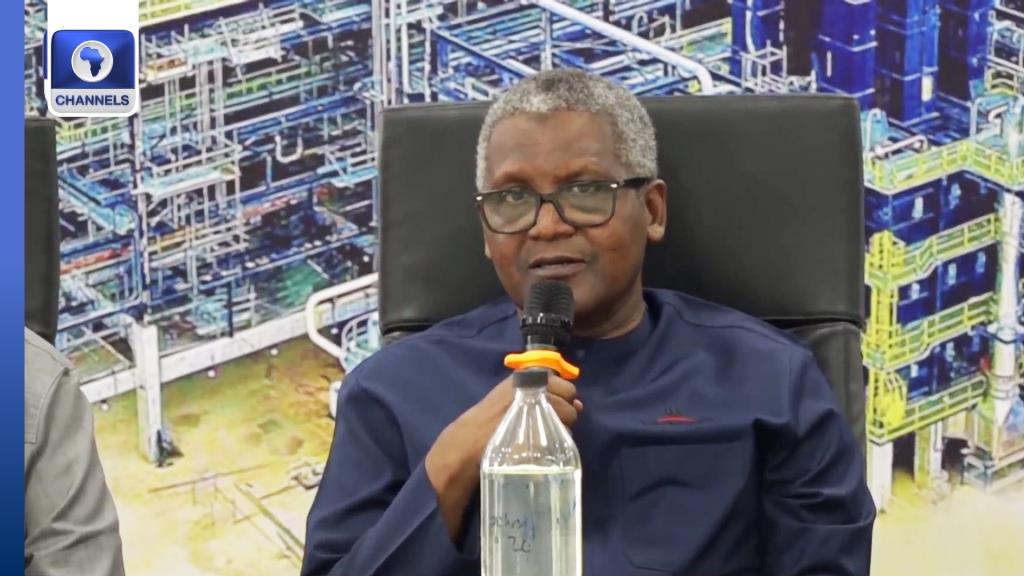
By Adedapo Adesanya
Crude oil deliveries from the Nigerian National Petroleum Company (NNPC) Limited to the Dangote Petroleum Refinery doubled in March, boosting prospects for improved fuel availability.
This was revealed by the chief executive of Dangote Industries Limited, Mr Aliko Dangote, on Tuesday, when he received the Deputy Secretary-General of the United Nations, Mrs Amina Mohammed, at the industrial complex in Ibeju-Lekki, Lagos.
While speaking on feedstock supply, Mr Dangote commended the NNPC for increasing crude deliveries to the refinery in March, noting that volumes rose to 10 cargoes—six supplied in Naira and four in Dollars—to support domestic fuel availability, according to a statement by the Refinery.
“Last month, they gave us six cargoes for Naira and four cargoes for Dollars,” he said.
Despite the improvement, Mr Dangote noted that the supply remains below the 19 cargoes required for optimal operations, with the refinery continuing to bridge the gap through imports from the United States and other African producers.
He also expressed concern over the unwillingness of international oil companies operating in Nigeria to sell to the refinery, stating that their preference for selling crude to traders forces it to repurchase at higher costs, with broader implications for the economy.
Mr Dangote added that the refinery is seeking increased access to domestically priced crude under local currency arrangements as part of efforts to moderate fuel costs and enhance long-term energy and food security across the continent.
On her part, Mrs Mohammed underscored the strategic importance of Dangote Industries Limited -particularly Dangote Fertiliser Limited—in addressing Africa’s mounting food security challenges, while calling for stronger global partnerships to scale its impact.
Mrs Mohammed said the United Nations would prioritise amplifying scalable solutions capable of mitigating the continent’s food crisis, describing Dangote’s integrated industrial model as a critical pathway.
“I think the UN’s job here is to amplify and to put visibility on the possibilities of mitigating a food security crisis, and this is one of them,” she said. “I hope that when we go back, we can continue to engage partners and countries that should collaborate with Dangote Industries.”
-
 Feature/OPED6 years ago
Davos was Different this year
-
Travel/Tourism10 years ago
Lagos Seals Western Lodge Hotel In Ikorodu
-

 Showbiz3 years ago
Estranged Lover Releases Videos of Empress Njamah Bathing
-
 Banking8 years ago
Sort Codes of GTBank Branches in Nigeria
-

 Economy3 years ago
Subsidy Removal: CNG at N130 Per Litre Cheaper Than Petrol—IPMAN
-

 Banking3 years ago
Sort Codes of UBA Branches in Nigeria
-

 Banking3 years ago
First Bank Announces Planned Downtime
-

 Sports3 years ago
Highest Paid Nigerian Footballer – How Much Do Nigerian Footballers Earn