Economy
Investors Give up N672bn as Profit-Taking Overwhelms Stock Market
By Dipo Olowookere
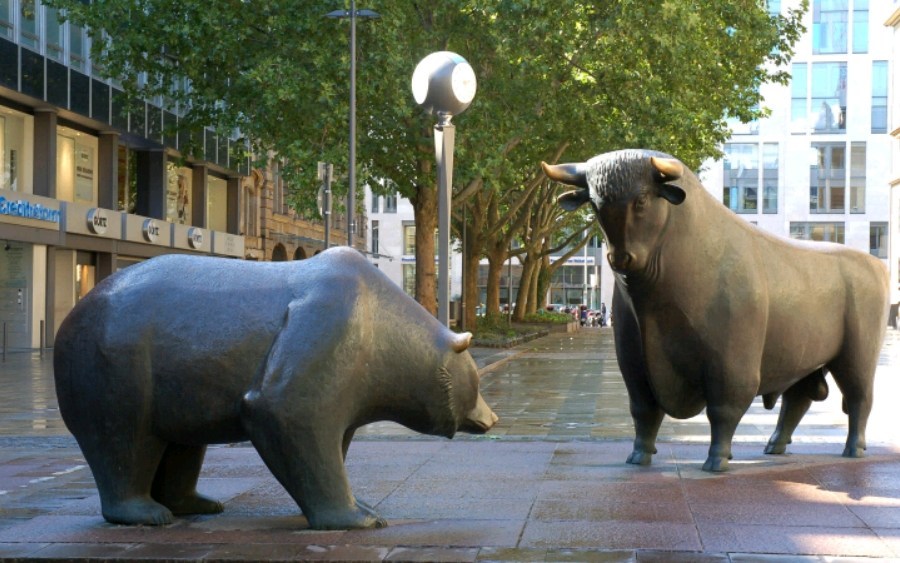
The Nigerian Exchange (NGX) Limited surrendered to the authority of the bears on Tuesday after it succumbed to profit-taking by 1.99 per cent at the close of business.
The stock market came under heavy selling pressure during the session, as investors quickly booked profit on equities that have gained additional weight in the past trading days.
This consequently chopped off N672 billion from the bourse, reducing its market capitalisation to N33.060 trillion from N33.732 trillion.
In the same vein, the All-Share Index (ASI) of the NGX shrank by 1234.20 points to 60,715.04 points from 61,949.24 points.
Business Post reports that the industrial goods sector cracked by 4.25 per cent during the trading day, as the banking index lost 3.88 per cent, with the consumer goods and insurance sectors falling by 1.35 per cent and 0.52 per cent apiece, while the energy counter expanded by 1.91 per cent.
The market breadth index was negative yesterday because the stock exchange finished with 33 price gainers and 44 price losers, indicating a weak investor sentiment.
PZ Cussons lost 10.00 per cent to trade at N20.70, Wema Bank crashed by 9.98 per cent to N5.23, BUA Cement depreciated by 9.86 per cent to N83.15, Transcorp slipped by 9.84 per cent to N3.48, and University Press slumped by 9.82 per cent to N2.48.
On the flip side, Consolidated Hallmark Insurance rose by 10.00 per cent to 99 Kobo, Eterna grew by 9.96 per cent to N25.40, Chams gained 9.88 per cent to quote at 89 Kobo, eTranzact chalked up 9.87 per cent to close at N7.79, and SAHCO moved up by 9.87 per cent to N12.25.
The volume of shares bought and sold yesterday stood at 1.1 billion units, 8.14 per cent lower than the 1.2 billion recorded a day earlier, the value of equities stood at N12.2 billion, 13.04 per cent lower than the N14.0 billion posted in the preceding day, as the number of deals increased by 0.54 per cent to 12,194 deals from 12,128 deals.
Analysis of the activity chart showed that FCMB topped with a turnover of 180.8 million shares worth N981.5 million, Sterling Holdings exchanged 107.5 million equities valued at N411.1 million, Transcorp transacted 105.9 million stocks valued at N381.0 million, UBA traded 87.3 million shares N1.1 billion, and Access Holdings sold 77.9 million stocks for N1.3 billion.
Economy
Naira Slips to N1,379/$1 at NAFEX, N1,400/$1 at Black Market
By Adedapo Adesanya
It was a bad day for the Nigerian Naira in the different segments of the foreign exchange (FX) market on Wednesday, July 8, as its value further slipped against the United States Dollar.
In the black market window, it lost N5 against the US Dollar during the session to trade at N1,400/$1 compared with Tuesday’s closing rate of N1,395/$1, but closed flat at the GTBank forex counter at N1,381/$1.
In the Nigerian Autonomous Foreign Exchange Market (NAFEX), the domestic currency depreciated against the greenback yesterday by N3.32 or 0.24 per cent to N1,379.07/$1, in contrast to the previous day’s N1,375.75/$1.
But the Naira appreciated against the Pound Sterling in the official market at midweek by 93 Kobo to 1,840.64/£1 from N1,841.57/£1, and gained N1.31 on the Euro to sell at N1,561.38/€1 compared with Tuesday’s N1,562.69/€1.
The market was liquidity-heavy, but increased demand for foreign payments dragged the exchange rate at the official window,
Traders reported that interbank FX turnover spiked by about 399 per cent on the day to $208.094 million, from $41.736 million the previous day. Also, the number of deals in the interbank market increased sharply to 150 from 47 deals.
FX analysts maintained positive expectations on the Naira outlook in the second half of 2026 despite the absence of interventions from the Central Bank of Nigeria (CBN) to support liquidity.
As for the cryptocurrency market, prices rose as Bitcoin (BTC) held above $62,000, chalking up 0.3 per cent to sell at $$62,754.96, after the US military completed another round of strikes against Iran and both sides raised the prospect of closing the Strait of Hormuz.
The escalation reignited inflation concerns and pulled forward rate expectations. Markets are increasingly treating war-related shocks as interest-rate events, with BTC now tracking front-end Treasury yields more closely than traditional hedges like crude or gold.
Dogecoin (DOGE) improved its value by 1.2 per cent to $0.0728, Binance Coin (BNB) soared by 1.1 per cent to $573.56, Ripple (XRP) appreciated by 0.9 per cent to $1.09, TRON (TRX) expanded by 0.6 per cent to $0.3309, Solana (SOL) grew by 0.2 per cent to $78.34 and Ethereum (ETH) jumped by 0.1 per cent to $1,751.22.
However, Cardano (ADA) decreased by 0.1 per cent to $0.1690, while the US Dollar Tether (USDT) and the US Dollar Coin (USDC) traded flat at $1.00 apiece.
Economy
Nigerian Equities Market Extends Bullish Run by 2.27%
By Dipo Olowookere
The bullish run seen lately in the Nigerian equities market continued on Wednesday after it closed the session with a 2.27 per cent growth.
This was influenced by renewed interest in domestic stocks by investors, who are locking funds in some shares with sound fundamentals like Airtel Africa, Aradel Holdings, Dangote Cement, and others.
Data showed that Airtel Africa and Trans-Nationwide Express gained 10.00 per cent to sell for N5,801.40 and N2.97, respectively. Fidelity Bank appreciated by 9.97 per cent to N19.85, Thomas Wyatt advanced by 9.89 per cent to N3.00, and UPDC REIT improved by 9.47 per cent to N10.40.
Conversely, Haldane McCall lost 9.95 per cent to trade at N3.53, McNichols declined by 8.89 per cent to N6.15, Transcorp slid by 5.65 per cent to N40.05, CWG went down by 5.24 per cent to N19.00, and VFD Group crashed by 5.19 per cent to N28.12.
The market breadth index remained positive after the Nigerian Exchange (NGX) Limited ended the day with 32 appreciating stocks and 24 depreciating stocks, indicating strong investor sentiment.
Business Post reports that the insurance sector was under pressure yesterday, resulting in a 0.20 per cent loss, which did not affect the outcome of the market.
The energy space gained 3.85 per cent, the industrial goods segment chalked up 1.89 per cent, the banking index rose by 1.07 per cent, and the consumer goods counter soared by 0.31 per cent.
As a result, the All-Share Index (ASI) added 5,378.70 points to finish at 242,459.98 points compared with the previous day’s 237,083.28 points, and the market capitalisation went up by N3.450 trillion to N155.586 trillion from N152.136 trillion.
The busiest equity during the trading session was Lasaco Assurance, with a turnover of 56.6 million units valued at N104.8 million. Fidelity Bank traded 47.5 million units worth N911.9 million, Linkage Assurance transacted 33.9 million units for N51.2 million, Zenith Bank sold 32.0 million units valued at N3.4 billion, and Sterling Holdings exchanged 30.5 million units worth N233.3 million.
At the close of transactions, 518.4 million shares worth N22.8 billion exchanged hands in 48,495 deals versus the 493.7 million shares valued at N28.0 billion traded in 49,969 deals a day earlier. This implied that the trading volume was up by 5.00 per cent, the trading value was down by 18.57 per cent, and the number of deals decreased by 2.95 per cent.
Economy
Oil Jumps 5% as Trump Declares Iran Deal Over
By Adedapo Adesanya
Oil prices surged over 5 per cent to a two-week high on Wednesday after US President Donald Trump declared that the interim ceasefire agreement with Iran is officially.
Brent futures rose $4.40 or 5.9 per cent to settle at $78.02 a barrel, while the US West Texas Intermediate (WTI) crude increased by $3.64 or 5.2 per cent to $73.52 per barrel.
The American President said an interim deal signed last month to end the war with Iran was “over” and that the US was likely to launch new strikes on Wednesday night following Iranian attacks on US bases in the Gulf and tankers in the Strait of Hormuz.
Asked before a NATO summit in Turkey whether the memorandum of understanding was over, President Trump said: “It’s a very interesting question. To me, I think it’s over. I don’t want to deal with them.”
He later ruled out the restart of full-fledged war with Iran, which pulled oil benchmarks lower from the session’s highest gains of as much as 9 per cent.
A fifth of global oil supplies moved through the Strait before the Iran war began on February 28 after US-Israeli airstrikes against Iran, which led to retaliation that forced Middle Eastern oil producers to cut millions of barrels of oil production.
Iran on Tuesday attacked three commercial vessels transiting the Strait of Hormuz, prompting retaliatory attacks by the US. A Saudi-flagged LNG tanker was struck on its port side, causing an engine room fire, while the supertanker suffered minor damage off the coast of Oman.
In response, US Central Command (CENTCOM) conducted massive offensive airstrikes hitting more than 80 military targets inside Iran while the Trump administration also revoked a temporary sanctions waiver that allowed Iran to sell oil and petrochemicals, cutting off a key revenue stream for the oil producer.
Freight rates for tankers operating in the Gulf have surged as shipowners demand higher risk premiums, while refiners in Asia are scrambling to secure alternative cargoes from West Africa, the US, and Latin America in case Hormuz remains closed.
The International Monetary Fund (IMF) downgraded its 2026 global economic growth forecast to 3 per cent, down from 3.5 per cent posted in 2025, with the impact of the Iran war expected to negate gains made by the ongoing AI boom.