Connect with us

Economy

Lagos Targets 4% GDP Growth in 2019

Published

on

**Dedicates 2019 Budget to Capital Projects
By Modupe Gbadeyanka

Governor Akinwunmi Ambode of Lagos State has said his administration hopes to achieve a 4 percent growth in its Gross Domestic Product (GDP) in 2019.

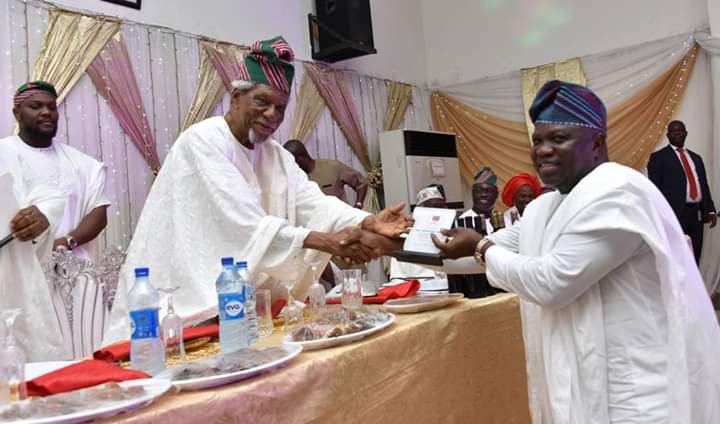
Speaking separately on Monday evening at the Christmas Eve Dance of Yoruba Tennis Club and Island Club, two foremost social clubs in the country, Mr Ambode said next year’s budget would be dedicated towards the completion of ongoing infrastructural projects, creation of more jobs, supporting businesses to thrive, as well as strengthening the security architecture of the state.

The Governor said while it was gratifying that a lot of provisions had been made for capital projects in the 2019 federal budget, the state government would also concentrate on scaling up infrastructure, among other programmes to enhance growth and development.

“The economic outlook for 2019 is quite positive. A lot of provision has been made for capital projects in the 2019 federal budget, some of which will directly impact the economy of our state and will support our growth plans. On our part, we will concentrate on completing existing infrastructural projects, creating more jobs, supporting our businesses to thrive and strengthening our security infrastructure.

“According to IMF, the Nigeria GDP will grow from 1.9% in 2018 to 2.8% in 2019. Lagos on a stand-alone basis will achieve over 4% growth in GDP and this could be more if the congestion at the port and the negative effect this has on the economy is addressed. We expect that the high rate of unemployment will reduce with various social intervention programmes of the state and federal governments geared towards financial inclusion and liquidity support to micro, small and medium enterprises,” the Governor said.

While recalling the activities of his administration in the last three and half years, Governor Ambode said it was particularly fulfilling that the state had made tremendous progress in all sectors of the economy and had become more globally competitive and strategically positioned among the major city-states worldwide.

“Three and a half years down the line, our state has progressed in all sectors of the economy. We have charted a clear path to the destination we have all dreamt about and desired. Today, our Lagos has become more globally competitive and strategically positioned among the major city-states of the world. Our state has become a top destination for business and tourism and it can only get better.

“One of the key promises I made at my inauguration on May 29th, 2015 was to make our state work for all; to spread development from the already congested city centre to other parts of the state with massive infrastructural development. The thinking has been to make every part of the state economically liveable.

“We have undertaken projects in all sectors of the economy with the sole intention of making life better for our people. All of these and similar initiatives were made possible by the personal taxes of high net worth residents of our state represented at this gathering which account for a significant percentage of our IGR and I want to use this opportunity to thank you so much for providing the resources, which have empowered us to make a positive difference in the lives of all citizens of our state,” he said.

Besides, Governor Ambode said it was obvious that the State could not afford a break in trajectory of progressive governance at this point in time, and urged the people to continue to support the ruling party in the state.

He cited the recently launched Lagos Health Insurance Scheme designed to guarantee access to quality healthcare delivery for all Lagosians, saying it was instructive that the bill for the scheme was signed into law by his predecessor, Mr Babatunde Fashola, while the process for its implementation was kick-started by his administration.

“This is the beauty in continuity and we have the assurances of Mr Babajide Sanwo-Olu, governorship candidate of All Progressives Congress (APC) in the state that the initiative will be sustained.

“Lagos State cannot afford the risk of a break in the trajectory of progressive governance at this crucial stage of development. The future is bright and assured. We must maintain continuity of progress in the state,” he said.

Governor Ambode also commended the clubs for their immense contributions to the development of the atate, and charged them to continue to play key part in taking Lagos into a brighter and more prosperous future.

In their respective addresses, Chairman of Island Club, Mr Olabanji Oladapo and his counterpart in Yoruba Tennis Club, Professor Adetokunbo Fabamwo commended Governor Ambode for the various infrastructural projects executed in the clubs, saying it was laudable that the Governor kept his promise.


Modupe Gbadeyanka is a fast-rising journalist with Business Post Nigeria. Her passion for journalism is amazing. She is willing to learn more with a view to becoming one of the best pen-pushers in Nigeria. Her role models are the duo of CNN's Richard Quest and Christiane Amanpour.

Click to comment

Leave a Reply

Your email address will not be published. Required fields are marked *

Economy

Naira Appreciates to N1,374/$ at NAFEX

Published

on

Naira-Dollar exchange rate gap

By Adedapo Adesanya

The Naira, in the Nigerian Autonomous Foreign Exchange Market (NAFEX) on Thursday, April 3, further appreciated against the United States Dollar by N4.52 or 0.33 per cent to N1,374.94/$1 from N1,379.46/$1.

Equally, the domestic currency gained against the Pound Sterling in the official market by N3.34 during the session to close at N1,858.24/£1 compared to the previous rate of N1,861.58/£1, and against the Euro, it improved by N5.29 to sell at N1,607.58/€1 versus N1,612.87/€1.

At the GTBank FX counter, the Nigerian Naira gained N4 against the Dollar to settle at N1,384/$1 versus Wednesday’s closing price of N1,389/$1, and at the parallel market, it improved by N5 to trade at N1,385/$1 compared with the N1,390/$1 it was transacted a day earlier.

Nigeria’s external reserves, which provide the Central Bank of Nigeria (CBN) with a buffer to support the Naira, continued their downward trend, declining to $48.36 billion as of April 29, 2026, according to data.

Market activity weakened sharply, with the NAFEM recording zero deals on Thursday, down from 393 deals on Wednesday. Total turnover in the official window also dropped from $802.44 million to zero, underscoring a severe liquidity squeeze.

Thursday’s price formation was driven entirely by the interbank segment, where turnover also fell significantly to $58.03 million from $249.91 million, suggesting that liquidity pressures extended across the broader FX market.

As for the cryptocurrency market, prices were up amid looming US inflation data, while high oil prices and rising bond yields weigh on risk assets.

The appreciation faces headwinds in the form of US March PCE inflation, which lands as oil prices keep pressure on risk assets, as well as reduced traffic through the Strait of Hormuz, which has kept energy markets fragile.

Dogecoin (DOGE) rose by 1.8 per cent to trade at $0.1082, Bitcoin (BTC) appreciated to $76,987.59, Ethereum (ETH) grew by 1.2 per cent to $2,276.11, Cardano (ADA) added 1.1 per cent to close at $0.2484, and Solana (SOL) soared by 1.1 per cent to $83.89.

Further, TRON (TRX) increased by 0.7 per cent to $0.3224, Ripple (XRP) jumped 0.4 per cent to $1.37, and Binance Coin (BNB) expanded by 0.2 per cent to $616.67, while the US Dollar Tether (USDT) and the US Dollar Coin (USDC) closed flat at $1.00 each.

Continue Reading

Economy

Customs Street Climbs 2.14% as BUA Cement, FTN Cocoa Top Gainers’ Log

Published

on

Customs Street

By Dipo Olowookere

A further 2.14 per cent leap was recorded by the Nigerian Exchange (NGX) Limited on Thursday, the last trading session of April 2026.

This was supported by strong buying pressure despite selling pressure in the consumer goods and insurance sectors, which lost 0.14 per cent and 0.07 per cent, respectively.

It was observed that the energy index went up by 4.78 per cent, the industrial goods space appreciated by 4.13 per cent, and the banking segment rose by 0.52 per cent.

As a result, the All-Share Index (ASI) gained 5,072.22 points to settle at 242,277.81 points versus the 237,205.59 points on Wednesday, and the market capitalisation jumped N3.266 trillion to N155.994 trillion from N152.728 trillion.

FTN Cocoa, BUA Cement, CAP, UAC Nigeria, and Zichis soared by 10.00 per cent each to quote at N5.50, N418.00, N145.20, N181.50, and N21.78, respectively.

On the flip side, Aluminium Extrusion lost 9.95 per cent to trade at N9.50, Royal Exchange declined by 9.93 per cent to N1.36, Legend Internet slipped by 9.32 per cent to N5.35, Austin Laz dropped 9.12 per cent to N3.39, and Neimeth went down by 7.26 per cent to N8.30.

Business Post reports that there were 46 price gainers and 41 price losers on Customs Street during the session, implying a positive market breadth index and strong investor sentiment.

A total of 1.9 billion shares valued at N104.3 billion were traded in 92,353 deals yesterday compared with the 1.3 billion shares worth N69.1 billion transacted in 83,445 deals at midweek, indicating a surge in the trading volume, value, and number of deals by 46.15 per cent, 50.94 per cent, and 10.68 per cent, respectively.

At the close of business, Access Holdings led the activity chart with 935.0 million units sold for N24.3 billion, Lasaco Assurance traded 90.2 million units valued at N175.2 million, UBA exchanged 89.0 million units worth N3.9 billion, Wema Bank transacted 68.4 million units worth N2.4 billion, and GTCO sold 54.7 million units valued at N7.4 billion.

Continue Reading

Economy

Crude Oil Slips Below $115 After Hitting Four-Year High on US-Iran Fears

Published

on

crude oil exports

By Adedapo Adesanya

Crude oil fell below $115 after hitting a four-year high of more than $126 a barrel earlier on Thursday ​on concerns the US-Iran war could disrupt the wider global economy.

Data showed that Brent crude futures lost $4.02 or 3.41 per cent to trade at $114.01 per barrel, and the US West Texas Intermediate (WTI) crude futures gave up $1.81 or 1.69 per cent to trade at $105.07 per barrel.

According to market analysts, the drop in prices from intraday highs did not have an obvious catalyst and did not look related to a specific development, but reflected the heightened volatility in the market since the Iran war started.

Others noted the retreat in US Dollar strength on Thursday also put downward pressure on oil.

Japan’s Yen surged 3 per cent, the most in a day in over three years, on Thursday, following stark warnings from Japanese officials that intervention to prop up the currency, as well as action in other markets, including ​energy, could be imminent.

The jump in the Japanese currency puts the US currency down, on track for its biggest one-day drop against the Yen since last August.

US President Donald Trump is slated to receive a ​briefing on plans for a series of fresh military strikes on Iran to compel it to negotiate an end to the conflict.

Iran said it would respond with “long and painful strikes” on US ‌positions if ⁠the US renewed attacks, and also reasserted its control over the Strait of Hormuz.

This complicates US plans for a coalition to reopen the waterway, which accounts for about 20 per cent of crude and Liquified Natural Gas (LNG) flows.

Since the US-Israeli attack on Iran began on February 28, the price of Brent and WTI has risen by around 90 per cent due to the effective closure of the strait.

The oil price gains risk a renewed spike in global inflation and higher pump prices across the world. Oil, gas, and their refined byproducts are critical for fuelling cars, ​trucks and planes, powering homes and industry and ​producing plastics and fertilisers.

President Trump called a ceasefire in ⁠the war earlier this month, but also imposed a US blockade on Iranian ports.

Talks to resolve the conflict, which has killed thousands and caused what the International Energy Agency (EIA) says is the world’s biggest oil disruption ever, have deadlocked.

Traders worry as the US insists on discussing Iran’s alleged nuclear weapons programme and Iran demands ​some control over the strait and reparations for damage from the war.

The United Arab Emirates (UAE) said on Tuesday it would exit the Organisation of Petroleum Exporting Countries (OPEC) after nearly 60 years as a member.

Continue Reading

Trending