Economy
Middle East Tensions: Dangote Refinery Exports 1.66 billion Litres of Petroleum Products
By Adedapo Adesanya
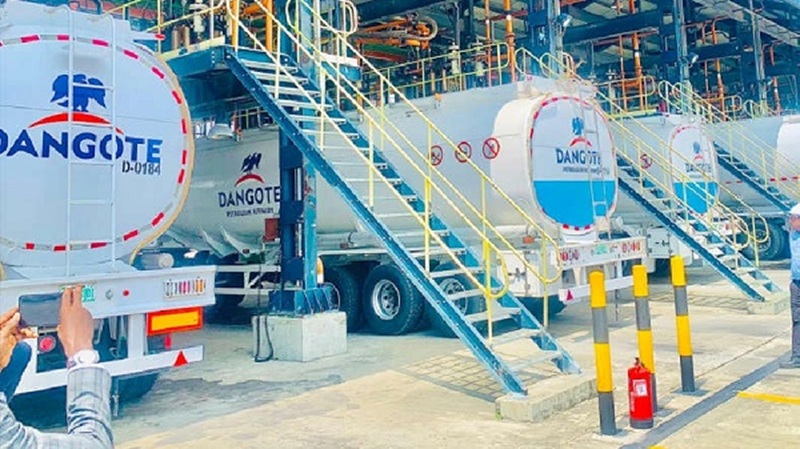
An estimated 1.66 billion litres of refined petroleum products were exported by Dangote Petroleum Refinery in April 2026, amid continued tensions in the Middle East and fears of possible disruption to global fuel supply routes following the growing conflict involving the United States and Iran.
According to the latest data from the Nigerian Midstream and Downstream Petroleum Regulatory Authority (NMDPRA), the country exported about 513 million litres of Premium Motor Spirit (PMS), popularly called petrol; 534 million litres of Automotive Gas Oil (AGO), also known as diesel; and 615 million litres of aviation fuel within the month under review.
The Dangote refinery is the only major functional refinery in Nigeria that currently produces enough refined petroleum products for both local consumption and export.
This is the first month the refinery has exported such a high volume of petroleum products, especially jet fuel and diesel, indicating the significance of the 650,000-barrel-per-day plant.
The combined export volume translates to approximately 55.4 million litres daily. The development comes as the international oil market faces fresh uncertainty over the security of the Strait of Hormuz, a critical global oil shipping route, following the failure of the United States and Iran to agree on a peace deal.
The NMDPRA document showed that local refineries operated at an average capacity utilisation of 99.12 per cent in April, with the Dangote refinery accounting for the lion’s share of production.
The downstream regulator stated that the refinery achieved 100 per cent capacity utilisation “for most of the days in April.” The report also indicated that domestic refineries received 18.37 million barrels of crude oil in April, up from 13.11 million barrels recorded in March.
Findings further showed that the refinery maintained strong export momentum despite increased domestic supply obligations.
According to the April fact sheet, average daily petrol production stood at 53.6 million litres, while 40.7 million litres were supplied locally and 17.1 million litres were exported daily.
Similarly, diesel production averaged 23.6 million litres daily, with exports accounting for 17.8 million litres per day, more than double the domestic supply volume of 8 million litres daily. For aviation fuel, exports stood at 20.5 million litres daily, compared to the domestic supply of 2.6 million litres per day.
The strong aviation fuel export performance comes weeks after reports emerged that domestic airline operators threatened to shut down over the rising cost of the fuel.
There are reports that Nigeria has become a net petrol exporter for the first time in decades due to rising output from the Dangote refinery. The refinery had earlier exported about 434 million litres of petrol in March after domestic production exceeded local consumption levels.
The latest figures underscore Nigeria’s gradual transition from a major importer of refined petroleum products to an export hub within Africa. It was observed that jet fuel exports may rise further if instability in the Middle East continues to disrupt traditional supply chains serving Europe and other regions.
The Middle East accounts for a substantial share of global aviation fuel exports, with the Strait of Hormuz serving as a strategic transit corridor for crude oil and refined petroleum products. The prolonged disruption in the region has tightened global fuel supply and pushed up prices internationally.
The NMDPRA report also revealed that Nigerians consumed an average of 51.1 million litres of petrol daily in April, slightly above the 50 million litres benchmark estimated by the regulator. Diesel consumption stood at 17.3 million litres daily, while aviation fuel consumption averaged 2.5 million litres per day.
Economy
Lagos Illustrates Digital Expansion Plans With $22m FDI Commitments
By Adedapo Adesanya
The Lagos State Government has secured about $22 million in Foreign Direct Investment (FDI) commitments to expand digital infrastructure across the state, in a move aimed at strengthening its position as Nigeria’s leading technology and innovation hub.
The investment was facilitated through the Lagos State Infrastructure Maintenance and Regulatory Agency (LASIMRA) and is expected to accelerate the deployment of fibre optic networks, improve broadband penetration and support smart-city development initiatives.
Speaking recently during the 2026 Ministerial Press Briefing held in Alausa, Ikeja, the Special Adviser to the Governor on Infrastructure, Mr Olufemi Daramola, disclosed that LASIMRA attracted foreign direct investment commitments worth about $22 million targeted at the rollout of high-capacity fibre optic infrastructure across Lagos State.
He said the development aligns with the government’s broader strategy to expand the state’s digital economy and enhance technology-driven growth in Africa’s most populous commercial centre.
Mr Daramola explained that the agency also facilitated additional investments for the deployment of about 30,000 kilometres of 28-way fibre duct infrastructure along strategic corridors across the state, building on the existing 3,000 kilometres of fibre already installed.
He noted that the expansion would significantly improve internet connectivity, boost broadband access and strengthen operations within Lagos’ rapidly growing digital ecosystem.
Beyond foreign investment inflows, he revealed that LASIMRA recorded a 300 per cent increase in revenue generation during the review period, driven by improved permit processing systems, enhanced regulatory compliance and the introduction of digital workflow platforms.
He further disclosed that the agency is advancing the Automated Telecom Infrastructure Registration System (TIRS), a digital platform designed to automate infrastructure registration, improve compliance monitoring and accelerate permit approvals for telecom operators.
“As part of its smart-city agenda, Lagos has deployed Geographic Information System (GIS) technology for mapping and monitoring fibre routes, telecommunications masts and towers, while also advancing the rollout of 5G-enabled smart poles across the state,” he said.
Mr Daramola added that the ongoing initiatives are aimed at building a resilient and future-ready digital infrastructure ecosystem capable of attracting further investments, fostering innovation and supporting long-term economic growth.
This marks the latest government move in tech following its plans to expand the city’s data centre capacity to over 250 megawatts (MW) by 2030 as part of efforts to strengthen the digital infrastructure ecosystem.
Economy
Nigeria’s Capital Market Leads Africa with Transition to T+1 Settlement Cycle
By Aduragbemi Omiyale
On Monday, June 1, 2026, the Nigerian capital market achieved a historic milestone with the successful transition to a T+1 settlement cycle.
With this feat, it becomes the first market in Africa to implement the shortened settlement framework designed to enhance efficiency, reduce risk, and improve global competitiveness.
This is part of efforts to align the ecosystem with global best practices, where shorter settlement cycles are increasingly being adopted to improve post-trade efficiency, reduce counterparty risk, and strengthen investor confidence, reaffirming regulators’ commitment to continued modernisation of market systems and processes.
The transition follows six months of coordinated industry-wide preparations involving regulators, exchanges, depositories, custodians, registrars, and other market participants, positioning Nigeria among global markets adopting shorter settlement cycles to improve post-trade efficiency and market resilience
At a ceremony to mark this achievement through a symbolic closing gong ceremony yesterday, the Director-General of the Securities and Exchange Commission (SEC), Mr Emomotimi Agama, described the development as a defining moment in the market’s evolution.
“The era of T+1 has begun. In just six months, Nigeria has successfully progressed from T+2 to T+1 settlement, joining a growing group of markets embracing faster and more efficient settlement cycles.
“This achievement signals that Nigeria is prepared to undertake the structural reforms required to compete for global capital,” Mr Agama enthused.
In his goodwill message, the chairman of the Nigerian Exchange (NGX) Group Plc, Mr Umaru Kwairanga, described the transition as a key step in the ongoing transformation of Nigeria’s capital market.
He said the development underscores the shared commitment of stakeholders to strengthening market institutions, deepening investor confidence, and enhancing the market’s role in supporting economic growth and capital formation.
“Milestones such as this reinforce confidence in our institutions and demonstrate our collective determination to build a more efficient and globally competitive capital market,” he stated.
Also speaking at the event, the Chairman of Central Securities Clearing System (CSCS) Plc and chief executive of NGX Group, Mr Temi Popoola, said the transition represents a critical step in the broader evolution of Nigeria’s capital market.
He noted that while the achievement marks a significant milestone, it is part of a longer journey toward building a deeper, more liquid, and more globally competitive market capable of supporting sustained economic growth and capital formation.
“While today is a significant milestone, it is not the destination. It is part of a broader journey toward building a deeper, more liquid, efficient, and globally competitive capital market capable of supporting long-term economic growth and capital formation,” Mr Popoola stated.
On his part, the chief executive of CSCS Plc, Mr Shehu Shantali, said the milestone reflects the strength and operational readiness of Nigeria’s post-trade ecosystem, noting that the new settlement cycle would enhance transaction speed, improve liquidity efficiency, and reduce settlement exposure across the market.
“This transition is far more than a reduction in settlement timelines. It represents a strategic upgrade to market infrastructure and reinforces our commitment to building a more efficient, resilient, and globally competitive capital market,” he disclosed.
Economy
NASD OTC Market Declines 0.21% as Capitalisation Falls to N2.587tn
By Adedapo Adesanya
The NASD Over-the-Counter (OTC) Securities Exchange recorded a loss of 0.21 per cent on Monday, June 1, with the market capitalisation down by N5.44 billion to N2.587 trillion from N2.592 trillion, and the Unlisted Security Index (NSI) falling by 9.10 points to close at 4,324.68 points compared with last Friday’s 4,333.78 points.
The unlisted securities exchange came under selling pressure yesterday, as investors trimmed their exposure to the landscape, with the volume of securities rising by 438.3 per cent to 3.6 million units from 666,853 units. Also, the value of securities increased by 465.9 per cent to N177.4 million from N31.4 million, and the number of deals surged by 37.0 per cent to 37 deals from 27 deals.
Great Nigeria Insurance (GNI) Plc closed the session as the most traded stock by value on a year-to-date basis with 3.4 billion units worth N8.4 billion, followed by Infrastructure Credit Guarantee (Infracredit) Plc with 2.3 billion units sold for N6.5 billion, and Central Securities Clearing System (CSCS) Plc with 61.2 million units exchanged for N4.4 billion.
GNI Plc also closed the day as the most traded stock by volume on a year-to-date basis with 3.4 billion units valued at N8.4 billion, followed by Infracredit Plc with 2.3 billion units transacted for N6.5 billion, and Resourcery Plc with 1.1 billion units traded at N415.7 million.
There were three price gainers and four losers on the first trading day of the new month yesterday, with FrieslandCampina Wamco Nigeria Plc up by N10.60 to N186.68 per share from N176.08 per share. MRS Oil Plc added N1.90 to close at N180.00 per unit versus N178.10 per unit, and Afriland Properties Plc grew by 5 Kobo to sell at N16.0o per share versus N15.90 per share.
On the flip side, CSCS Plc dropped N4.83 to trade at N72.97 per unit compared with the previous session’s N77.80 per unit, IPWA Plc lost 21 Kobo to sell at N2.03 per share versus N2.24 per share, Industrial and General Insurance (IGI) Plc fell by 6 Kobo to 54 Kobo per unit from 60 Kobo per unit, and Food Concepts Plc declined by 2 Kobo to N2.68 per share from N2.70 per share.
The market has commenced the T+1 settlement cycle, meaning securities transactions will be executed within one business day as part of efforts to enhance efficiency and speed in the Nigerian capital market.
-
Feature/OPED6 years agoDavos was Different this year
-
Travel/Tourism10 years ago
Lagos Seals Western Lodge Hotel In Ikorodu
-
Showbiz3 years agoEstranged Lover Releases Videos of Empress Njamah Bathing
-
Banking8 years agoSort Codes of GTBank Branches in Nigeria
-
Economy3 years agoSubsidy Removal: CNG at N130 Per Litre Cheaper Than Petrol—IPMAN
-
Banking3 years agoSort Codes of UBA Branches in Nigeria
-
Banking3 years agoFirst Bank Announces Planned Downtime
-
Sports3 years agoHighest Paid Nigerian Footballer – How Much Do Nigerian Footballers Earn