Economy
We Will Continue to Borrow Responsibly—Tinubu
By Adedapo Adesanya
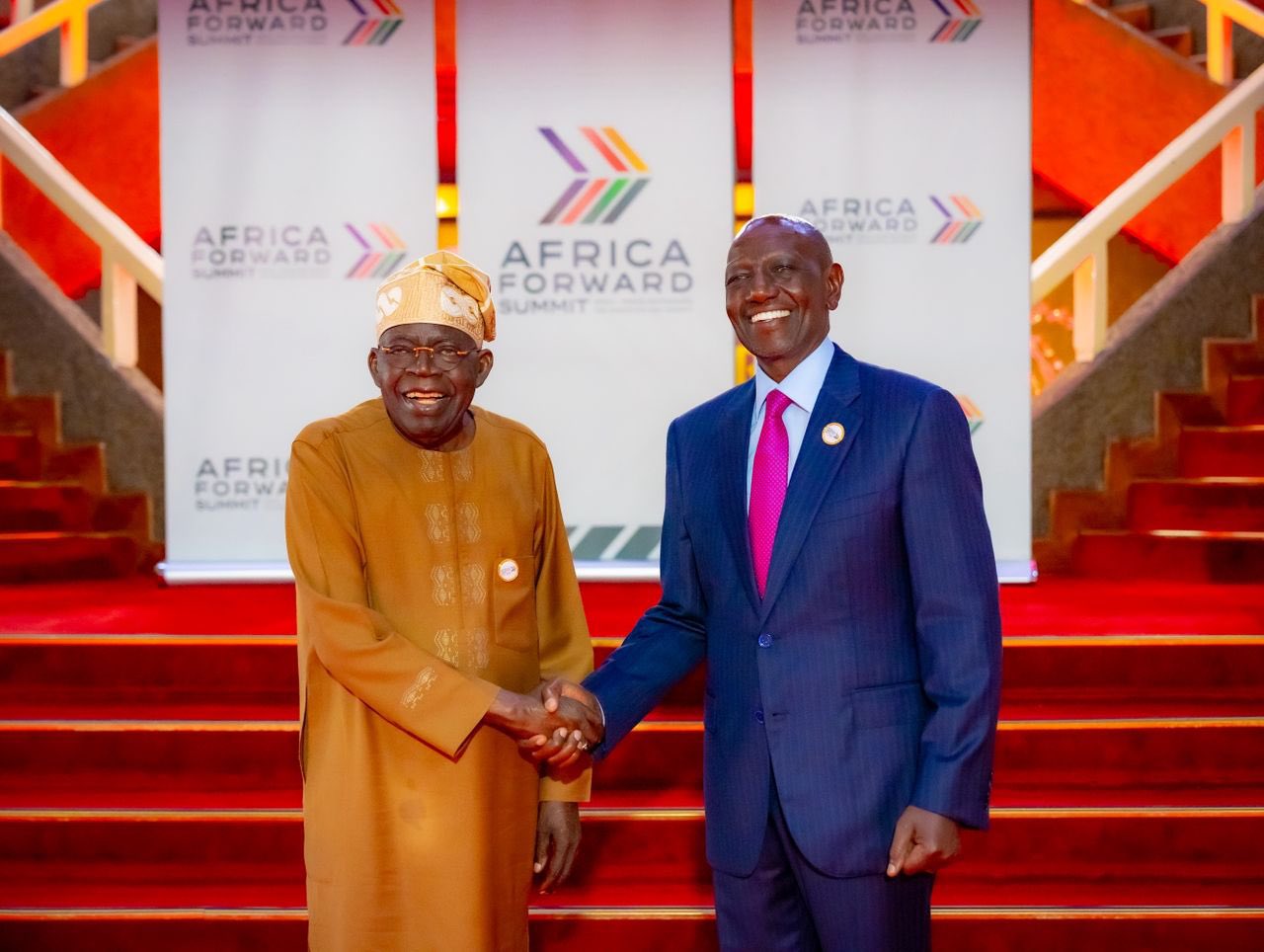
President Bola Tinubu has said that Nigeria would continue to borrow responsibly amid rising concerns about the country’s swelling debt profile.
According to a statement by presidential spokesperson, Mr Bayo Onanuga, President Tinubu made the remarks on Tuesday while leading Nigeria’s government, diplomatic, and business delegation to the Africa Forward Summit at the Kenyatta Convention Centre in Nairobi.
Mr Tinubu noted that the debt to be repaid in the year is nearly half of the projected revenue, at about $11.6 billion.
“Every single dollar that leaves our treasury to pay punitive interest rates is a Dollar that did not go into our steel sector, our textile mills, our agro-processing plants, or our digital industries. It is a dollar that did not train a young Nigerian engineer or provide affordable power for our factories.
“Our industrial base is being starved of the blood it needs — long-term, affordable finance — while creditors and rating agencies treat African sovereigns as permanent high-risk borrowers, regardless of our fiscal performance.
“So, I ask this gathering: how can an African manufacturer compete with a competitor in Europe, Asia, or North America when the cost of borrowing in our nations is five to ten times higher? How can we build cross-border industrial value chains under the African Continental Free Trade Area when our infrastructure projects face a financing gap deepened by the very institutions meant to bridge it? The answer is plain: we cannot. The international financial architecture, as currently constituted, is an instrument of industrial disarmament for Africa.”
He emphasised that Nigeria is not asking for charity, adding that the country will have to borrow, albeit responsibly.
“We are demanding a financial system that intentionally enables Africa to industrialise — to process its own minerals, refine its own crude oil, manufacture its own pharmaceuticals, and compete fairly in global markets.
“We will continue to borrow responsibly, but we insist that our creditworthiness be measured by our economic fundamentals and our industrial potential, not by outdated stereotypes,” he noted.
He called for deeper economic integration across Africa, stressing the need for policies that prioritise the continent’s industrial growth and prosperity.
Mr Tinubu highlighted Nigeria’s blue economy potential as a key driver of Africa’s development, noting that it had long been underutilised due to insecurity and uncertainty.
“Today, I make an explicit commitment: Nigeria will intensify regional coordination by offering our Deep Blue Project’s maritime intelligence infrastructure as a shared data hub for willing Gulf of Guinea states. Interoperable systems, harmonised laws, and seamless joint enforcement must become the daily reality, not an aspiration on paper.
“Let no one misunderstand: maritime sovereignty does not repel investment — it attracts it. Secure sea lanes, predictable regulation, and functional courts are the preconditions that unlock private capital. Governance has de-risked Nigeria’s maritime proposition. We now invite partners to build on these gains as we advance climate-aligned port modernisation and the digital transformation of our maritime sector.
“As we endorse the Nairobi Declaration, Nigeria affirms that maritime sovereignty and ocean governance are the non-negotiable foundations of Africa’s Blue Economy transformation. We will continue to earn that sovereignty — through institutions, through assets, through law, and through iron-clad regional solidarity that turns our waters from a theatre of risk into a story of shared resilience.
“The oceans have no duplicate as a common heritage of mankind. For Africa, moving from sea blindness to ocean sovereignty is not a choice — it is a generational duty. Nigeria is ready, and we invite all present to join us in that duty,” the President stated.
Economy
Brent, WTI Climb 1% Amid Hopes of Iran-US War Truce
By Adedapo Adesanya
The prices of the two major crude oil grades climbed about 1 per cent on Tuesday as the market waited for news on the Iran war, with the Iranian government reviewing a proposed agreement with the United States to halt the conflict.
Brent futures rose $1.02 or 1.1 per cent to $96.00 a barrel, while the US West Texas Intermediate (WTI) crude increased by $1.60 or 1.7 per cent to $93.76 per barrel.
Iran is examining the proposed deal with the US to halt their war but has not communicated with the American government for a few days, according to Iranian media.
This is even as US President Donald Trump said on Monday that negotiations had been going on, adding there would be a deal in the coming days to extend a ceasefire agreed to in April and reopen the strait.
Meanwhile, US Secretary of State Marco Rubio told lawmakers yesterday that Iran has agreed to negotiate aspects of its nuclear programme that it previously refused to discuss, but said that was not a guarantee that negotiations would lead to a deal.
More than three months after the US and Israel launched strikes against Iran, the conflict is stuck in a stalemate, with a shaky ceasefire in place while the pivotal Strait of Hormuz remains largely shut to maritime traffic.
Iran has effectively halted most non-Iranian shipping in and out of the Gulf since the war began, choking off about a fifth of global oil and liquefied natural gas flows and driving prices up by 50 per cent or more. The US has also maintained a blockade on Iranian ports.
The European Union (EU) signalled willingness to support a durable agreement through maritime operations, economic incentives and conditional sanctions relief. This is contingent on a temporary peace agreement between the US and Iran.
The International Energy Agency (IEA) warned that global oil markets could enter a “red zone” in July and August as rapidly depleting crude inventories coincide with the onset of peak summer fuel demand.
According to the energy watchdog, global oil inventories fell by over 250 million barrels between March and May, with on-land commercial and strategic stockpiles draining at a record pace.
The closure of the Strait of Hormuz has knocked out roughly 10 per cent of global oil supply, making this the largest oil supply shock in history. Net cumulative losses from Gulf producers exceed 1 billion barrels, with approximately 14 million barrels per day shut in. Global supply is projected to fall by around 3.9 million barrels per day across 2026, with the IEA projecting that the global oil deficit will average 1.78 million barrels per day for the full year.
Economy
Lagos Illustrates Digital Expansion Plans With $22m FDI Commitments
By Adedapo Adesanya
The Lagos State Government has secured about $22 million in Foreign Direct Investment (FDI) commitments to expand digital infrastructure across the state, in a move aimed at strengthening its position as Nigeria’s leading technology and innovation hub.
The investment was facilitated through the Lagos State Infrastructure Maintenance and Regulatory Agency (LASIMRA) and is expected to accelerate the deployment of fibre optic networks, improve broadband penetration and support smart-city development initiatives.
Speaking recently during the 2026 Ministerial Press Briefing held in Alausa, Ikeja, the Special Adviser to the Governor on Infrastructure, Mr Olufemi Daramola, disclosed that LASIMRA attracted foreign direct investment commitments worth about $22 million targeted at the rollout of high-capacity fibre optic infrastructure across Lagos State.
He said the development aligns with the government’s broader strategy to expand the state’s digital economy and enhance technology-driven growth in Africa’s most populous commercial centre.
Mr Daramola explained that the agency also facilitated additional investments for the deployment of about 30,000 kilometres of 28-way fibre duct infrastructure along strategic corridors across the state, building on the existing 3,000 kilometres of fibre already installed.
He noted that the expansion would significantly improve internet connectivity, boost broadband access and strengthen operations within Lagos’ rapidly growing digital ecosystem.
Beyond foreign investment inflows, he revealed that LASIMRA recorded a 300 per cent increase in revenue generation during the review period, driven by improved permit processing systems, enhanced regulatory compliance and the introduction of digital workflow platforms.
He further disclosed that the agency is advancing the Automated Telecom Infrastructure Registration System (TIRS), a digital platform designed to automate infrastructure registration, improve compliance monitoring and accelerate permit approvals for telecom operators.
“As part of its smart-city agenda, Lagos has deployed Geographic Information System (GIS) technology for mapping and monitoring fibre routes, telecommunications masts and towers, while also advancing the rollout of 5G-enabled smart poles across the state,” he said.
Mr Daramola added that the ongoing initiatives are aimed at building a resilient and future-ready digital infrastructure ecosystem capable of attracting further investments, fostering innovation and supporting long-term economic growth.
This marks the latest government move in tech following its plans to expand the city’s data centre capacity to over 250 megawatts (MW) by 2030 as part of efforts to strengthen the digital infrastructure ecosystem.
Economy
Nigeria’s Capital Market Leads Africa with Transition to T+1 Settlement Cycle
By Aduragbemi Omiyale
On Monday, June 1, 2026, the Nigerian capital market achieved a historic milestone with the successful transition to a T+1 settlement cycle.
With this feat, it becomes the first market in Africa to implement the shortened settlement framework designed to enhance efficiency, reduce risk, and improve global competitiveness.
This is part of efforts to align the ecosystem with global best practices, where shorter settlement cycles are increasingly being adopted to improve post-trade efficiency, reduce counterparty risk, and strengthen investor confidence, reaffirming regulators’ commitment to continued modernisation of market systems and processes.
The transition follows six months of coordinated industry-wide preparations involving regulators, exchanges, depositories, custodians, registrars, and other market participants, positioning Nigeria among global markets adopting shorter settlement cycles to improve post-trade efficiency and market resilience
At a ceremony to mark this achievement through a symbolic closing gong ceremony yesterday, the Director-General of the Securities and Exchange Commission (SEC), Mr Emomotimi Agama, described the development as a defining moment in the market’s evolution.
“The era of T+1 has begun. In just six months, Nigeria has successfully progressed from T+2 to T+1 settlement, joining a growing group of markets embracing faster and more efficient settlement cycles.
“This achievement signals that Nigeria is prepared to undertake the structural reforms required to compete for global capital,” Mr Agama enthused.
In his goodwill message, the chairman of the Nigerian Exchange (NGX) Group Plc, Mr Umaru Kwairanga, described the transition as a key step in the ongoing transformation of Nigeria’s capital market.
He said the development underscores the shared commitment of stakeholders to strengthening market institutions, deepening investor confidence, and enhancing the market’s role in supporting economic growth and capital formation.
“Milestones such as this reinforce confidence in our institutions and demonstrate our collective determination to build a more efficient and globally competitive capital market,” he stated.
Also speaking at the event, the Chairman of Central Securities Clearing System (CSCS) Plc and chief executive of NGX Group, Mr Temi Popoola, said the transition represents a critical step in the broader evolution of Nigeria’s capital market.
He noted that while the achievement marks a significant milestone, it is part of a longer journey toward building a deeper, more liquid, and more globally competitive market capable of supporting sustained economic growth and capital formation.
“While today is a significant milestone, it is not the destination. It is part of a broader journey toward building a deeper, more liquid, efficient, and globally competitive capital market capable of supporting long-term economic growth and capital formation,” Mr Popoola stated.
On his part, the chief executive of CSCS Plc, Mr Shehu Shantali, said the milestone reflects the strength and operational readiness of Nigeria’s post-trade ecosystem, noting that the new settlement cycle would enhance transaction speed, improve liquidity efficiency, and reduce settlement exposure across the market.
“This transition is far more than a reduction in settlement timelines. It represents a strategic upgrade to market infrastructure and reinforces our commitment to building a more efficient, resilient, and globally competitive capital market,” he disclosed.
-
Feature/OPED6 years agoDavos was Different this year
-
Travel/Tourism10 years ago
Lagos Seals Western Lodge Hotel In Ikorodu
-
Showbiz3 years agoEstranged Lover Releases Videos of Empress Njamah Bathing
-
Banking8 years agoSort Codes of GTBank Branches in Nigeria
-
Economy3 years agoSubsidy Removal: CNG at N130 Per Litre Cheaper Than Petrol—IPMAN
-
Banking3 years agoSort Codes of UBA Branches in Nigeria
-
Banking3 years agoFirst Bank Announces Planned Downtime
-
Sports3 years agoHighest Paid Nigerian Footballer – How Much Do Nigerian Footballers Earn