Economy
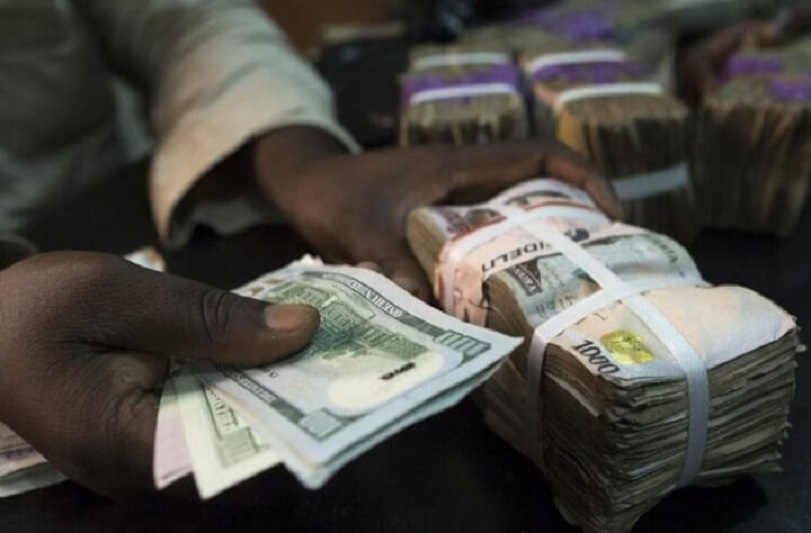
Naira Corrects to N1,353/$1 at Official Market
By Adedapo Adesanya
The Naira depreciated against the United States Dollar by N4.71 or 0.35 per cent in the Nigerian Autonomous Foreign Exchange Market (NAFEX) on Thursday, February 12, to N1,353.66/$1 from the N1,348.95/$1 it was traded on Wednesday.
Similarly, it weakened against the Pound Sterling in the same market segment by N9.53 to settle at N1,849.64/£1 versus the previous day’s N1,840.11/£1 and lost N8.55 against the Euro to close at N1,608.68/€1 compared with the N1,600.13/€1 it was exchanged at midweek.
Also, at the GTBank FX section, the Nigerian Naira suffered a N1 loss against the US Dollar yesterday to quote at N1,359/$1, in contrast to Wednesday’s price of N1,358/$1, but closed flat in the parallel market at N1,430/$1.
The pullback witnessed by the Nigerian currency at the currency market on Thursday came as the market corrected from recent gains, with a further boost coming as the Central Bank of Nigeria (CBN) said all duly licensed Bureaux De Change (BDC) operators are permitted to purchase foreign exchange from the Nigerian FX market through any authorised dealer bank of their choice at prevailing market rates.
The move follows the apex bank confirmation in September 2025 that 82 BDC operators had been fully licensed under its revised regulatory framework, with operations commencing on November 27, 2025, as part of reforms aimed at formalising retail foreign exchange supply.
According to Mr Aminu Gwadabe, president of the Association of Bureaux De Change Operators of Nigeria (ABCON), there are expectations that the CBN’s move will help the Naira-US Dollar exchange value.
He noted that BDC operators have started approaching their banks to understand the operational modalities and framework for accessing dollars.
“We expect before the close of the week a comprehensive take-off of operations,” he added.
In the cryptocurrency market, Bitcoin has mostly erased its bounce from last week’s crypto crash, returning to the $66,000 area. It tumbled by 1.9 per cent to $66,161.78 yesterday.
The sell-off in digital assets tracked a broader pullback in the tech sector, particularly in the software names with which Bitcoin has been so strongly correlated.
Solana (SOL) dropped 2.4 per cent to sell for $77.68, Ripple (XRP) dipped 0.7 per cent to $1.36, and Ethereum (ETH) went down by 0.6 per cent to $1,938.96.
However, Cardano (ADA) added 1.7 per cent to trade at $0.2612, Dogecoin (DOGE) grew by 1.4 per cent to $0.0923, Litecoin (LTC) expanded by 0.6 per cent to $52.69, and Binance Coin (BNB) jumped 1.2 per cent to $610.55, while the US Dollar Tether (USDT) and the US Dollar Coin (USDC) closed flat at $1.00 each.
Economy
Linking Macroeconomic Trends to Personal Financial Goals Vital—Delano
By Aduragbemi Omiyale
The Executive Director for Personal and Private Banking at Stanbic IBTC, Mr Olu Delano, has stressed the need to link macroeconomic trends to personal financial goals.
At the 2026 Regional Economic Outlook Series of Stanbic IBTC recently, he said, “Whether planning for retirement, funding education abroad, or expanding a business, improved stability creates opportunities. But those opportunities require careful structuring around foreign exchange dynamics, inflation trends, and interest rate movements.”
Business Post reports that the regional investor summit was designed to provide high-net-worth individuals, investors, business leaders, and senior executives with clarity in a rapidly evolving economic environment.
Hosted in Lagos, Abuja, and Port Harcourt, the series served as a strategic platform for translating Nigeria’s reform momentum into practical investment and business decisions.
It featured a keynote address by Professor Adedipe, whose insights set a strong analytical foundation for the conversations that followed. His presentation unpacked structural reforms, fiscal recalibration, and the direction of monetary policy, offering attendees a comprehensive perspective on Nigeria’s growth trajectory and the discipline required to sustain macroeconomic stability.
Across all three cities, Stanbic IBTC’s subject matter experts and industry professionals moved the discussion from macroeconomic signals to market strategy. Sessions were structured to bridge economic context with sector-specific opportunities, portfolio construction frameworks, and risk management considerations. The focus extended beyond understanding the environment to making informed, disciplined decisions within it.
A recurring theme throughout the summit was the evolving monetary policy cycle. Discussions examined the Central Bank of Nigeria’s tight stance in addressing inflationary pressures and stabilising the currency.
Participants also considered the potential implications of a gradual policy easing cycle, particularly for fixed income instruments, equity positioning, and broader asset allocation strategies. Emphasis was placed on timing, selectivity, and portfolio resilience.
Beyond markets, the conversations addressed the practical realities of wealth and business strategy. High net worth individuals gained clarity on diversification, currency exposure, and inflation management, while business leaders explored how improving macroeconomic stability can support capital allocation decisions and long-term expansion plans.
The chief executive of Stanbic IBTC Asset Management, Ms Busola Jejelowo, reflected on the quality of engagement across the regions.
She noted that the depth of questions and analytical rigour demonstrated a maturing investment culture and a growing appetite for data-driven strategies.
According to her, the series was not only about presenting forecasts, but about equipping clients with structured frameworks for navigating uncertainty.
Economy
Coronation Registrars Processes N1.28trn Dividends for Stock Investors
By Adedapo Adesanya
Coronation Registrars Limited processed N1.28 trillion in dividends for the year 2025, representing over 40 per cent of the total dividends distributed on the Nigerian Exchange (NGX) Limited.
This information was revealed by the company in its 2025 performance scorecard, highlighting its continued role in supporting transparency, efficiency, and investor confidence within Nigeria’s capital market.
According to the company, the performance underscores its scale and the trust placed in it by leading publicly listed companies, which it helps in administering dividend processing. Other functionalities include managing shareholder records, corporate actions, and investor communications while ensuring compliance with regulations of the NGX and the Securities and Exchange Commission (SEC).
Coronation Registrars also recorded 34.8 per cent market share of the NGX by market capitalisation, while maintaining 64 per cent coverage of companies listed on the NGX Premium Board, reflecting strong partnerships with some of Nigeria’s largest and most influential issuers.
Operationally, the registrar facilitated 1.99 million buy and sell transactions in 2025, while managing 2.91 million shareholder accounts across its registrar’s portfolio.
The organisation also continued to address the longstanding issue of unclaimed dividends. In 2025, N3.67 billion in legacy unclaimed dividends was successfully returned to investors, helping reconnect shareholders with previously outstanding entitlements.
To further strengthen shareholder record accuracy and service efficiency, Coronation Registrars processed over 513,000 Know-Your-Customer (KYC) and shareholder account updates, including Clearing House Number (CHN) updates and record changes.
Commenting on the milestone, the Managing Director of Coronation Registrars Limited, Mr Seyi Owuturo, stated, “Our 2025 scorecard reflects the responsibility we carry as custodians of shareholder records and facilitators of dividend distribution for many of Nigeria’s leading companies. We remain committed to improving investor access, strengthening operational efficiency, and supporting the continued development of Nigeria’s capital market.”
Coronation Registrars said it remains focused on leveraging technology, operational excellence, and strong issuer partnerships to deliver reliable registry services while supporting the evolving needs of shareholders and listed companies.
Economy
Union Dicon Salt Raises Alarm Over Inability to Reach Major Shareholder
By Adedapo Adesanya
Union Dicon Salt Plc has raised an alarm that it has been unable to establish contact with Aims Limited, which holds a significant equity stake in the company, stalling its revival plans.
In a formal announcement issued to the Nigerian Exchange (NGX) Limited, shareholders and the investing public, Union Dicon Salt, said Aims Limited owns 64 million shares, representing 40 per cent of the company’s issued share capital, effectively positioning it as one of the most influential shareholders in the listed salt manufacturing firm. Aims Limited is a Brazilian company.
This development, according to the statement signed by Mr Alfred E. James, the company secretary, has raised fresh questions about shareholder communication and governance oversight within Nigeria’s listed companies.
The company disclosed that repeated attempts to communicate with the shareholder have so far been unsuccessful, prompting the unusual step of issuing a public notification in compliance with provisions of the exchange’s rulebook governing disclosures by listed issuers.
“In line with the provisions of 17.5 Rule Book of the Exchange 2015 (Issuers Rules), Union Dicon Salt Plc hereby notifies the Nigerian Exchange Limited, shareholders of the company, and the general public,” the notice stated, before outlining the inability to reach the shareholders despite several efforts.
Union Dicon Salt Plc said the public disclosure is intended to formally request that Aims Limited immediately establish contact with the company through its corporate offices located at Kirikiri Lighter Terminal, Kirikiri Phase 2, Apapa, Lagos, or through the office of the company secretary.
Established in 1984, the Company operates a 60 – 40 per cent joint venture between the Defence Industries Corporation of Nigeria (DICON) and its technical partners, Aims. In 1987, it established a factory at Kirikiri Lighter Terminal in Lagos, where Dicon Salt was importing bulk salt, doing some refining processes, and selling the product through the company’s established network. Its products include pure, refined, and iodised edible salts.
-
Feature/OPED6 years agoDavos was Different this year
-
Travel/Tourism10 years ago
Lagos Seals Western Lodge Hotel In Ikorodu
-
Showbiz3 years agoEstranged Lover Releases Videos of Empress Njamah Bathing
-
Banking8 years agoSort Codes of GTBank Branches in Nigeria
-
Economy3 years agoSubsidy Removal: CNG at N130 Per Litre Cheaper Than Petrol—IPMAN
-
Banking3 years agoSort Codes of UBA Branches in Nigeria
-
Banking3 years agoFirst Bank Announces Planned Downtime
-
Sports3 years agoHighest Paid Nigerian Footballer – How Much Do Nigerian Footballers Earn