Economy
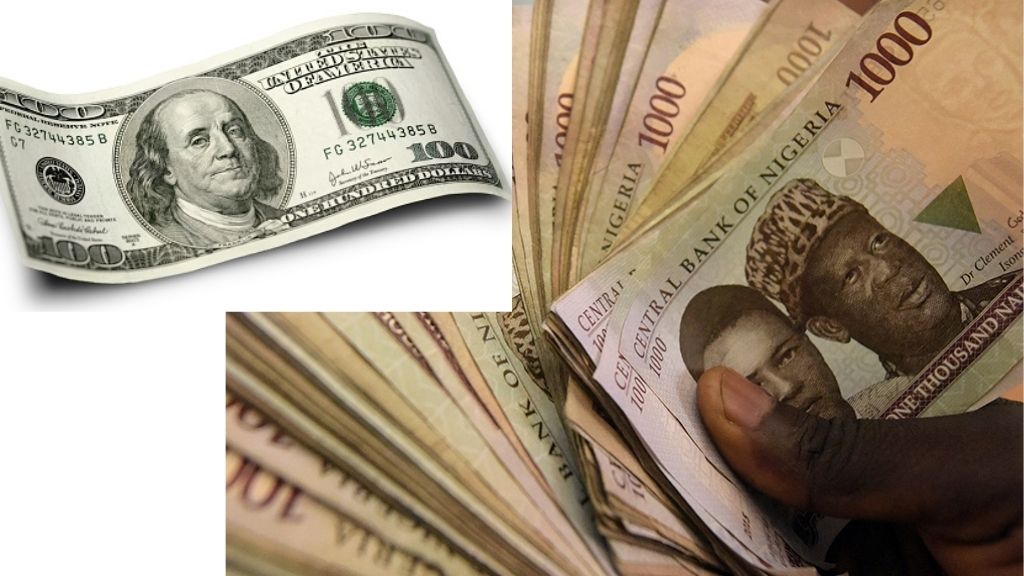
Naira Crashes to N810/$1 as Dollar Scarcity Triggers Speculative Activities
By Dipo Olowookere
The value of the Naira to its United States counterpart, the Dollar, further depreciated to an all-time low of N810/$1 on Monday in the parallel market segment of the foreign exchange (FX) market.
This was driven by the persistent demand for the Dollars as efforts are being made to convert the Naira to hard currencies after the Central Bank of Nigeria (CBN) announced the redesigning of the N200, N500, and N1000 notes.
Those who had kept a huge sum of the local currency outside the banking system are trying hard to use the black market to change the funds into Dollars.
Last Wednesday, the apex bank said it would introduce the new banknotes on December 15, 2022, and would expect the old notes to be out of circulation by January 31, 2023.
This has mounted pressure on the domestic currency, and over the week, it weakened to N800/$1 before further declining by N10 on Monday morning to N810/$1.
The significant rush for the US Dollar, which had been scarce over the past weeks, further drove speculative activities in the parallel market.
Last week, the Minister of Finance, Budget and National Planning, Mrs Zainab Ahmed, kicked against the policy, warning that there would be severe consequences on the nation’s economy.
She made this comment when she said the central bank did not consult her Ministry before announcing the Naira redesign.
The CBN had said it got the approval of President Muhammadu Buhari to change the design of the Nigerian currency.
On Sunday, Mr Buhari confirmed this when he said he was convinced of the benefits of the action to the economy, which some observers said was dwindling.
The President said those who will have issues with the policy are “People with illicit money buried under the soil,” noting that “workers, businesses with legitimate incomes will face no difficulties at all.”
Recall that last Friday, the Naira lost N16 to trade at N785/$1 compared with the rate of N769/$1 it was sold a day earlier.
Economy
Naira Appreciates to N1,441/$1 as FX Pressure Eases
By Adedapo Adesanya
Recent foreign exchange (FX) pressure on the Naira eased on Thursday as its against the US Dollar closed stronger in the Nigerian Autonomous Foreign Exchange Market (NAFEM) by N1.64 or 0.11 per cent to N1,441.44/$1 from the N1,443.08/$1 it was exchanged a day earlier.
Equally, the Nigerian Naira improved its value against the Pound Sterling in the official market by N2.44 to sell for N1,898.96/£1 versus the previous day’s N1,901.40/£1. However, it depreciated against the Euro by 99 Kobo to close at N1,674.96/€1, in contrast to Wednesday’s closing price of N1,673.97/€1.
At the GTBank forex counter, the domestic depreciated against the Dollar yesterday by N3 to settle at N1,450/$1 versus the preceding session’s rate of N1,447/$1, and in the black market, the exchange rate of the Naira to the Dollar remained unchanged at N1,455/$1.
The local currency is trying to claw back some losses recorded this week as unmet demand from thin US dollar supply has invited pressure across key segments.
However, positive signals like Nigeria’s gross external reserves rising by more than $30 million day on day to close at $43.427 billion as of November 11, 2025, gives the Central Bank of Nigeria (CBN) enough power to make significant intervention.
In recent weeks, the apex bank FX injection has been minimal and erratic due to increasing FX inflows from foreign portfolio investors and exporters. FX inflow into currency market has fallen from peaked of $1.37 billion to $899 million.
In the cryptocurrency market, there were significant declines on Thursday as short and long-term investors liquidated their positions. More than $1 billion in leveraged crypto positions were wiped out over 24 hours, with roughly $887 million coming from longs.
Ethereum (ETH) slumped by 10.9 per cent to $3,160.25, Solana (SOL) went south by 10.3 per cent to $140.65, Cardano (ADA) depreciated by 9.6 per cent to $0.5146, Ripple (XRP) fell by 9.2 per cent to $2.27, Dogecoin (DOGE) slipped by 8.2 per cent to $0.1620, Bitcoin (BTC) dropped 6.9 per cent to $96,351.91, Binance Coin (BNB) shrank by 6.1 per cent to $909.83, and Litecoin (LTC) went down by 5.4 per cent to $95.57, while the US Dollar Tether (USDT) and the US Dollar Coin (USDC) remained unchanged at $1.00 apiece.
Economy
Oil Rises Amid Global Oversupply Concerns, Lukoil Sanctions
By Adedapo Adesanya
Oil gained on Thursday as investors weighed concerns about global oversupply with looming sanctions against Russia’s Lukoil.
The price of the Brent crude grade chalked up 30 cents or 0.5 per cent to $63.01 a barrel, and the US West Texas Intermediate (WTI) crude increased by 20 cents or 0.3 per cent to $58.69 a barrel.
The US has imposed sanctions on Lukoil as part of its efforts to bring the Russian government to peace talks with Ukraine. The sanctions prohibit transactions with the Russian company after November 21.
According to JPMorgan, nearly a third of Russia’s current seaborne oil export potential is now stuck in tankers as the US sanctions upend crude flows and Russia’s top buyers, China and India, are still struggling to assess the implications of the sanctions.
“Russia’s oil exports are entering a new phase of disruption as sanctions targeting Rosneft and Lukoil are set to take effect, prompting its two largest customers — India and China — to sharply reduce their December purchases,” the Wall Street bank said in a note.
JPMorgan estimates that as many as 1.4 million barrels per day of Russian crude oil or nearly a third of its exporting potential are on tankers at present, amid re-routing and slowed unloading as buyers are hesitant following the US sanctions on Russia’s top oil producers and exporters, Rosneft and Lukoil.
Also, the US Energy Information Administration (EIA) showed a larger-than-expected rise in US crude stocks, while gasoline and distillate inventories fell less than expected last week. Crude inventories rose by 6.4 million barrels to 427.6 million barrels in the week ended November 7, the EIA said.
The Organisation of the Petroleum Exporting Countries (OPEC) said global oil supplies would slightly exceed demand in 2026, a further shift from the group’s earlier projections of a deficit.
It also said it expected the supply surplus next year because of wider production increases by OPEC+, a group of producers that includes OPEC members and allies like Russia.
The International Energy Agency (EIA) raised its global oil supply growth forecasts for this year and next in its monthly oil market report on Thursday, signaling a bigger surplus in 2026.
The US EIA also said in its Short-Term Energy Outlook on Wednesday that U.S. oil production is expected to set a larger record this year than previously forecast.
Global oil inventories will grow through 2026 as production increases faster than demand for petroleum fuels, adding to pressure on oil prices, the EIA added.
Economy
Nigerian Exchange Rallies 1.08%
By Dipo Olowookere
The bulls tightened their grip on the local bourse by 1.08 per cent on Thursday as investors mopped up shares selling at attractive prices.
On Wednesday, the Nigerian Exchange (NGX) rebounded after enduring a series of losses due to a special interest of the United States in the incessant attacks on Christians in the country by some alleged Islamic terrorists.
However, clarity in the implementation of the controversial capital gains tax (CGT) by the Minister of Finance, Mr Wale Edun, on Tuesday, triggered a fresh round of buying pressure.
Yesterday, apart from the industrial goods space, which lost 0.09 per cent and the commodity index, which closed flat, every other sector ended in green.
The insurance counter appreciated by 4.58 per cent, the banking industry improved by 3.80 per cent, the consumer goods space rose by 1.73 per cent, and the energy sector grew by 0.65 per cent.
Consequently, the All-Share Index (ASI) went up by 1,577.34 points to 146,981.17 points from 145,403.83 points and the market capitalisation soared by N1.003 trillion to N93.481 trillion from N92.478 trillion.
Linkage Assurance advanced by 10.00 per cent to N1.76, Custodian Investment also surged by 10.00 per cent to N38.50, Oando increased by 9.97 per cent to N43.55, Legend Internet expanded by 9.96 per cent to N5.74, and NAHCO jumped by 9.96 per cent to N106.55.
Conversely, Austin Laz lost 9.96 per cent to sell for N2.35, Union Dicon declined by 9.68 per cent to N7.00, Sterling Holdings shed 5.81 per cent to N7.30, NGX Group crashed by 5.31 per cent to N52.60, and Guinness Nigeria depleted by 5.14 per cent to N166.00.
Business Post reports that 55 equities ended on the advancers’ chart and 10 equities finished on the decliners’ table, indicating a positive market breadth index and strong investor sentiment.
However, the level of activity was lower than the preceding session as the trading volume, value, and number of deals went down by 25.63 per cent, 53.32 per cent and 3.40 per cent, respectively.
This was because traders transacted 599.7 million shares worth N22.7 billion in 23,675 deals during the trading day versus the 806.4 million shares valued at N50.8 billion traded in 24,509 deals at midweek.
Wema Bank was the busiest yesterday with 98.4 million units sold for N2.0 billion, UBA transacted 53.0 million units worth N2.2 billion, Access Holdings exchanged 50.9 million units valued at N1.2 billion, Fidelity Bank traded 41.2 million units for N784.0 million, and Zenith Bank transacted 40.8 million units valued at N2.6 billion.
-
Feature/OPED6 years agoDavos was Different this year
-
Travel/Tourism9 years ago
Lagos Seals Western Lodge Hotel In Ikorodu
-
Showbiz3 years agoEstranged Lover Releases Videos of Empress Njamah Bathing
-
Banking7 years agoSort Codes of GTBank Branches in Nigeria
-
Economy2 years agoSubsidy Removal: CNG at N130 Per Litre Cheaper Than Petrol—IPMAN
-
Banking3 years agoFirst Bank Announces Planned Downtime
-
Sports3 years agoHighest Paid Nigerian Footballer – How Much Do Nigerian Footballers Earn
-
Banking3 years agoSort Codes of UBA Branches in Nigeria