
Economy
Naira Suffers Significant Decline Against Dollar After Buhari’s FX Directive


By Adedapo Adesanya
The foreign exchange (forex) market in Nigeria on Friday reacted negatively to the directive of President Muhammadu Buhari to the Central Bank of Nigeria (CBN) on Thursday ”not to issue a kobo” of the country’s reserves for the importation of food items and fertilisers.
This directive means importers of food and fertiliser will no longer get forex at discounted rates from the government but will have to buy at the black market to bring in their goods into Nigeria.
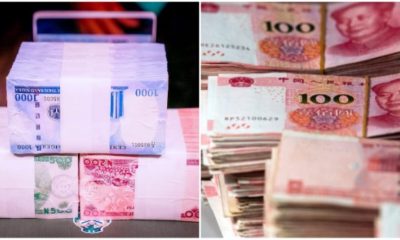
Business Post observed that at the Bureau De Change (BDC) segment of the FX market yesterday, the Naira came under huge pressure, losing significant value against the United States Dollar at the close of business.
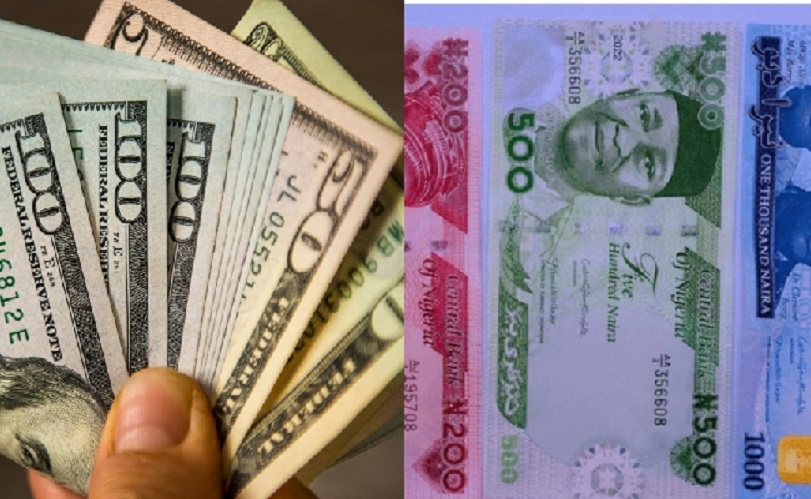
According to data sourced from the Association of Bureaux De Change Operators of Nigeria (ABCON), at the Lagos BDC market, the local currency depreciated against the Dollar by N4 to trade at N454/$1 compared to N450/$1 of the previous session.
However, against the Pound, the local currency closed flat at N585/£1 but gained N29 on the Euro to sell for N530/€1 in contrast to N559/€1 it traded on Thursday.
In Abuja, the local currency depreciated by N14 to close at N454/$1 versus N440/$1 and remained unchanged against the Pound and Euro at N580/£1 and N515/€1 respectively.
At the Port Harcourt BDC market, the Naira lost N12 against the Dollar to quote at N456/$1 versus N440/$1 it was exchanged at the last session. Against the Pound, the Naira lost N17 to close at N603/£1 in contrast to N586/£1 of Thursday and against the Euro, it lost N7 to close at N520/€1 versus N513/€1.
However, it was a different outcome at the Kano BDC market, where the domestic currency traded flat against the Dollar, Pound and Euro at N440/$1, N585/£ and N515/€1 respectively.
At the parallel market, the local currency traded flat against the Dollar at N455/$1 but lost N5 against the Pound to quote at N585/£1 versus N580/£1 and remained unchanged against the Euro at N520/€1.
At the interbank segment of the foreign exchange market, the Naira traded flat at N379/$1.
A look at the Investors and Exporters (I&E) segment of the market showed that on Friday, the Naira appreciated by 17 kobo or 0.04 per cent to sell for N386/$1 compared with N386.17/$1 it traded at the previous session.
It was observed that a decline in the turnover at the market segment yesterday supported the growth recorded by the local currency.
During the session, transactions valued at $20.76 million were recorded compared with Thursday’s $30.8 million, representing $10.04 million or 32.6 per cent decline.






By Adedapo Adesanya
All insurance and reinsurance companies operating in Nigeria are required to remit 0.25 per cent of their annual net premium income to a new fund, according to new guidelines by the National Insurance Commission (NAICOM).
The insurance regulator has issued binding guidelines for a new industry-wide protection fund that will compel every licensed insurer and reinsurer in the country to make annual cash contributions, or risk losing their operating licence.
NAICOM published the framework for the Insurance Policyholders’ Protection Fund (IPPF) under the authority of the Nigerian Insurance Industry Reform Act (NIIRA) 2025, which was signed into law last August.
The guidelines, which take effect immediately, did not disclose an initial capitalisation target for the fund or a timeline for when it would be considered adequately funded for resolution purposes.
The IPPF is designed to function as a resolution backstop as a capital pool available to settle outstanding policyholder claims when a licensed insurer or reinsurer becomes insolvent or enters regulatory distress.
The mechanism addresses a longstanding vulnerability in the Nigerian market, where policyholders holding valid claims against failed insurers have historically had no guaranteed recourse.
The 0.25 per cent payments are due into designated deposit money bank accounts no later than June 30 each year.
NAICOM said it will supplement industry contributions by injecting 0.25 per cent of the balance held in the existing Security and Insurance Development Fund (SIDF) into the IPPF annually, creating a dual-stream capitalisation model.
The guidelines state explicitly that failure to remit the full assessed contribution within the stipulated timeframe shall constitute grounds for suspension or cancellation of an operator’s licence. The same penalty framework applies to defaults on any loans extended from the fund.
Day-to-day management of the IPPF will be delegated to an independent professional Fund Manager, subject to a minimum paid-up capital threshold of N5 billion.
Investment activity is restricted to low-risk, government-backed instruments. This is a deliberate constraint intended to preserve liquidity and protect the fund from market volatility.
Members are bound by a Code of Conduct that bars them from using their positions for personal advantage or to direct decisions in favour of any insurer, reinsurer, or connected party.
The guidelines introduce a mandatory early-warning mechanism: insurance operators who become aware of imprudent practices within their organisations or elsewhere in the industry are required to report such conduct to NAICOM within five working days.
The commission has provided explicit anti-retaliation protections, stating that no whistleblower shall be subjected to retaliation, intimidation, or any form of adverse action for making a disclosure.

By Modupe Gbadeyanka
President Bola Tinubu has been called on to use his influence to halt the passage of the proposed Customs, Excise and Tariff Amendment (CETA) Bill.
The proposed piece of legislation is currently before the National Assembly, and it seeks to introduce a percentage levy per litre of the retail price on non-alcoholic beverages.
In an outlined advertorial published in key newspapers, the Organised Private Sector of Nigeria urged the federal government to engage with the leadership of the parliament to stop the ongoing legislative process with a view to stepping down the CETA Bill, thus allowing the executive-led fiscal reforms to be fully integrated and aligned.
The OPS comprises the Manufacturers Association of Nigeria (MAN), Nigerian Association of Chambers of Commerce, Industry, Mines and Agriculture (NACCIMA), Nigeria Employers’ Consultative Association (NECA), Nigerian Association of Small Scale Industrialists (NASSI), and the Nigerian Association of Small and Medium Enterprises (NASME).
In the advertorial signed by the presidents of all members of the group, it was submitted that allowing for more talks would strengthen policy coherence, enhance predictability, and improve the effectiveness of the nation’s excise framework.
It was stressed that halting the bill would also encourage structured, evidence-based engagement with industry stakeholders, thereby ensuring that any future measures will effectively balance revenue generation, public health objectives, and economic sustainability.
“While we fully support well-designed fiscal reforms and evidence-based public health interventions, we are concerned that the Bill, in its current form, raises significant social, economic, administrative, and legal issues that could undermine Your Excellency’s broader fiscal reform objectives,” the body stated.
While calling on the government to restrain the Senate from proceeding with the process, the organisation noted that the proposed levy would therefore constitute a regressive measure, reducing consumer purchasing power without providing viable alternatives or meaningful public health support.
Commenting on the impact of such a levy on industry stability, investment, and employment, OPS stated that the sector was already under severe pressure from exchange rate adjustments, high energy costs, and rising prices of imported inputs, packaging materials, and machinery.
“An additional excise burden would further increase production costs, reduce capacity utilisation, delay or cancel planned investments, and threaten the livelihoods of thousands of small distributors, retailers, and informal traders who depend on high-volume, low-margin sales.
“These pressures would inevitably be passed on to consumers through higher prices, leading to reduced demand and potential further job losses across the value chain,” it stated.
While commending the president for the leadership and bold economic reforms undertaken since assuming office in 2023, it noted that the reforms have played an important role in restoring macroeconomic stability and rebuilding confidence within the business community.

By Adedapo Adesanya
Three stocks further weakened the NASD Over-the-Counter (OTC) Securities Exchange by 1.12 per cent on Wednesday, April 8, with the Unlisted Security Index (NSI) down by 44.43 points to 3,930.91 points from the previous day’s 3,975.34 points, and the market capitalisation went down by N26.59 to N2.351 trillion from N2.378 trillion.
MRS Oil lost N11.00 during the session to close at N161.00 per share compared with Tuesday’s closing price of N172.00 per share, Central Securities Clearing System (CSCS) Plc dipped by N3.74 to N67.95 per unit from N71.69 per unit, and Afriland Properties Plc fell by N1.10 to sell at N15.95 per share versus N17.05 per share.
There were two gainers at the midweek trading session, led by IPWA Plc, which appreciated by 55 Kobo to N6.61 per unit from N6.06 per unit, and First Trust Mortgage Bank Plc improved its value by 4 Kobo to N2.32 per share from N2.28 per share.
Yesterday, the volume of securities rose by 620.4 per cent to 5.7 million units from 797,264 units, the value of securities increased by 25.1 per cent to N32.7 million from N26.1 million, and the number of deals climbed by 12.1 per cent to 37 deals from the preceding session’s 33 deals.
Great Nigeria Insurance (GNI) Plc ended the day as the most traded stock by value on a year-to-date basis with 3.4 billion units sold for N8.4 billion, trailed by CSCS Plc with 57.2 million units exchanged for N3.9 billion, and Okitipupa Plc with 27.5 million units traded for N1.8 billion.
GNI Plc also finished the session as the most traded stock by volume on a year-to-date basis with 3.4 billion units valued at N8.4 billion, followed by Resourcery Plc with 1.1 billion units worth N415.7 million, and Infrastructure Guarantee Credit Plc with 400 million units transacted for N1.2 billion.
-
 Feature/OPED6 years ago
Davos was Different this year
-
Travel/Tourism10 years ago
Lagos Seals Western Lodge Hotel In Ikorodu
-

 Showbiz3 years ago
Estranged Lover Releases Videos of Empress Njamah Bathing
-
 Banking8 years ago
Sort Codes of GTBank Branches in Nigeria
-

 Economy3 years ago
Subsidy Removal: CNG at N130 Per Litre Cheaper Than Petrol—IPMAN
-

 Banking3 years ago
Sort Codes of UBA Branches in Nigeria
-

 Banking3 years ago
First Bank Announces Planned Downtime
-

 Sports3 years ago
Highest Paid Nigerian Footballer – How Much Do Nigerian Footballers Earn