Connect with us

Economy

Nigeria—No be Juju be this?

Published

on

No be Juju be this

By Prince Charles Dickson PhD

This is not just primitive rural superstition; [juju] is practised by all kinds of people, from illiterate herd boys to multi-degreed university professors. If you don’t understand the power of this belief, you will never truly grasp the rich albeit often incomprehensible spirituality of Africa. Lawrence Anthony, The Elephant Whisperer.

Nobody respects the law of Nigeria. Judges don’t. Police don’t. Lawyers don’t. Politicians don’t. Citizens don’t. Why? Because there are no consequences. Those who fear the laws are the downtrodden who have no godfathers. That is why stealing a goat is more dangerous than stealing billions. Nigeria is a country of absurdities. J. S. Okutepa. (SAN)

No be juju be this…

So, wetin be or what is juju?

juju; plural noun: jujus.

A charm or fetish, especially of a type used by some West African peoples. Supernatural power attributed to a charm or fetish. “Juju and witchcraft”.

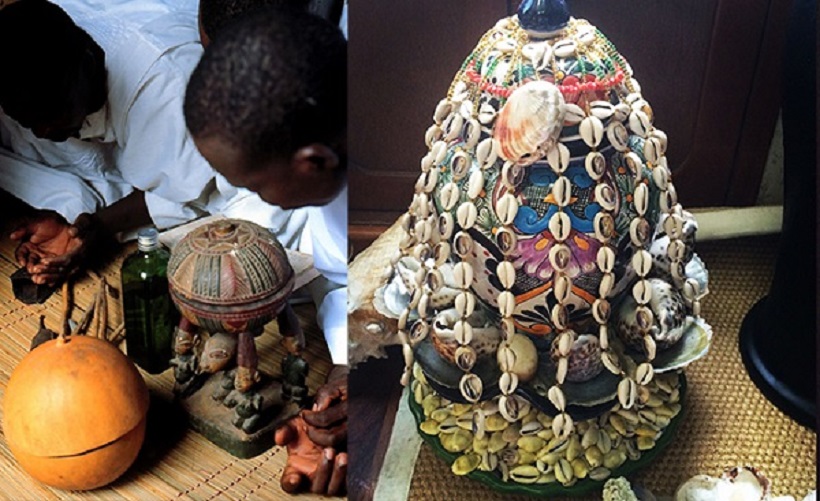
Juju, an object that has been deliberately infused with magical power or the magical power itself; it also can refer to the belief system involving the use of juju. Juju is practised in West African countries such as Nigeria, Benin, Togo, and Ghana, although its assumptions are shared by most African people.

Juju comes from the traditional African religion popularly known as voodoo. Juju refers specifically to objects used in conjunction with spells or curses, and like any practice or belief, it can be manipulated to create power over people.

Witches and juju things are absolutely fascinating—they can fly on broomsticks, do magic spells with their wands and stir up incredible potions in their cauldrons. They can ask for and do the unimaginable. In Nigeria, it is just about the unthinkable things they can and cannot do or are held liable for doing or not allowing to happen.

The Harry Potter books for example have made witches (and wizards) really cool recently – who wouldn’t want to be as smart as Hermione Granger, as brave as Ginny Weasley or play Quidditch as well as Cho Chang? However, in Nigeria, it is about child rights abuse and killings.

This admonition is not about juju or witchcraft but it is about juju and the witchcraft ‘worrying’ Nigeria. Kindly follow me for the next few paragraphs and then we can share thoughts.

Almost eight years and the government could not get one refinery working at full capacity, providing employment and serving Nigerians in a land blessed with the resources. A nation of all typologies of expertise in the oil sector and still cannot simply have an agreement on whether there is subsidy or not and what to do with it—no be juju be that!

Police follow PHCN abi DisCo officials to disconnect electricity from another police station. Meanwhile, DisCo is indebted to the Water Board and the Water Board is indebted to local contractors that supply purifying chemicals and the contractors cannot pay local tax because they are indebted to the local electrician who repairs household electronics destroyed as a result of terrible electricity current supplied to homes. We have changed names, balkanized the utility company, privatized it, funded it yet the energy problem persists, it is one hellish vicious cycle—No be juju be that!

How many times have you seen policemen wear protective gloves, or collect forensic evidence? Do we have a data bank? A country of different data capture for NIN, another for driver’s licence, another for BVN, even another set of data for ‘unavailable’ Nigerian passports (printed in another country). Yet, there’s ‘no-go-to’ data bank, wait…have you seen a desktop in a local police station, not-to-talk of a laptop, apart from the ‘big boys’—No be juju be that!

We close factories to build places of worship and then pray for jobs, every national celebration has an interdenominational service and Juma’at prayers as accompaniment, yet we are a religiously wicked people. Every Christian with his personal juju-man, and every Muslim her own ‘boka-man’. We do interfaith prayers at official events, meetings and steal afterwards, and then do thanksgiving; saying ‘na God ooo’—No be juju be that!

A government official builds a hospital and calls it world-class, and yet he goes to another country for healthcare. They commission schools they describe as world-class and yet they are kids, are schooling in puppet colleges in other climes. They live in villages and build castles in the US, and beg these dudes for aid and loans—no be juju be that!

We are venting on power relations across balance of the geographical spread called Nigeria. In other words, we want power to go the South, the North has had its share, we are talking Muslim-Muslim ticket, and can’t say Christian-Christian ticket. No one is talking about the Ogboni-Krishna ticket.

Sadly, we are stuck with if the President is from here the Vice must be from there in the only nation with the aberrations such as South-South, North East, North West, South East and too many juju-like political expediency laced necessities such as federal character, catchment area, indigene and non-indigene, educationally disadvantaged; still no way, In fact, historically, we have no history so we cannot agree on who is at fault or what the solution is—No be juju be that!

Who remembers in 2015, the Witches and Wizards Association of Nigeria (WITZAN) announced that it had endorsed Goodluck Jonathan as its candidate for the 2015 presidential election.

“We just held a meeting of witches in Kogi State where it was revealed to me that Jonathan would win the presidential election. He has the support of all witches to continue in office,” said a certain Dr Iboi, the President of the association.

Well, we can see that WITZAN’s pick ended up not winning the race. The following year, WITZAN made a cry for help, as the association released a statement for Nigerians to stop persecuting them, we are waiting for them towards 2023—no be juju be that!

Last week in the news, brother and mother colluded to murder a sibling. Another son attempted to kill his mother. Young lads ate their ‘poo’ in public and in the same week, three lads, the oldest being 20, beheaded the girlfriend of one of them, all for money ritual. A trend that has seen a scary rise in the last two years, and being the pretentious people that we are, acting like it’s new, only a few years back it was ‘panties stealing’ and till date, nobody has been arrested, prosecuted, convicted, and jailed—no be juju be that!

Our Federal Road Safety Corps Officers only work during the day and close by 5:00 pm and the roads can be left unsafe at night. Nigerians cannot be ‘de-jujulized’ by praying, by big grammar, by protests, the juju has to be engaged, the gatekeepers of power and resources in Nigeria are not up to 5000 but their juju is strong and is holding the nation down.

It is a sad reality that 2023 really does not offer much if we refuse to address the witchcraft that has beset the motherland if we refuse to see that all is not well and keep behaving like a bewitched people, a big storm is not far away, and if we don’t act, the disaster that looms—Only time will tell.


Economy

UAE to Leave OPEC May 1

Published

on

Nigeria OPEC

By Adedapo Adesanya

The United ‌Arab Emirates has announced its decision to quit the Organisation of the Petroleum Exporting Countries (OPEC) to focus on national interests.

This dealt ⁠a heavy ⁠blow to the oil-exporting group at a time when the US-Israel war on Iran had caused ⁠a historic energy shock and rattled the global economy.

The move, which will take effect on May 1, 2026, reflects “the UAE’s long-term strategic and economic vision and evolving energy profile”, a statement carried by state media said on Tuesday.

“During our time in the organisation, we made significant contributions and even greater sacrifices for the benefit of all,” it added. “However, the time has come to focus our efforts on what our national interest dictates.”

The loss of the UAE, a longstanding OPEC member, could create disarray and weaken the oil cartel, which has usually sought to show a united ⁠front despite internal disagreements over a range of issues from geopolitics to production quotas.

UAE Energy Minister Suhail Mohamed al-Mazrouei said the decision was taken after a careful look at the regional power’s energy strategies.

“This is a policy decision. It has been done after a careful look at current and future policies related to the level of production,” the minister said.

OPEC’s Gulf producers have already been struggling to ship exports through the Strait of Hormuz, a ‌narrow chokepoint between Iran and Oman through which a fifth of the world’s crude oil and liquefied natural gas supplies normally pass, because of threats and attacks against vessels during the war.

The UAE had been a member of OPEC first through its emirate of Abu Dhabi in 1967 and later when it became its own country in 1971.

The oil cartel, based in Vienna, has seen some of its market power wane as the US has increased its production of crude oil in recent years.

Additionally, the UAE and Saudi Arabia have increasingly competed over economic issues and regional politics, particularly in the Red Sea area.

The two countries had joined a coalition to fight against Yemen’s Iran-backed Houthis in 2015. However, that coalition broke down into recriminations in late December when Saudi Arabia bombed what it described as a weapons shipment bound for Yemeni separatists backed by the UAE.

Continue Reading

Economy

NASD OTC Exchange Inches Up 0.03% as CSCS Outshines Four Price Decliners

Published

on

Nigerian OTC securities exchange

By Adedapo Adesanya

Central Securities Clearing System (CSCS) Plc bested four price decliners on the NASD Over-the-Counter (OTC) Securities Exchange on Monday, April 27. The alternative stock market opened the week bullish during the session with a 0.03 per cent uptick.

According to data, the security depository company added N2.61 to its share price to close at N76.26 per unit compared with the preceding session’s N78.87 per unit.

As a result, the market capitalisation of the platform increased by N820 million to N2.425 trillion from N2.424 trillion, and the NASD Unlisted Security Index (NSI) gained 1.38 points to finish at 4,053.97 points compared with the 4,052.58 points it ended last Friday.

The four price losers were led by NASD Plc, which slumped by N3.80 to sell at N34.70 per share versus N38.50 per share. FrieslandCampina Wamco Nigeria Plc fell by N1.45 to N98.10 per unit from N99.55 per unit, Food Concepts Plc slid by 27 Kobo to N2.43 per share from N2.70 per share, and Geo-Fluids Plc dipped by 9 Kobo to N2.91 per unit from N3.00 per unit.

The value of securities transacted by market participants went down by 82.0 per cent to N7.4 million from N41.3 million units, the volume of securities declined by 28.5 per cent to 319,831 units from 447,403 units, and the number of deals dropped by 34.1 per cent to 29 deals from 44 deals.

Great Nigeria Insurance (GNI) Plc was the most active stock by value on a year-to-date basis with 3.4 billion units worth N8.4 billion, followed by CSCS Plc with 59.6 million units sold for N4.0 billion, and Okitipupa Plc with 27.8 million units exchanged for N1.9 billion.

Also, GNI Plc was the most traded stock by volume on a year-to-date basis with 3.4 billion units valued at N8.4 billion, followed by Resourcery Plc with 1.1 billion units traded for N415.7 million, and Infrastructure Guarantee Credit Plc with a turnover of 400 million units worth N1.2 billion.

Continue Reading

Economy

Naira Opens Week Weaker at N1,364/$ at NAFEX After N5.80 Loss

Published

on

NAFEX Rate

By Adedapo Adesanya

The first trading day of the week in the currency market was bearish for the Naira in the Nigerian Autonomous Foreign Exchange Market (NAFEX) on Monday, April 27.

Yesterday, it lost N5.80 or 0.43 per cent against the United States Dollar to trade at N1,364.24/$1, in contrast to the N1,358.44/$1 it was traded last Friday.

In the same vein, the Nigerian currency depreciated against the Pound Sterling in the official market by N13.70 to close at N1,847.72/£1 versus the preceding session’s N1,834.02/£1, and slumped against the Euro by N11.56 to sell at N1,602.29/€1 versus N1,590.73/€1.

Also, the Nigerian Naira tumbled against the greenback during the trading day by N5 to quote at N1,385/$1 compared with the previous rate of N1,380/$1, and at the GTBank FX desk, it traded flat at N1,370/$1.

The poor performance of the domestic currency could be attributed to liquidity shortage at the official currency market on Monday, which came amid surging demand for international payments. At $76.50 million, interbank liquidity printed higher across 79 deals, up from the $43.572 million reported on Friday.

Nigeria’s gross external reserves declined to $48.45 billion amid a month-long decline in inflows, amid uncertainties in the global commodity market. The depletion of foreign reserves could be partly attributed to the Central Bank of Nigeria’s intervention in the FX market.

The market remains perturbed by persistent concerns over liquidity constraints, policy transparency, and weakening confidence in Nigeria’s FX market, while boosters, including oil prices, continue to look rocky due to stalled discussions and unclear ceasefire negotiations between the US and Iran.

A look at the cryptocurrency market, Bitcoin (BTC) has been rejected near $79,000 three times in eight sessions, leaving the level as the de facto ceiling of its current trading range even as major cryptocurrencies trade lower over the past day. It lost 0.9 per cent to sell at $77,003.61.

Analysts say that upcoming US Federal Reserve policy decisions and top tech firms’ earnings this week could provide the catalyst to push bitcoin decisively above $80,000.

The market also continued to weigh Iran’s interim deal proposal to reopen the Strait of Hormuz, which failed to advance over the weekend. The White House said US officials were discussing the latest Iranian proposal but maintained “red lines” on any deal to end the eight-week war.

Solana (SOL) dropped 1.8 per cent to $84.25, Ripple (XRP) went down by 1.6 per cent to $1.39, Ethereum (ETH) depreciated by 1.3 per cent to $2,290.00, Binance Coin (BNB) declined by 0.5 per cent to $625.18, and Cardano (ADA) fell by 0.2 per cent to $0.2480.

However, Dogecoin (DOGE) rose by 2.0 per cent to $0.1002, and TRON (TRX) appreciated by 0.2 per cent to $0.3242, while the US Dollar Tether (USDT) and the US Dollar Coin (USDC) remained unchanged at $1.00 apiece.

Continue Reading

Trending