Economy
Nigeria’s Overnight Lending Rate Closes at 21% on Monday
By Dipo Olowookere
The Overnight (OVN) lending rate in Nigeria depreciated by 2.50 percent on Monday to 21.00 percent from the 23.50 percent it ended last Friday.
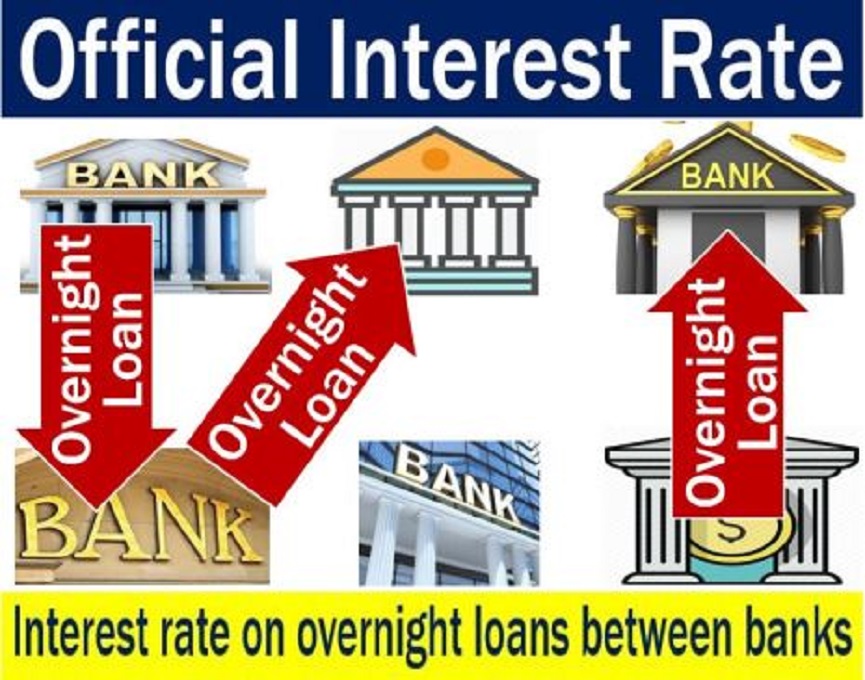
The overnight lending rate is the interest rate most commercial banks borrow funds among themselves in the overnight market.
Last Friday, the Central Bank of Nigeria (CBN) debited some banks excess cash in their reserves as part of efforts to control liquidity in the financial system.
This spiked the money market rates to double digits during the session. Also last Friday, the apex bank asked the commercial banks to bid for the Dollar at N380 instead of the usual N361. This move was seen as an effort to collapse the exchange rate system in the country into one as suggested by many observers, including the International Monetary Fund (IMF).
On Monday, the OVN rate remained at double digits, just as the Open Buy Back (OBB) also closed high during the session.
According to data obtained by Business Post, the OBB rate depreciated to 19.60 percent from 21.50 percent, indicating a decline of 1.90 percent.
Consequently, the average money market rates depleted by 2.20 percent to 20.30 percent from 22.50 percent it ended last Friday.
Meanwhile, the average yields of treasury bills at the secondary market increased by 0.08 percent as a result of the selling pressure witnessed at the trading session.
It was observed that only the three-month tenor recorded a decline in yield by 0.03 percent to settle at 1.63 percent as against its previous level of 1.66 percent.
The yields on the six-month instrument and the 12-month bill appreciated by 0.14 percent each to close at 2.03 percent and 3.22 percent respectively, while the yield on the one-month maturity rose by 0.06 percent to 1.68 percent from 1.62 percent.
Economy
Naira Rebounds Slightly to N1,382/$1 at Official Market
By Adedapo Adesanya
Pressure on the Naira eased on Wednesday, July 15, as it appreciated against the United States Dollar by 90 Kobo or 0.07 per cent on Tuesday, July 15, in the Nigerian Autonomous Foreign Exchange Market (NAFEX) to close at N1,382.18/$1 compared with the previous day’s N1,383.08/$1.
Also, the local currency gained a further N4.07 against the Euro in the official market to sell at N1,576.69/€1 versus Tuesday’s rate of N1,583.76/€1, but depreciated against the Pound Sterling by N1.71 to quote at N1,856.69/£1, in contrast to the preceding session’s N1,854.98/£1.
At the GTBank forex counter, the Naira lost N1 against the greenback at midweek to close at N1,389/$1 compared with the preceding day’s N1,388/$1, and at the black market, it traded flat at N1,405/$1.
Data from the Central Bank of Nigeria (CBN) showed that interbank FX turnover moderated as trading activities among financial institutions and market makers declined sharply.
Daily FX data released showed that NFEM interbank FX turnover closed the day at $121.727 million, about 50 per cent below the previous record of $243.095 million set on Tuesday.
Official trading records released by the central bank revealed that interbank FX deals among market makers went down from the previous day to 115 from 140.
Inflation news also eased pressure, even if the print dropped marginally to 15.91 per cent in June, a 0.2 per cent reduction from the 15.93 per cent recorded in the preceding month. The month-on-month headline inflation rate in June 2026 was 1.66 per cent, which was 0.09 per cent lower than the rate recorded in May 2026, which came in at 1.75 per cent.
In the crypto market, prices were mixed as some traders banked on softer-than-expected US inflation reports for June, while others say the inflation data is obsolete, given the renewed strength in oil prices, which sparked after fresh fighting in the Middle East.
US inflation had earlier cooled more than expected, sharply reducing market odds of a near-term Federal Reserve rate hike.
Ethereum (ETH) rose by 1.9 per cent to $1,921.62, Ripple (XRP) appreciated by 0.4 per cent to $1.11, and Binance Coin (BNB) also increased by 0.4 per cent to $582.42.
However, Solana (SOL) dropped 1.3 per cent to finish at $77.29, TRON (TRX) slumped by 0.8 per cent to $0.3240, Dogecoin (DOGE) shrank by 0.6 per cent to $0.0741, Bitcoin (BTC) declined by 0.3 per cent to $64,762.28, and Cardano (ADA) lost 0.2 per cent to end at $0.1640, while the US Dollar Tether (USDT) and the US Dollar Coin (USDC) remained unchanged at $1.00 each.
Economy
Nigerian Exchange Drops 0.21%
By Dipo Olowookere
A 0.21 per cent loss was suffered by the Nigerian Exchange (NGX) Limited on Wednesday, as investor chew on the contraction in Nigeria’s June 2026 inflation rate to 15.91 per cent, according to data released during the session by the National Bureau of Statistics (NBS).
It was observed that the consumer goods sector lost 1.24 per cent, the industrial goods space shed 0.23 per cent, and the energy index crashed by 0.10 per cent, with these losses offsetting the gains recorded by the financial services sector, as the banking segment rose by 4.53 per cent, and the insurance counter chalked up 1.23 per cent.
Consequently, the All-Share Index (ASI) retreated by 503.69 points to 242,366.75 points from 242,870.44 points, but the market capitalisation added N390 billion to close at N156.239 trillion compared with the previous session’s N155.849 trillion.
During the trading day, Trans-Nationwide Express shed 9.85 per cent to end at N3.02, International Breweries moderated by 6.12 per cent to N13.05, Haldane McCall slipped by 5.95 per cent to N3.32, DAAR Communications declined by 5.68 per cent to N1.66, and NGX Group lost 4.38 per cent to finish at N28.12.
On the flip side, First Holdco improved by 9.98 per cent to N79.35, Thomas Wyatt expanded by 9.29 per cent to N2.94, Legend Internet gained 8.99 per cent to settle at N4.85, Tripple Gee grew by 8.96 per cent to N3.89, and Coronation Insurance increased by 6.61 per cent to N2.42.
Yesterday, market participants transacted 476.3 million stocks worth N29.6 billion in 40,992 deals compared with the 634.8 million stocks valued at N53.3 billion traded in 42,494 deals, showing a decline in the trading volume, value, and number of deals by 24.97 per cent, 44.47 per cent, and 3.54 per cent, respectively.
First Holdco was the busiest equity with 78.7 million units sold for N6.2 billion, Sterling Holdings transacted 56.7 million units worth N439.2 million, Zenith Bank traded 30.0 million units valued at N3.3 billion, Fidelity Bank exchanged 27.3 million units for N563.9 million, and Stanbic IBTC traded 22.8 million units valued at N3.8 billion.
Economy
Deloitte Africa Lauds Nigeria’s Ongoing Financial, Fiscal Reforms
**Tinubu Says Economy on Steady Growth
By Modupe Gbadeyanka
President Bola Tinubu has been praised for the ongoing financial and fiscal reforms in the country and encouraged to pursue a stronger partnership that supports investments, youth training, and employment.
The chief executive of Deloitte Africa, Ms Ruwayda Redfearn, who led a delegation to visit Mr Tinubu in Abuja on Wednesday, said the global organisation is primarily focused on digital and business transformation, with over 500,000 employees worldwide working across various roles and locations, including over 6,000 in Africa, adding that her accountancy firm’s revenue was $74 billion in 2025.
“We are here before you to say that we want to serve. We have a local team on the ground that is ready, as well as the global firm, to support you and support your administration as you lead the country,” she said.
Also, the chief executive of Deloitte West Africa, Mr Yomi Olugbenro, assured President Tinubu of the firm’s support for the reforms.
“We do what we do because of the philosophy that our African CEOs talk about – making an impact that matters. Where we are at the moment, we believe that the ground has been solidly laid. There is a need to truly extract more value and deliver the dividends of democracy to ordinary Nigerians on the street. The bigger work is really about how to cascade some of those big reforms further down.
“We do believe that with the capabilities that the firm has all over the world, with the half a million people that our CEO spoke about, we have use cases, examples, and experiences of how we supported nations all around the world, so Nigeria will definitely benefit from those experiences.
“So, that is why we are here, and we welcome the invitation that you may grant us as to where exactly you want us to support you,” he stated.
In his remarks, Mr Tinubu informed his guests that his administration’s reforms have steadily stabilised the economy over three years, with growing plaudits for positive development and growth indicators.
“We are following the example of Deloitte’s greatness to change things from the foundation, building the necessary future for our people.
“Yes, reforms are difficult. It has not been a McDonald’s customer relationship but a harvester of good things, if implemented well, and that is what we are about.
“Thank you for your partnership in paying attention to what we are doing here, as we have heard from the Minister of Finance about the fiscal, revenue and tax reforms that have taken place and are moving the nation forward.
“The reforms on revenue will continue to stimulate growth. And the effect of the reform? Yes, some issues are difficult to take the bitter medicine, but it is working well. For the economy, Nigeria is making serious foundational progress,” he stated.
The President said the reforms had stimulated the economy, strengthened the fiscal and revenue sectors, repositioned financial institutions, and prepared the country to be more globally relevant and competitive, urging Deloitte Africa to improve its impact on the Nigerian economy by training and recruiting the dynamic youth population.
“The family of Deloitte; you just reminded me of my cradle years in accountancy and where I cut my childhood accounting teeth in Chicago. Deloitte has a good training programme, and I believe you will continue to reflect that,” he added.