Economy
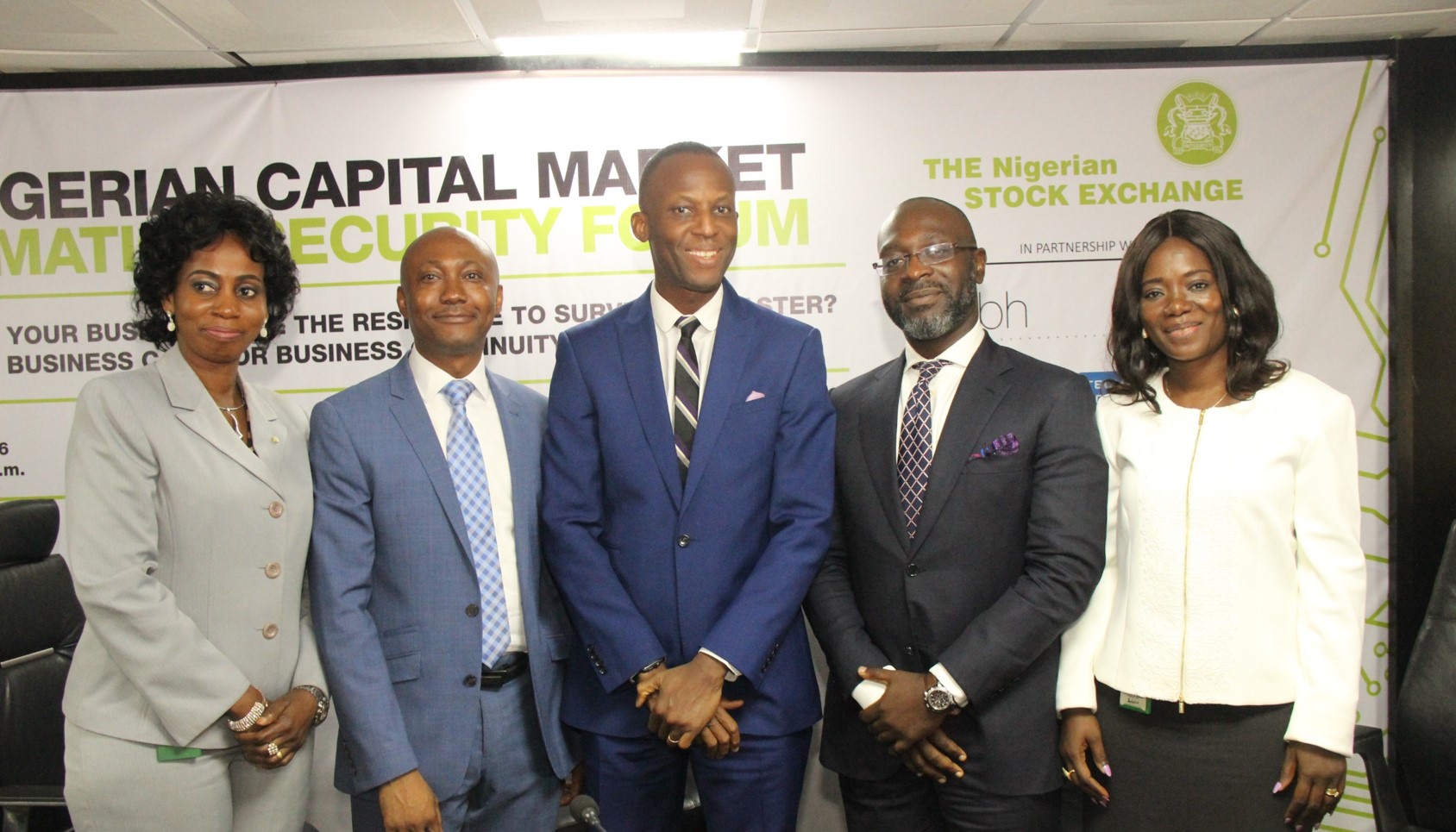
NSE Promotes Business Continuity Management in Capital Market

By Modupe Gbadeyanka
The need for capital market operators and other business leaders in the country to ensure they protect valuable intellectual property and business information in digital form against theft and misuse has been reiterated by the Nigerian Stock Exchange (NSE).
Executive Director, Market Operations and Technology of the NSE, Mr Ade Bajomo, stated this at the 4th Nigerian Capital Market Information Security Forum (NCMISF) on Thursday in Lagos.
At the occasion themed ‘Does your business have the resilience to withstand a disaster? The Business Case for Business Continuity Management,’ Mr Bajomo noted that cyber security is an increasingly critical management issue, which must be addressed head-on.
He said NCMISF was born out of the need to provide a platform for stakeholders and thought leaders in the information security space to share knowledge on Information Security, best practices and cyber breaches in Nigeria and the world at large.
According to him, as technology evolves and businesses become more prone to attacks, it was evident that business continuity could no longer be treated as an afterthought or a surplus cash flow item.
Mr Bajomo opined that, “It should become an integral part of operational planning and operational cost. The need for business continuity planning has grown rapidly in today’s fast-paced, volatile business climate and as such organisations cannot afford the risk of not having a continuity plan in place.”
Business continuity, which is the capability of the organisation to continue delivery of products or services at acceptable predefined levels following a disruptive incident is now considered a societal security issue, essential to protect a society or economy.
He noted that at the NSE, “We remain committed to executing several key innovations that are aimed at developing a more transparent and sustainable market, with structures to support the delivery of a wide range of investment products and ensure continuity.”
Economy
Nigeria Inks $1bn Steel Investment Deal with India’s Rashmi Metaliks
By Adedapo Adesanya
The federal government has signed a Memorandum of Understanding (MoU) with an Indian conglomerate, Rashmi Metaliks Group, to boost Nigeria’s steel production.
The agreement, signed by the Minister of Steel Development, Mr Shuaibu Abubakar Audu, on Tuesday in Kolkata, India, was for a projected investment of $1 billion over three years.
This followed the Minister’s tour of the steel plant in Kolkata, where he commended the scale of the operations and advanced technology deployed at the facility.
He also lauded the company’s integrated operations — spanning Direct Reduced Iron (DRI), pig iron, billets, and finished ductile iron pipes — describing them as a strong example of industrial efficiency and excellence in modern steel production.
According to the Minister, Nigeria’s proactive investment drive is already attracting significant global capital.
He noted that the MoU signed with the company represents a major milestone in Nigeria’s efforts to reposition the steel sector, reaffirming President Bola Tinubu’s commitment to revitalising the industry, creating employment opportunities, and conserving foreign exchange through strategic import substitution.
He added that the efficiency of the facility underscored the importance of value addition, innovation, and sustainability in modern steel production, emphasising that the visit further reflected the strengthening economic ties between Nigeria and India in the areas of steel, mining, and manufacturing.
In signing the MoU, Audu highlighted Nigeria’s vast steel potential, noting that the country is transitioning from a raw minerals exporter to a value-adding industrial economy.
He disclosed that Nigeria possesses well over 3 billion tonnes of iron ore reserves, with some deposits grading as high as approximately 67 per cent iron content (Fe), while domestic steel consumption is estimated at about $10 billion annually.
He said that Nigeria aims to become a leading steel hub in Africa under President Tinubu’s Renewed Hope Agenda, which targets crude steel production of approximately 10 million tonnes per annum by 2030.
This is evidenced by recent Foreign Direct Investments in the sector, including a $400 million Stellar Steel plant in Ewekoro, Ogun State and a Chinese-Nigerian joint venture for a modern hot-rolled coil steel plant scheduled to commence operations by November 2026.
Also, African Industries Group (AIG) is completing a fully integrated iron-and-steel plant at Gujeni in Kaduna State. The company has invested $300 million in the Direct Reduced Iron (DRI) and steel unit of the project, and the galvanising and fabrication plant in Ikorodu, Lagos, which was recently commissioned by the Minister.
Energy infrastructure is also being developed to support the growth of the industry. The Nigerian National Petroleum Company (NNPC) Limited, the Ministry of Steel Development, and their partners recently broke ground on five mini-LNG plants in Ajaokuta, Kogi State — a $500 million project aimed at boosting gas supply to the steel industry, with a combined capacity of approximately 97 million standard cubic feet per day.
Mr Audu used the visit to invite additional Indian investors to explore opportunities within Nigeria’s steel sector.
He highlighted prospects for establishing integrated steel plants in Nigeria, deploying Direct Reduced Iron and electric-arc furnace technologies, and developing full value chains for automotive, construction, and infrastructure steel.
He further assured prospective investors that the Nigerian Government remains committed to providing an enabling environment through policy stability, fiscal incentives, and ongoing ease-of-doing-business reforms aimed at protecting investments.
“We are open to credible investors willing to partner with us for mutual growth,” the Minister said.
On his part, the Vice Chairman of Rashmi Metaliks Group, Mr Sunil Kumar Patwari, on behalf of the company, expressed appreciation to the Nigerian delegation for the successful visit to their facilities in Kolkata.
He emphasised that the visit reflects the priority placed on the partnership by the Nigerian Government and assured that, with the necessary support from the Nigerian government, Rashmi Group is committed to delivering on the projects envisioned in the MoU.
Economy
Meristem Projects Nigeria’s March 2026 Inflation at 13.59%
By Aduragbemi Omiyale
Analysts at Meristem Research have projected that the inflation rate in Nigeria for March 2026 should further moderate to 13.59 per cent on a year-on-year basis from the 15.06 per cent recorded in February 2026.
The company, in a note sighted by Business Post, explained that easing in the average prices of goods and services for last month would be impacted by a high base from the same period of 2025, but noted that on a month-on-month basis, the rate will spike.
Last month, energy prices soared after the price of crude oil on the global market soared as a result of the war in Iran, with prices of items growing in Nigeria.
“However, month-on-month pressures are likely to pick up, driven by the renewed increases in energy prices, which should nudge headline inflation higher.
“Core inflation is also likely to edge higher, reflecting second-round effects from higher transportation and production costs, although the relative stability of the Naira should help moderate the pace of increase.
“Food inflation is also expected to rise on a month-on-month basis, driven by higher logistics and distribution costs, as well as recent increases in staple food prices,” a part of the report noted.
The National Bureau of Statistics (NBS) is expected to release the inflation numbers later today.
Nigeria’s headline inflation rate moderated marginally by 0.04 per cent to 15.06 per cent in February 2026 from 15.10 per cent in January 2026, though on a month-on-month basis, inflationary pressures accelerated.
Economy
Nigeria’s Public Debt Nears N160trn
By Adedapo Adesanya
Nigeria’s total public debt rose from N153.29 trillion at the end of September 2025 to N159.28 trillion in December 2025, according to the latest data released by the Debt Management Office (DMO) on Tuesday.
The increase indicates a quarter-on-quarter increase of N5.98 trillion or 3.9 per cent.
The debt office noted that the December 2025 figures are provisional and were converted using the Central Bank of Nigeria’s official exchange rate of N1,435.25/$, while the September 2025 figures were converted using N1,474.85/$.
On a year-on-year basis, the debt profile marked an increase of N14.61 trillion or 10.1 per cent, from N144.67 trillion in December 2024 to N159.28 trillion in December 2025, representing a rise from $94.23 billion to $110.97 billion, an increase of $16.75 billion, in Dollar terms.
Domestic debt remained the largest, rising from N81.82 trillion in September 2025 to N84.85 trillion in December 2025.
This represents a quarter-on-quarter increase of N3.03 trillion or 3.7 per cent compared to December 2024, when domestic debt stood at N74.38 trillion – the figure increased by N10.47 trillion or 14.1 per cent year-on-year.
In Dollar terms, domestic debt rose from $55.47 billion in September 2025 to $59.12 billion in December 2025, and from $48.44 billion in December 2024. This highlights a sustained reliance on the domestic market for financing.
The federal government accounted for the bulk of domestic debt at N80.49 trillion, representing 50.53 per cent of total public debt, while states and the Federal Capital Territory (FCT) accounted for N4.36 trillion.
Nigeria’s external debt stood at N74.43 trillion as of December 2025, representing 46.73 per cent of total public debt.
This reflects a quarter-on-quarter increase of N2.95 trillion from N71.48 trillion in September 2025, and a year-on-year increase of N4.14 trillion from N70.29 trillion recorded in December 2024.
In Dollar terms, external debt rose from $48.46 billion in September 2025 to $51.86 billion in December 2025, and from $45.78 billion in December 2024.
The federal government continued to dominate external borrowing, accounting for N66.27 trillion of the total external debt, while states and the FCT accounted for N8.16 trillion.
However, the structure of Nigeria’s debt portfolio remained broadly stable despite the increase in overall debt.
While domestic debt accounted for 53.27 per cent of total debt in December 2025, compared to 53.37 per cent in September 2025 and 51.41 per cent in December 2024, external debt stood at 46.73 per cent in December 2025, compared to 46.63 per cent in September 2025 and 48.59 per cent a year earlier.
-
Feature/OPED6 years agoDavos was Different this year
-
Travel/Tourism10 years ago
Lagos Seals Western Lodge Hotel In Ikorodu
-
Showbiz3 years agoEstranged Lover Releases Videos of Empress Njamah Bathing
-
Banking8 years agoSort Codes of GTBank Branches in Nigeria
-
Economy3 years agoSubsidy Removal: CNG at N130 Per Litre Cheaper Than Petrol—IPMAN
-
Banking3 years agoSort Codes of UBA Branches in Nigeria
-
Banking3 years agoFirst Bank Announces Planned Downtime
-
Sports3 years agoHighest Paid Nigerian Footballer – How Much Do Nigerian Footballers Earn