Economy
Onne Command of Customs Generates N249bn in Five Months
By Bon Peters
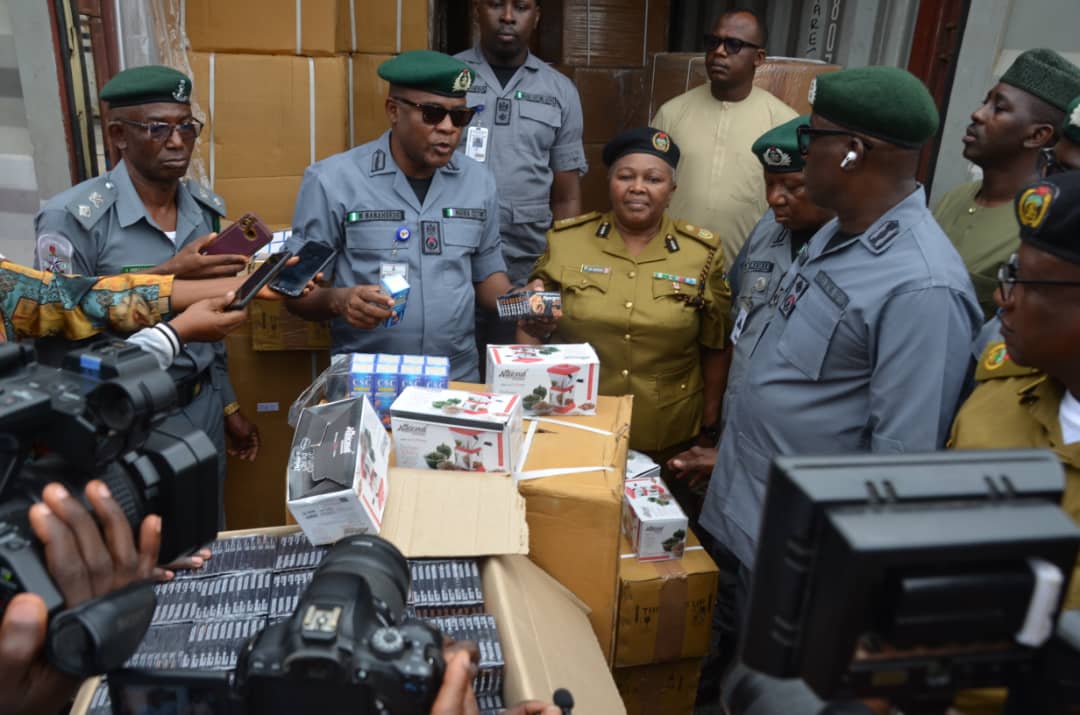
The Port Harcourt Area 11 Command, Onne Rivers State of the Nigeria Customs Service (NCS) has generated over N249 billion as revenue from January to May 2024.
The Customs Area Controller (CAC) for the command, Comptroller Mohammed Babandede, while addressing newsmen, disclosed that his men also seized six containers of contraband goods worth over N3 billion within the period under review.
“On assumption of office, I embarked on courtesy visits to Bonded Terminals, various sister agencies and had series of meetings with stakeholders to seek for their cooperation in terms of collaboration, synergy and information sharing, in line with the Controller General of Customs, Mr Adewale Adeniyi, policy thrust of consolidation, collaboration and innovation.”
“The command was initially given a target of N494 billion before it was reviewed two weeks ago to N618 billion as revenue target for the year 2024,” he stated further, adding that, “As of the end of May 2024, the command had generated a total revenue of N249.8 billion, which translate to 50.4 per cent of the initial target and 40.3 per cent of the current annual target.”
He noted that the command had an increase in revenue generation of N153.2 billion when compared with the preceding year, positing that this achievement occurred despite the nationwide strike embarked upon by the organised labour unions and holidays.
He insisted that the command looked forward to continuing the rise in revenue generation in the coming months and was optimistic that it would surpass the annual target by the end of the year.
On anti-smuggling activities, Mr Babandede, said, “We have on display six seized containers for violations or contraventions of various customs laws and breach of procedures as provided under the revised import prohibition guidelines of the Common External Tariff 2022-2026, as well as Sections 233, 234, 235, 245, 246 of Nigeria Customs Service Act 2023.”
“Also, today we have on display a seized Container of used electronics which has turned to e-waste. As you are aware of the environmental effect such waste pose to human lives, for the purpose of disposal we shall be working with the National Environmental Standards and Regulation Enforcement Agency (NESREA) in the spirit of inter-agency cooperation, synergy and in line with section 119 & 245 of the NCS Act 2023.”
“The content of these importations contravenes the provision of the law which prohibits and restricts certain goods for the protection of the public health and safety. Put together, the total Duty Paid Value of the 7 seized containers stands at N3.2 billion,” he added.
Economy
Dangote Refinery Crude Intake Hits 635,000b/d in April, Receives 21 Cargoes
By Adedapo Adesanya
Nigeria’s 650,000 barrels-per-day Dangote Refinery hit its highest-ever monthly crude intake in April 2026, taking in about 635,000 barrels per day of crude oil, according to Argus tracking data.
Deliveries in the review month rose from 565,000 barrels per day in March, bringing the refinery close to its full installed capacity.
The increase followed the completion of maintenance work on one of the refinery’s crude distillation units earlier this year.
This indicates that the Dangote Refinery is steadily ramping up operations toward full capacity after a gradual start since late 2023.
The refinery received 21 separate crude cargoes in April — a record since operations began.
All supplies came from West Africa, mainly Nigerian crude grades, with one cargo from Cameroon.
Nigerian grades delivered included Bonny Light, Escravos, Qua Iboe, Bonga, Forcados, Brass River, Amenam, and others.
Cameroon’s Ebome crude was supplied to the refinery for the first time.
April receipts comprised 160,000 barrels per day of Bonny Light, 65,000 barrels per day each of Escravos, Qua Iboe and Bonga, 50,000 barrels per day of CJ Blend, then 25,000-35,000 barrels per day each of Nigerian Utapate, EA, Jones Creek, Amenam, Forcados, Brass River, plus 25,000 barrels per day of Cameroon’s Ebome.
The strong rise in local and regional crude supply could also reduce the refinery’s dependence on imported crude grades and strengthen Nigeria’s domestic fuel production capacity.
The Argus report said that no US crude was delivered in April, despite the US West Texas Intermediate (WTI) crude previously being a major feedstock for the plant in 2025.
The refinery relied heavily on Suezmax tankers, with some vessels making multiple shuttle trips between offshore terminals and the refinery.
Average crude receipts in the first four months of 2026 climbed to 495,000 barrels per day, significantly above last year’s average of 375,000 barrels per day.
The data assessed Dangote’s April receipts at a weighted average of 35.1°API and 0.2 per cent sulphur content, compared with 37.2°API and 0.2 per cent sulphur in March. Receipts averaged 37.1°API and 0.15 per cent sulphur in January-April, compared with 36.8°API and 0.2 per cent sulphur across 2025.
The report also added receipts for May appear good as the refinery should get a cargo each of Qua Iboe and Odudu this week.
Economy
Customs Area 11 Command Seizes N2bn Containers of Illicit Items
By Bon Peters
About 17 containers containing illicit items worth over N2 billion have been seized by the Area 11 Command of the Nigeria Customs Service (NCS) in Onne, Port Harcourt, Rivers State, between January and April 2026.
In the period under review, the agency generated about N258 billion as revenue, a statement signed by the command’s acting spokesman, Mr Paul Istifanus Gimba, an Assistant Superintendent of Customs 1, disclosed on Thursday.
The Customs Area Controller for the Command, Comptroller Aliyu Mohammed Alkali, said last month, more than N77 billion was generated, noting that this reflects the command’s unwavering commitment to revenue generation, trade facilitation, and the enforcement of extant government fiscal policies.
He stated that in the second month of this month, his men intercepted an attempt to smuggle one 40-foot container declared to contain plumbing materials, with a Duty Paid Value (DPV) of N185.2 million.
According to him, upon examination, it was discovered that the perpetrators had concealed the original container number and replaced it with a fake one in an attempt to unlawfully remove the container from the port without payment of duty.
Furthermore, he hinted that in April 2026, the command intercepted six 20-foot containers carrying a total of 1,100 jerricans of Super Delicieux Vegetable Oil with a DPV of N494.0 million, in contravention of section 55 of the Nigeria Customs Service Act, 2023, which prohibited the importation of refined vegetable oils and fats in order to protect and promote local industries, particularly domestic vegetable oil producers and agro-allied businesses.
The senior customs officer highlighted other items seized by his men during the period under review, including cartons of chilli cutters, ceiling fans, and food packs.
The Comptroller reminded all mischievous importers and their agents that the command remained unwavering in its resolve to combat smuggling and all forms of illegal trade practices at the port, even as he strongly encouraged all law-abiding traders to remain compliant and resist the temptation to engage in activities that contravene the law.
Mr Alkali praised the professionalism of the officers and men of the command as well as their vigilance and dedication to duty.
He also thanked members of the press for their continued partnership and commitment to disseminating accurate and reliable information about the activities of the agency to the public.
Economy
Indonesia Buys Nigerian Crude Oil to Reduce Exposure to Hormuz Disruptions
By Adedapo Adesanya
Indonesia has imported crude oil from Nigeria as Southeast Asia’s largest economy moves to reduce its dependence on Middle Eastern supplies amid rising geopolitical tensions involving the United States, Israel, and Iran.
Indonesia’s Ministry of Energy and Mineral Resources confirmed that Nigerian crude cargoes have already arrived in the country as part of efforts to diversify supply routes away from the volatile Strait of Hormuz, a key global oil transit chokepoint that handles about 20 per cent of world oil shipments.
The development positions Nigeria as an increasingly strategic alternative supplier in the global energy market as buyers seek more stable and flexible crude sources outside the Middle East.
Nigeria, which is Africa’s largest crude producer, has always sold some of its crude grades via joint ventures with international oil companies as well as to Dangote Refinery, to boost domestic production.
Indonesia’s Director General of Oil and Gas, Mr Laode Sulaeman, said the country was prioritising crude imports from suppliers whose shipping routes do not pass through the Strait of Hormuz, which has faced heightened security concerns following the ongoing conflict involving Iran, Israel, and the United States.
Apart from Nigeria, Indonesia is also considering crude supplies from Russia and the US.
The move could strengthen Nigeria’s crude export market at a time the country is seeking to boost production levels and attract new long-term buyers for its oil grades.
Speaking in March, the chief executive of the Nigerian National Petroleum Company (NNPC) Limited, Mr Bayo Ojulari, said that Nigeria could increase oil production by about 100,000 barrels per day over the next few months to realistically help the global shortfall.
Before the latest geopolitical tensions, around 20 per cent of Indonesia’s crude imports came from the Middle East. However, the country has now accelerated plans to diversify supply sources, naming Nigeria among key replacement suppliers alongside Angola, Brazil, Russia, and the US.
The development comes as Nigeria continues to gain attention in global oil markets, with its crude grades increasingly sought after because of their relatively low sulphur content and suitability for modern refineries.
Indonesia also recently opened talks with Russia for long-term crude and liquefied petroleum gas supplies, including a proposed purchase of 150 million barrels of Russian crude scheduled for delivery from late 2026.
-
Feature/OPED6 years agoDavos was Different this year
-
Travel/Tourism10 years ago
Lagos Seals Western Lodge Hotel In Ikorodu
-
Showbiz3 years agoEstranged Lover Releases Videos of Empress Njamah Bathing
-
Banking8 years agoSort Codes of GTBank Branches in Nigeria
-
Economy3 years agoSubsidy Removal: CNG at N130 Per Litre Cheaper Than Petrol—IPMAN
-
Banking3 years agoSort Codes of UBA Branches in Nigeria
-
Banking3 years agoFirst Bank Announces Planned Downtime
-
Sports3 years agoHighest Paid Nigerian Footballer – How Much Do Nigerian Footballers Earn