Connect with us

Economy

Quickly Settle Rift with Senate to Save Economy, LCCI Tells FG

Published

on

By Dipo Olowookere

The presidency has been charged to, as a matter of urgent public importance, resolve its issues with the Senate over the confirmation of members of some boards and agencies, including that of the Monetary Policy Council (MPC).

This Monday, the council could not meet to make decisions on monetary policies for the country, a thing observers said was dangerous to the economy.

Since this Monday, the Nigerian Stock Exchange (NSE) has closed in the red zone, with some analysts attributing this to the gradual loss of investors’ confidence in the economy as a result of cancellation of the MPC meeting because the council lacked quorum to seat.

President Muhammadu Buhari had in 2017 sent names of people to fill the vacant positions in the council, but the Senate did not attend to the nominees because of its rift with the presidency.

The upper parliament wants Mr Ibrahim Magu removed as the Acting Chairman of the Economic and Financial Crimes Commission (EFCC), but the President has refused. His name was sent to the Senate two times, but was rejected by the red chamber.

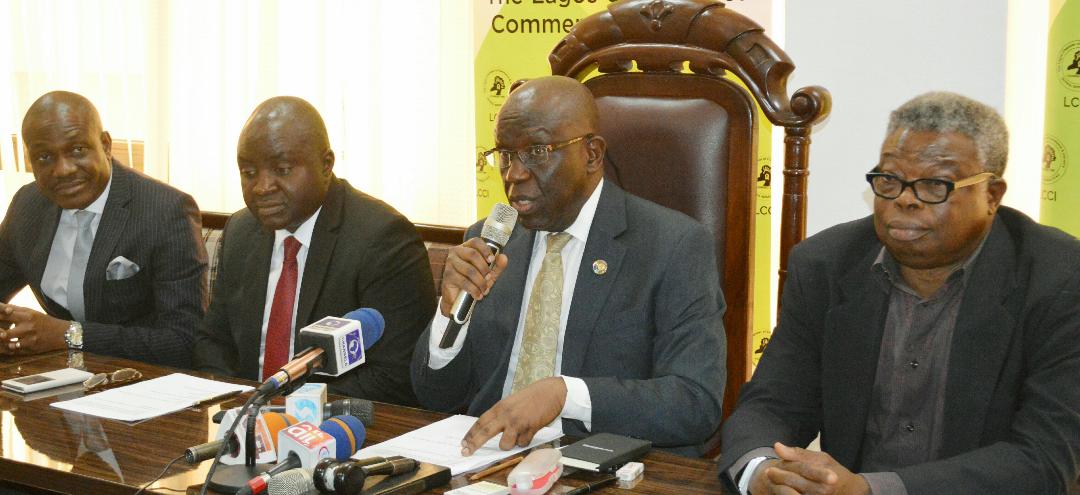
At a press briefing on Wednesday on the state of the economy, President of the Lagos Chamber of Commerce and Industry (LCCI), Mr Babatunde Paul Ruwase, appealed to both parties to sheath their swords.

He said the crisis was already affecting the nation’s economy.

“The disagreement between the presidency and the Senate over the confirmation of nominees for heads of some agencies is beginning to take its toll on the economy.

“For instance, the Central Bank of Nigeria (CBN) suspended its first MPC meeting for this year scheduled for January 22 and 23 due to its inability to form a quorum as a result of non-confirmation of nominees by the Senate.

“The MPC has the mandate to review economic and financial conditions of the economy, make decisions on policies for the economy in the short and medium terms, review regularly the CBN monetary policy framework and adopt changes when necessary.

“The failure of the MPC to meet as scheduled has adverse effect on stakeholders in the financial sector and the economy in general.

“We call on the presidency and the Senate to quickly resolve their differences in the interest of public,” Mr Ruwase said at the event.

On the incessant scarcity of petrol in the country, the LCCI boss said, “We have concerns over the reluctance of government to liberalise the sector and open it up to private sector participation.

“The concentration of petroleum products supply in the Nigerian National Petroleum Corporation remains a major cause for concern. The arrangement is an inherent entrenchment of state monopoly in the NNPC to the detriment of private investors.

“The midstream and downstream petroleum sector currently suffers from regulatory regime which is negatively impacting growth, investment and job creation in the sector.

“The current model of managing the downstream petroleum sector is not sustainable. It is at variance with the present administration’s vision to diversify the economy and create jobs.

“It perpetuates the phenomenon of rent economy and is detrimental to economic competition. The truth is that the citizens are the ultimate beneficiaries of a competitive market environment.”


Dipo Olowookere is a journalist based in Nigeria that has passion for reporting business news stories. At his leisure time, he watches football and supports 3SC of Ibadan. Mr Olowookere can be reached via [email protected]

Click to comment

Leave a Reply

Your email address will not be published. Required fields are marked *

Economy

Naira Gains 0.03% Against Dollar at NAFEX, Bitcoin Drops Below $60,000

Published

on

yuan-naira $10bn

By Adedapo Adesanya

The Naira recorded a marginal gain of 43 Kobo or 0.03 per cent against the United States Dollar on Wednesday, June 25, in the Nigerian Autonomous Foreign Exchange Market (NAFEX) to sell for N1,380.11/$1 compared with the previous day’s N1,380.54/$1.

However, the Nigerian currency lost N3.21 against the Pound Sterling in the official market during the session to close at N1,818.84/£1, in contrast to Wednesday’s exchange rate of N1,815.63/£1, and against the Euro, it fell by N3.21 to trade at N1,566.84/€1 versus midweek’s value of N1,563.63/€1.

In the same vein, the Nigerian Naira depreciated against the Dollar at the GTBank FX deck yesterday by N3 to sell for N1,383/$1 compared with the preceding session’s value of N1,380/$1, and at the black market window, it remained unchanged at N1,395/$1.

Interbank FX turnover at the NFEM window surged by about 56 per cent day-on-day to close at $195.371 million from $125.588 million reported on Wednesday, according to data from the Central Bank of Nigeria (CBN).

The Naira continues to feel the impact of rising FX payments and a strong US Dollar amid a sharp slowdown in forex market interventions by the central bank, with more than six weeks of no support for the local currency.

Nigeria’s foreign reserves increased further to $51.142 billion, while oil prices continue to be held in the $70 range by developments in the geopolitical scene.

Meanwhile, in the cryptocurrency market, Bitcoin sank below $60,000 as more than $1 billion in crypto positions were liquidated over the past 24 hours, with longs accounting for $842 million of the damage. About 148,500 traders were wiped out. The largest single position was a $38 million bitcoin-dollar bet on Hyperliquid. It led at $489 million in liquidations and dropped 2.8 per cent to sell at $59,862.61.

Ethereum (ETH) crashed by 5.5 per cent to $1,554.57, Ripple (XRP) declined by 4.8 per cent to $1.03, Cardano (ADA) fell by 4.3 per cent to $0.1433, Dogecoin (DOGE) dropped 3.4 per cent to sell at $0.0745, TRON (TRX) slid 2.2 per cent to $0.3215, Binance Coin (BNB) slumped by 1.8 per cent to $561.34, and Solana (SOL) dipped by 0.3 per cent to $62.94, while the US Dollar Tether (USDT) and the US Dollar Coin (USDC) sold flat at $1.00 each.

Continue Reading

Economy

Dangote Refinery Cuts PMS Gantry Price by N50 to N1,125 Per Litre

Published

on

Dangote refinery petrol

By Aduragbemi Omiyale

The gantry price of Premium Motor Spirit (PMS), commonly known as petrol, has been cut down by N50 to N1,125 per litre from N1,175 per litre by Dangote Petroleum Refinery.

The refinery confirmed this development via a statement on Thursday to newsmen.

Dangote Refinery described this downward review of the product’s price as a reflection of its ongoing commitment to ensuring price stability, improving affordability, and supporting Nigeria’s energy security objectives.

It further said it underscores its responsiveness to prevailing market conditions and its efforts to pass on cost efficiencies to downstream partners and consumers.

In the statement, the company said it remains focused on its broader mission of contributing to economic growth, enhancing fuel availability, and fostering a more competitive and sustainable petroleum sector in Nigeria.

Continue Reading

Economy

Crude Oil Jumps Over 2% After Vessel Hit Near Strait of Hormuz

Published

on

Cawthorne crude oil

By Adedapo Adesanya

Crude oil prices rose more than 2 per cent on Thursday after a cargo vessel was hit ‌by an unknown projectile near Oman, putting an evacuation effort for ships from the key Strait of Hormuz on hold.

Brent futures gained $1.52 or 2.1 per cent to ​settle at $75.26 a barrel, while the US West Texas Intermediate (WTI) crude chalked up $1.58 or 2.3 per cent to trade at $71.92 per barrel.

The flow of oil and gas has been disrupted since the joint US-Israeli attacks on Iran at the end of February, but the agreement between the US and Iran to end the war has ​allowed the resumption of traffic through the crucial strait.

The United Nations International Maritime Organisation on Thursday paused its effort ​to shepherd ships and seafarers through the strait after the cargo ship reported a suspected attack. This reawakened concerns about the worldwide flow of oil.

Reuters reported that Iran fired on the cargo ship ​as it attempted to pass through the strait after Iranian authorities said the security of vessels passing outside designated Hormuz routes is not guaranteed.

Previously, crude shipments through the strait rose to their highest since the start of the war on Wednesday. Before the war, about 20 per cent of world oil supplies passed through the ​Strait, located between Iran and Oman.

Key fuel oil producers Iraq, Saudi Arabia, and Oman have moved to increase shipments from ports outside the Persian Gulf. Middle Eastern fuel oil exports are set to jump by 20 per cent from May to about 508,000 barrels per day in June.

US ‌Secretary of ⁠State Marco Rubio told Gulf allies on Thursday that any deal with Iran would take their interests into account, as he wrapped up a Middle East trip aimed at winning over regional partners with deep reservations about the preliminary accord.

The US and the six-member Gulf Cooperation Council (GCC) said a lasting peace would mean addressing Iran’s ballistic missiles, drones and support for proxy groups. However, the US also threatened that if Iran threatens or blocks ships ​in the strait, there will be a “problem.”

The ​Wall Street Journal reported that Iran estimates charging for security, safety and environmental services in the strait, which would bring ​in $40 billion a year ⁠for the states involved.

In Venezuela, thousands were feared dead ⁠after two ​powerful earthquakes affected the capital, Caracas. The quakes could slow the ​increase in Venezuelan oil exports expected by US President Donald Trump’s administration after it captured Venezuela’s President Nicolas Maduro in January.

Continue Reading

Trending