Economy
Sanwo-Olu Foresees Lagos as Largest Food Logistics Hub in West Africa
By Adedapo Adesanya
The Lagos State Governor, Mr Babajide Sanwo-Olu, has disclosed that the first phase of the largest food logistics hub in West Africa will be inaugurated in the state by 2024 to boost food security.
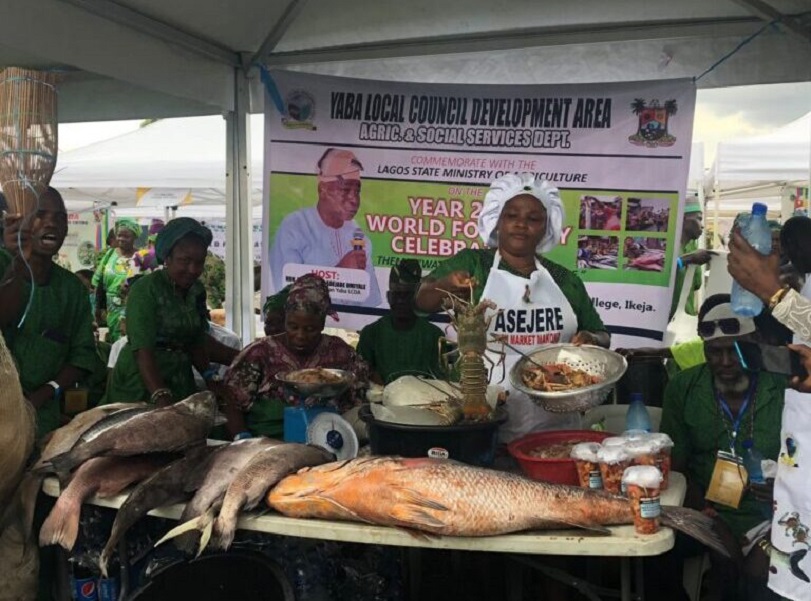
Mr Sanwo-Olu said this while addressing journalists at the grand finale of the 2023 World Food Day celebration at the Nigeria Police College, Ikeja, Lagos, on Monday. The programme tagged Farm Fair, Shop, Eat and Learn was to commemorate the 2023 World Food Day with the theme Water is Life, Water is Food, Leave No One Behind.
World Food Day is an annual celebration by the Food and Agriculture Organisation of the United Nations on October 16, to encourage action on food insecurity.
“Apart from the middle-level markets that we are building, we are building the largest food logistics hub in the whole of West Africa.
“You were part of the ground-breaking ceremony which we did last year and I want to inform you that before middle-level next year, we should have finished phase one of the project.
“It is the largest logistics hub in the whole of West Africa, you can take a trip there independently and see for yourself, the amount of work that is going on there.
“That logistics food market is supposed to be the central hub where all sorts of food in Lagos will come in, it has cold storage and dry storage and all sorts.
“Our plan, if you remember that two years ago, we flagged with our five-year plan, it will now take them to the middle-level market; we have built about three of them and we are building an additional five.
“The middle-level markets will now take it from main hubs before it now goes to the last mile, the corner show markets and the markets that all of you see in the state,” he said.
The governor said the state had a robust integrated plan that would ensure food sufficiency and food adequacy in Lagos.
He noted that the plan became important because food security globally was becoming an issue.
“We have a robust integrated plan to ensure that food sufficiency, and food adequacy in Lagos are secured because food security globally is becoming an issue.
“For us as a government, we need to be able to help the market, we need to be able to help the farmers and to help our citizens.”
“We will continue to bring about infrastructure and funding to ensure that the theme for this year leaves no one behind,” he said.
The governor encouraged more people to go into rice cultivation to sustain the state’s rice mill in Imota, Ikorodu.
“We are looking for paddy rice growers in Lagos because we have the biggest rice mill and we are also collaborating with other states.
“Our rice mill still needs a lot of paddy. It does not matter the quantity of tonnes of paddy that they grow, we will buy it from them.
“The same thing with other paddy growers in the country and we need to begin to ensure that food is also affordable and accessible.
“We know that the price of food has gone up but with intervention like this, that brings the market closer to the consumers, am sure that all of the produce that has been brought here today will be picked up and bought up,” he said.
Mr Sanwo-Olu said his administration was committed to encouraging farmers while assuring that farming was important to his administration to ensure that food was affordable and accessible for all.
“I am here this afternoon to give them all the encouragement, to show to the world that Lagos can begin to show the way for urban farming.
“We do not have a lot of land but the little one that we have, we are encouraging our farmers to continue to support the needs of the citizens because we know that we need to grow what we eat and eat what we grow.
“We can collaborate with other neighbouring states and other parts of the country to bring all of these produce to Lagos because the population is here.
“For me, it is to continue to encourage the Ministry of Agric and all of their officers, extension workers and project managers to continue to help and hold these farmers, especially in the aquaculture farming, piggery, fishing, poultry and all of the other areas in which we can excel.”
Economy
Crude Oil Jumps Over 2% After Vessel Hit Near Strait of Hormuz
By Adedapo Adesanya
Crude oil prices rose more than 2 per cent on Thursday after a cargo vessel was hit by an unknown projectile near Oman, putting an evacuation effort for ships from the key Strait of Hormuz on hold.
Brent futures gained $1.52 or 2.1 per cent to settle at $75.26 a barrel, while the US West Texas Intermediate (WTI) crude chalked up $1.58 or 2.3 per cent to trade at $71.92 per barrel.
The flow of oil and gas has been disrupted since the joint US-Israeli attacks on Iran at the end of February, but the agreement between the US and Iran to end the war has allowed the resumption of traffic through the crucial strait.
The United Nations International Maritime Organisation on Thursday paused its effort to shepherd ships and seafarers through the strait after the cargo ship reported a suspected attack. This reawakened concerns about the worldwide flow of oil.
Reuters reported that Iran fired on the cargo ship as it attempted to pass through the strait after Iranian authorities said the security of vessels passing outside designated Hormuz routes is not guaranteed.
Previously, crude shipments through the strait rose to their highest since the start of the war on Wednesday. Before the war, about 20 per cent of world oil supplies passed through the Strait, located between Iran and Oman.
Key fuel oil producers Iraq, Saudi Arabia, and Oman have moved to increase shipments from ports outside the Persian Gulf. Middle Eastern fuel oil exports are set to jump by 20 per cent from May to about 508,000 barrels per day in June.
US Secretary of State Marco Rubio told Gulf allies on Thursday that any deal with Iran would take their interests into account, as he wrapped up a Middle East trip aimed at winning over regional partners with deep reservations about the preliminary accord.
The US and the six-member Gulf Cooperation Council (GCC) said a lasting peace would mean addressing Iran’s ballistic missiles, drones and support for proxy groups. However, the US also threatened that if Iran threatens or blocks ships in the strait, there will be a “problem.”
The Wall Street Journal reported that Iran estimates charging for security, safety and environmental services in the strait, which would bring in $40 billion a year for the states involved.
In Venezuela, thousands were feared dead after two powerful earthquakes affected the capital, Caracas. The quakes could slow the increase in Venezuelan oil exports expected by US President Donald Trump’s administration after it captured Venezuela’s President Nicolas Maduro in January.
Economy
Distributors Kick Against Plans by Lagos to Tackle Egg Glut
By Adedapo Adesanya
The Eggs Sellers and Distributors Association of Nigeria (ESDAN) has kicked against the proposed plan involving the production of egg powder to tackle the glut of eggs.
The National President of ESDAN, Mrs Olaide Graham, made the position clear in an interview with the News Agency of Nigeria (NAN) this week.
Egg glut occurs when egg production exceeds consumer demand, resulting in a surplus that often forces farmers to sell at reduced prices to avoid spoilage.
The Lagos State Government recently announced plans to establish an egg powder processing facility as part of efforts to address seasonal egg glut in the poultry sector.
Mrs Graham described the initiative as a welcome development but maintained that it would not address the fundamental challenges facing the industry.
“The establishment of an egg powder factory in Lagos to address the egg glut situation will have a positive impact if it is properly implemented and the product meets market standards.
“It could help reduce waste and, to some extent, stabilise prices temporarily.
“However, egg powder may not be widely accepted as a substitute for fresh eggs in this part of the country because of differences in taste, texture and consumer perception.
“Many consumers still regard fresh eggs as more nutritious,” she said.
According to her, the major issue is identifying and addressing the root causes of the egg glut rather than focusing solely on processing surplus eggs.
“We have a population of over 200 million people. Why should there be an egg glut?
“We need to examine what farmers, distributors and other stakeholders are not getting right and provide the necessary support.
“Egg powder is not the cure for egg glut in Nigeria. Stakeholders should come together to identify sustainable solutions,” she said.
Mrs Graham noted that egg powder could serve as a raw material for the production of other goods, but should not be viewed as a long-term remedy for the challenge.
She emphasised the need for improved distribution systems across the egg value chain.
“Effective distribution can go a long way in addressing the problem.
“We should remember that Lagos distributes not only eggs produced within the state but also eggs brought in from other parts of the country.
“In every challenge, there is always a solution, but egg powder is not the major solution to egg glut,” she said.
The ESDAN president also dismissed concerns that egg distributors could be negatively affected by the proposed factory.
“Distributors have nothing to fear because Nigerians are accustomed to consuming fresh eggs.
“The number of consumers who will continue to prefer fresh eggs will still be higher.
“Even if egg powder production affects access to fresh eggs, there will still be ways to address that challenge.“If the purpose of producing egg powder is to reduce glut, then that is why distributors have joined the conversation,” she said, according to the news agency.
Economy
Oyedele Advocates Domestic Resource Mobilisation Over Foreign Aid
By Adedapo Adesanya
The Minister of Finance and Coordinating Minister of the Economy, Mr Taiwo Oyedele, says that reliance on aid and concessional finance was neither sustainable nor sufficient.
He said this at the opening of a high-level capacity-building session in Abuja on Wednesday, noting that Nigeria needs to strengthen local funding sources, a message that also guided discussions during a visit by an Ethiopian delegation to learn about Nigeria’s Integrated National Financing Framework (INFF).
“Domestic Resource Mobilisation remains the most critical pillar of any credible financing framework”, he said. “Our objective is not to increase the burden on citizens. Our objective is to create a fairer, more efficient and growth-oriented revenue system that supports development, encourages enterprise and strengthens voluntary compliance.”
The minister presented Nigeria’s INFF as a practical, evolving response to the continent’s widening financing gap for the Sustainable Development Goals (SDGs) and Agenda 2063.
He outlined the process that had produced the framework — a Development Finance Assessment, a multi-stakeholder steering committee and a Financing Strategy aligned with the Medium-Term National Development Plan.
He also cited concrete reforms such as expanded digitalisation of tax administration, deeper engagement with international capital markets through green and sustainability-linked instruments and institutionalised accountability mechanisms.
“These are not merely technical outputs,” Mr Oyedele said. “They are the instruments by which we mobilise, align and deploy financing to turn plans into services — schools, clinics, roads and social protection for our people.”
He insisted the INFF was “a living framework” that would continue to adapt as Nigeria sought to deepen private-sector participation, mobilise climate finance and strengthen subnational financing architecture.
The minister’s emphasis on sovereign revenue came with a direct appeal to state actors, urging states to pursue reforms that would increase the tax-to-GDP ratio without unduly burdening households.
Mr Oyedele positioned the INFF as the mechanism to reduce external dependence by aligning public, private, domestic and international finance with national priorities.
“This is not cause for despair”, he said of Africa’s financing gap. “Rather, it is an opportunity to rethink how development is financed and to ensure that every available source of capital is aligned with national priorities.”
Addressing the Ethiopian delegation directly, Mr Oyedele framed the engagement as mutual learning, stating: “Nigeria does not claim to have all the answers. Rather, we offer our experience in the spirit of partnership, transparency and mutual learning. Ask difficult questions. Challenge assumptions. Share your innovations and experiences.”
In her remarks, the Senior Special Assistant to the President on SDGs, Mrs Adejoke Orelope-Adefulire, told delegates that the capacity of states to effectively mobilise, manage and deploy financial resources directly influenced the quality of life of millions of Nigerians.
She stressed that states must carry constitutional responsibility for primary healthcare, basic education, water and sanitation and other frontline services.
She also warned that current revenue and institutional weaknesses at the subnational level threatened service delivery across the country.
“The fiscal realities confronting many sub-national governments — rising expenditure pressures, limited internally generated revenue, growing infrastructure deficits, climate-related vulnerabilities and global economic uncertainties — are battering state finances,“ Mrs Orelope-Adefulire said. “Addressing these issues requires innovative thinking, bold reforms and stronger collaboration among all key stakeholders.”
On her part, UNDP Resident Representative, Ms Elsie Attafuah, echoed the call for domestic solutions while emphasising the value of peer learning.
“The Sustainable Development Goals are ultimately delivered in states, provinces, cities and communities,” she said. “This is why strengthening fiscal capacity at the state level is not simply a revenue issue. It is fundamentally a development issue.”
Ms Attafuah commended Nigeria’s reform agenda and stressed that South-South cooperation, exemplified by the Ethiopia–Nigeria exchange, could accelerate progress, noting, “No single country has all the answers. Yet every country has lessons that can help others move further and faster.”
-
Feature/OPED6 years agoDavos was Different this year
-
Travel/Tourism10 years ago
Lagos Seals Western Lodge Hotel In Ikorodu
-
Showbiz3 years agoEstranged Lover Releases Videos of Empress Njamah Bathing
-
Banking8 years agoSort Codes of GTBank Branches in Nigeria
-
Economy3 years agoSubsidy Removal: CNG at N130 Per Litre Cheaper Than Petrol—IPMAN
-
Banking3 years agoSort Codes of UBA Branches in Nigeria
-
Banking3 years agoFirst Bank Announces Planned Downtime
-
Sports3 years agoHighest Paid Nigerian Footballer – How Much Do Nigerian Footballers Earn