Connect with us

Economy

Senate Summons Edun Over 4% FOB Fees, Gives Customs N10trn Revenue Target

Published

on

wale edun senate

By Adedapo Adesanya

The Senate has directed the Nigeria Customs Service (NCS) to raise its revenue target for 2025 from N6 trillion to N10 trillion.

The upper chamber of the National Assembly on Monday cited the urgent need for enhanced enforcement and surveillance amid rising smuggling and insecurity challenges across the country as rationale for the upward review.

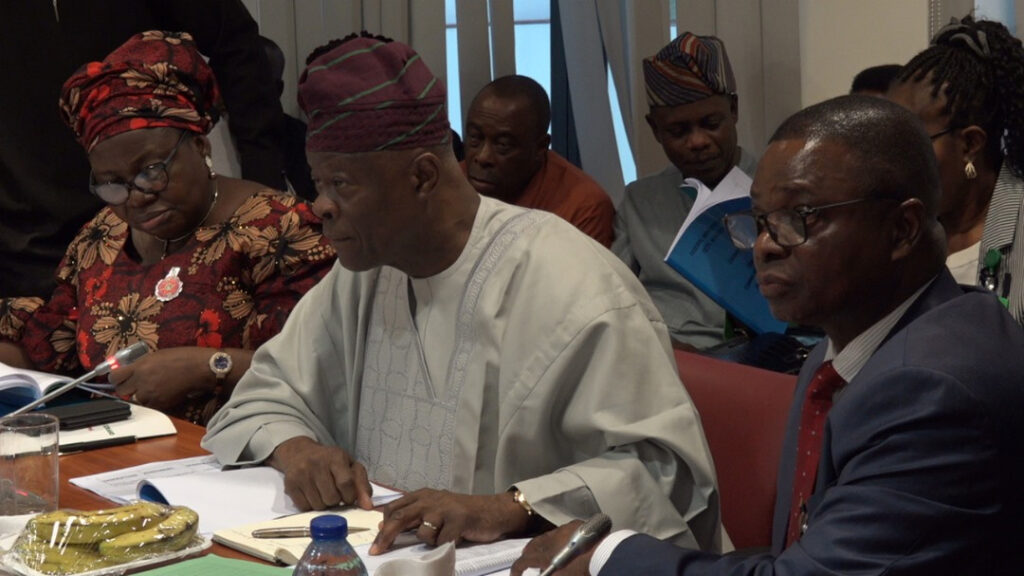
The Chairman of the Senate Committee on Customs, Mr Isah Jibrin, stated this  when the NCS’ Deputy Comptroller General Jibo Bello appeared before the committee for its budget defence.

The tariff policy of the government became the crux of the matter as the committee identified gaps, frowning upon the lack of enforcement of a 4 per cent freight on board (FOB) by the agency.

Mr Bello disclosed that customs had been authorised by the Ministry of Finance to halt collection of the 4 per cent freight on board.

Based on this, the chairman of the committee mandated the Minister of Finance, Mr Wale Edun, to appear before it to explain the suspension of the 4 per cent freight on board charges, which they say was an infraction of the law.

The Senate is expected to question the finance minister and key stakeholders at the scheduled appearance on Thursday, as it seeks to ensure accountability, revenue optimisation, and national security enforcement in line with existing legislative frameworks.

Earlier this year, the Customs announced the suspension of the 4 per cent charge and noted that the pause period will enable comprehensive engagement and consultations between the Minister of Finance, Mr Wale Edun and other stakeholders.

The FOB, put at 4 per cent charge on imported goods, was meant to replace an older system where companies like Webb Fontaine handled import inspections for a 1 per cent fee. The move sparked heavy criticism from stakeholders like the Nigeria Employers’ Consultative Association (NECA).

“The suspension period will allow the Service to further engage with stakeholders while ensuring proper alignment with the Act’s provisions for sustainable funding of these modernisation initiatives.” NCS said in February.

NCS also cancelled declarations made during the short-lived implementation.

Adedapo Adesanya is a journalist, polymath, and connoisseur of everything art. When he is not writing, he has his nose buried in one of the many books or articles he has bookmarked or simply listening to good music with a bottle of beer or wine. He supports the greatest club in the world, Manchester United F.C.

Economy

Oyedele Eyes Fiscal Discipline, Investor-friendly Environment, Fair Taxation

Published

on

taiwo oyedele wale edun

By Aduragbemi Omiyale

Mr Taiwo Oyedele has set some goals he intends to achieve as Nigeria’s Minister of Finance and Coordinating Minister of the Economy.

While taking over from his predecessor, Mr Wale Edun, on Thursday, the tax expert assured that he has no plans to overturn some of the reforms already put in place by the former occupier of the seat.

In a message on Friday, he emphasised that, “Our immediate task is to consolidate these gains, deepen ongoing reforms, and ensure they translate into tangible benefits for all Nigerians.”

He promised to ensure fiscal discipline by embracing transparent and prudent management of public resources, while also harmonising revenue administration, broadening the tax base, reducing the burden on the vulnerable population, and supporting economic growth.

Mr Oyedele further said his other strategic priorities include creating a predictable and investor-friendly environment anchored on policy coherence, consistency, and clarity; and aligning efforts across all tiers and institutions to maximise policy impact.

He also said efforts would be made to deepen collaboration with the private sector and other key stakeholders for data-driven policy design, co-implementation, and feedback for continuous improvement.

According to him, “Good policy design alone is not enough; success will be defined by execution. We are committed to disciplined implementation, accountability, and measurable results.”

“I look forward to working with colleagues across government, the private sector, and all Nigerians as we move from reform to result, accelerate growth and build a more stable, inclusive, and prosperous economy,” he stated.

Continue Reading

Economy

NASD Bourse Edges Up 0.23% as NSI Nears 3,970 Points

Published

on

NASD OTC Bourse

By Adedapo Adesanya

The NASD Over-the-Counter (OTC) Securities Exchange further appreciated by 0.23 per cent on Thursday, April 23, with the Unlisted Security Index (NSI) adding 8.99 points to close at 3,969.96 points against the previous day’s 3,968 points.

The rise in the share price of Central Securities Clearing System (CSCS) Plc by N2.86 to N69.34 per unit from N66.48 per unit raised the market capitalisation of the NASD bourse by N5.38 billion to N2.380 trillion from N2.375 trillion.

Yesterday, there were two price losers, led by Food Concepts Plc, which lost 29 Kobo to sell at N2.65 per share versus N2.94 per share, while UBN Property Plc dipped by 22 Kobo to N2.03 per unit from N2.25 per unit.

During the session, the volume of securities traded declined by 97.9 per cent to 451,522 units from 21.5 million units on Wednesday, the value of securities depreciated by 52.32 per cent to N23.6 million from N49.5 million, and the number of deals depreciated by 3.6 per cent to 27 deals from 28 deals.

At the close of business, Great Nigeria Insurance (GNI) Plc remained the most active stock by value on a year-to-date basis with 3.4 billion units valued at N8.4 billion, followed by CSCS Plc with 59.5 million units exchanged for N4.0 billion, and Okitipupa Plc with 27.8 million units traded for N1.9 billion.

GNI Plc also closed the day as the most traded stock by volume on a year-to-date basis with 3.4 billion units worth N8.4 billion, trailed by Resourcery Plc with 1.1 billion units transacted for N415.7 million, and Infrastructure Guarantee Credit Plc with 400 million units sold for N1.2 billion.

Continue Reading

Economy

Naira Weakens to N1,353/$ at Official Market

Published

on

Naira appreciates

By Adedapo Adesanya

Fresh foreign exchange (forex) demand pressure saw the Naira depreciate against the United States Dollar in the Nigerian Autonomous Foreign Exchange Market (NAFEX) on Thursday, April 22, by N5.46 or 0.4 per cent to trade at N1,353.91/$1 compared with the preceding day’s value of N1,348.45/$1.

It was the same outcome for the local currency in the official market after it depreciated against the Pound Sterling by N4.13 to close at N1,825.88/£1, in contrast to the preceding session’s N1,821.75/£1, and against the Euro, it dropped 72 Kobo to finish at N1,582.72/€1 versus N1,582.00/€1.

But the Nigerian Naira appreciated against the US Dollar at the GTBank FX desk by N2 during the session to quote at N1,361/$1 compared with Wednesday’s closing price of N1,361/$1, and at the parallel market, it closed flat at N1,375/$1.

FX Pressure came as data showed that NFEM interbank turnover was N28.117 million, lower than the N66.084 million recorded the previous day.

Concerns over liquidity pressures, policy transparency, and confidence in Nigeria’s FX market continue to grip the market while the country’s foreign reserve declines further, even as the Central Bank of Nigeria (CBN) recently said that the recent decline in Nigeria’s external reserves should not be a cause for concern.

Global developments also played a significant role, as rising geopolitical tensions boosted demand for the US Dollar, further weakening emerging market currencies, including the Naira.

As for the cryptocurrency market, there was a mixed outcome as traders reacted to rising geopolitical tensions from the Iran war and fresh inflation data from Japan.

Japanese inflation ticked higher in March, stoking expectations that the Bank of Japan may soon signal rate hikes, which could strengthen the yen and unsettle global risk assets.

The Iran conflict has disrupted oil flows through the Strait of Hormuz, raising energy costs and inflation risks worldwide and potentially complicating efforts by the Federal Reserve to cut interest rates.

Ethereum (ETH) declined by 1.8 per cent to $2,316.53, Bitcoin (BTC) lost 0.6 per cent to sell at $77,935.53, Solana (SOL) fell by 0.5 per cent to $85.67, and Binance Coin (BNB) dropped 0.4 per cent to sell for $634.85.

However, Dogecoin (DOGE) appreciated by 1.4 per cent to $0.0976, Ripple (XRP) grew by 0.7 per cent to $1.43, Cardano (ADA) expanded by 0.6 per cent to $0.2493, and TRON (TRX) improved by 0.2 per cent to $0.3279, while the US Dollar Tether (USDT) and the US Dollar Coin (USDC) traded flat at $1.00 each.

Continue Reading

Trending