Connect with us

Economy

Strifor Broker Launches Summer Client Contest

Published

on

Strifor Broker trading competition

In July 2023, all clients of Strifor broker can take part in a trading contest, the winners of which will receive money prizes ranging from $1,000 to $3,000.

It should be reminded that the Strifor broker has been present on the market for more than three years. It is trusted by traders from CIS countries, Asia (it is especially popular among investors in Indonesia and India) and North Africa. Four account types are available on the service, one of which is an Islamic account. All accounts have fairly low commissions and spreads. For example, Professional account holders, the commission per lot when trading metals and currency pairs does not exceed $5; spreads start at 0.1 pip. Basic and Advanced accounts have slightly higher commissions: $8 and $7 per lot; however, the leverage is 1:500, whereas on the Professional account, the leverage is 1:200.

The Strifor broker’s partners also appreciate its affiliate program and loyalty program. The former allows earning income from all of the referrals’ trades. When the highest, Gold level, is reached, the commission bonus reaches 60%. Two other levels, Silver and Bronze, have 50% and 40% correspondingly. With the Loyalty Program, traders can use their deposits to accumulate funds with an annual yield of up to 18%. Due to this, the Strifor clients can switch from one type of account to another much faster, without investing extra money on their part.

Conditions for participation in the contest

All active users of the service are eligible to take part in the contest. This means that a trader should be verified at strifor.org and has one of the real account types open.

For participation, it is necessary to:

  • Send a free-form application to [email protected] with the number of the account participating in the contest;
  • Confirm consent to participate in the contest by sending an email.

All traders who work over 50 lots during the campaign are guaranteed to win prizes.

There is one important thing! Only orders with activity more than 10 minutes and with the result not less than +/-20 points by Forex tools and metals are taken into the contest results.

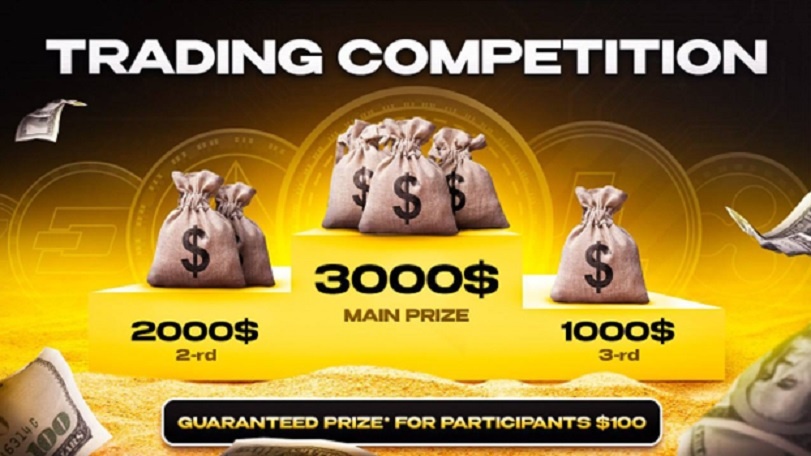
The traders, who worked with the largest volume, will get money prizes from the Strifor broker. The award amounts to:

  • 1st place – $3000;
  • 2nd place – $2000;
  • 3rd place – $1000.

The contest period is from July 1, 2023, to July 31, 2023. It is possible to take part in the campaign at any time. The main thing is to send an application during the period of this campaign.

Summing up of results and awarding of prizes

The results of the contest will be announced from August 1, 2023 to August 7, 2023. All prizes will be awarded automatically on August 7, 2023.

Intermediate results will be regularly posted on strifor.org in the “News” section, as well as on the broker’s official Telegram-channel.

Further information on the contest

The Strifor broker points out that:

  • Winners and other participants in the campaign are personally responsible for payment of taxes and other fees associated with receiving the money reward;
  • If a winner refuses to verify his/her profile and provide identification details, he/she may be denied a prize;
  • Only one prize may be awarded to one trader;
  • The Strifor employees and their relatives are not eligible to participate;
  • All questions and claims regarding the campaign are handled according to the clauses of the client agreement posted on the Strifor broker’s website;
  • Participation in the trading contest automatically implies that the trader is familiar with the rules of the contest and fully accepts them.

The broker also notes that the contest winners may be invited for advertising and marketing activities (interviews, photo- and video-reportages, and media publications). At the same time, Strifor undertakes not to disclose the personal data of the campaign participants without their prior consent.


Dipo Olowookere is a journalist based in Nigeria that has passion for reporting business news stories. At his leisure time, he watches football and supports 3SC of Ibadan. Mr Olowookere can be reached via [email protected]

Economy

Russia-Ukraine Peace Talks, Trim in Expected Surplus Weaken Oil Prices

Published

on

oil prices fall

By Adedapo Adesanya

Oil prices fell on Thursday as investors focused on Russia-Ukraine peace talks and trimming in the projected 2026 oil surplus, with Brent crude trading at $61.28 a barrel after losing 93 cents or 1.49 per cent and the US West Texas Intermediate (WTI) crude at $57.60 a barrel, down by 86 cents or 1.47 per cent.

The prospect of a possible peace agreement between Russia and Ukraine also appeared to be driving the market lower. Such a deal would likely increase the supply of Russian oil that is currently off the market for most of the world.

Despite attacks, market analysts noted that there seems to be some movement on a possible path to peace between Russia and Ukraine.

The leaders of Britain, France and Germany held a call on Wednesday with US President Donald Trump to discuss the US’ latest peace efforts to end the war in Ukraine, in what they said was a “critical moment” in the process.

Russian Foreign Minister Sergei Lavrov said on Thursday that a recent visit to Moscow by US envoy Steve Witkoff had resolved misunderstandings between the two countries.

Ukraine’s security services (SBU) executed a long-range drone strike on the Vladimir Filanovsky offshore oil field in the Caspian Sea, a key Lukoil facility, forcing a suspension of oil and gas production.

The attack is significant as it marks the first time Kyiv has targeted hydrocarbon extraction assets in the distant Caspian region, demonstrating a growing capability to hit critical upstream assets far from the frontline.

On Wednesday, the US said it seized an oil tanker off the coast of Venezuela, as escalating tensions between the two countries raised concerns about supply disruptions.

The Organisation of the Petroleum Exporting Countries (OPEC) in its latest monthly report maintained a firm demand outlook for 2025-2026, pointing to resilient consumption in China, India, and the Middle East while reiterating that non-OPEC supply growth is set to moderate after 2025.

The group also noted that OPEC+ supply management continues to anchor market stability, a markedly more optimistic stance than the International Energy Agency (IEA’s) earlier glut-heavy narrative.

In its latest update, the agency trimmed the projected 2026 surplus for the first time since May, cutting its glut forecast from 4.09 million barrels per day to 3.84 million barrels per day as sanctions on Russia and Venezuela curb supply and as global demand proves stronger than previously assumed. Improved macro conditions and easing tariff concerns also prompted the IEA to revise 2026 demand growth upward by 90,000 barrels per day.

Continue Reading

Economy

Lagos Ranks Best State for Business Operations in Nigeria

Published

on

Sanwo-Olu minimum wage

By Adedapo Adesanya

Lagos remains Nigeria’s top-performing state for ease of doing business, according to a new report by the Presidential Enabling Business Environment Council (PEBEC).

PEBEC in its Subnational Ease Of Doing Business Report 2025, which analyses the business environment across Nigeria’s 36 states and the Federal Capital Territory (FCT), noted that five states stood out as the strongest performers: Lagos, Kaduna, Oyo, the FCT and Ogun.

Lagos with 85.6 per cent stood out particularly for infrastructure such as roads and logistics, land administration, regulatory digital transformation, and digital literacy. It also continues to serve as the country’s tech hub and logistics gateway. Others include Kaduna (65.1 per cent), Oyo (62.7 per cent), the FCT (61.0 per cent) and Ogun (59.9 per cent).

Meanwhile, states such as Benue, Borno, and Zamfara remain at the bottom of the ranking as years of prolonged conflict and terrorism continue to make business operations challenging.

“Lagos state demonstrates strong market access, supported by efficient one-stop shops and clearly published incentives. Streamlined regulatory procedures and coordinated institutional support enable businesses to enter and expand operations with minimal delays, fostering investor confidence and enhancing the state’s attractiveness for new investment,” it said.

While Lagos ranks ahead of its peers, critical gaps include touting and loitering, investor aftercare, and digital connectivity.

PEBEC warned that “the presence of unauthorized individuals loitering around key business and logistics touchpoints creates an environmental nuisance and introduces significant security and safety concerns for commercial operators and the public.”

On digital connectivity, PEBEC said with network coverage concentrated in urban centres, limiting businesses to city clusters and restricting e-commerce adoption in inner towns and communities, and curtailing digital economic gains, adding that poor performance in investor aftercare signals gaps in post-entry support.

“The absence of a dedicated desk or poorly functioning departments results in delayed responses, inconsistent engagement, and limited guidance for investors, reducing Lagos state’s ability to retain existing investments and attract new capital.”

PEBEC noted that the Lagos State government must launch a high-capacity, dedicated Investor Aftercare Service to provide white-glove support for existing investors.

In the medium term, it advised that the state to prioritize enhanced security measures and regulatory enforcement by integrating real-time surveillance at key street corners and business corridors, coupled with deploying dedicated special task forces to physically remove loitering individuals.

“Crucially, the state should also pass an anti-loitering law to provide the legal framework necessary for sustained enforcement.”

On tackling its long term challenges, Lagos needs to upgrade digital infrastructure by extending fiber optic networks and incentivising last-mile connectivity.

“This will make high-speed internet more reliable, cut operational friction, and help businesses access markets easier,” PEBEC said.

Continue Reading

Economy

Nigeria’s Trade Surplus Falls 10.4% to N6.7trn in Q3 as Import Jumps

Published

on

trade surplus

By Adedapo Adesanya

Nigeria’s trade surplus, which measures the difference between export and imports, fell 10.4 per cent to N6.7 trillion in the third quarter of 2025 as import increased, the latest data by the National Bureau of Statistics (NBS) shows.

The Foreign Trade in Goods Statistics (Q3 2025) Report showed that Nigeria’s total merchandise trade stood at N38.94 trillion in Q3 2025, representing an increase by 2.4 per cent compared to the value recorded in Q2 2025 (N38.04 trillion).

Total exports in the period under-review were valued at N22.81 trillion, reflecting a 11.1 per cent rise compared to N20.54 trillion in the corresponding quarter of 2024 and a 0.3 per cent increase when compared to N22.75 trillion in Q2 2025. The value of total imports stood at N16.12 trillion in the same period, representing a 5.5 per cent increase from the value recorded in the corresponding quarter of 2024 (N15.28 trillion) and a 5.5 per cent increase compared to the value recorded in Q2, 2025 (N15.29 trillion).

This happened even after Nigeria launched a Nigeria First Policy initiative, which seeks to prioritize Nigerian companies, goods, and services in procurement with the aims to reduce import dependency.

Exports accounted for 58.59 per cent of total trade while imports accounted for 41.41 per cent of total trade in the third quarter of 2025.

Analysis shows that crude oil remained Nigeria’s major exported commodity in the third quarter of 2025 with a value of N12.81 trillion,  representing 56.1 per cent of total exports. A further breakdown reveals that the value of non-crude oil exports stood at N10.01 trillion accounting for 43.9 per cent of total exports; of which non-oil products contributed N29.96 trillion or 13.1 per cent of total exports.

In Q3 2025, Nigeria’s top five trading export partners were India, Spain, France, The Netherlands, and Italy. The most exported commodities were crude oil, natural gas, other petroleum gases in a gaseous state, Kerosene type jet fuel, and Urea, whether or not in aqueous solution.

China continued to dominate as Nigeria’s top import partner followed by the United States of America, India, the United Arab Emirates (UAE), and the Belgium. The most traded commodities imported during the quarter were Petroleum oils and oils obtained from bituminous minerals crude, Gas oil, Motor spirit ordinary, Durum wheat, Cane sugar meant for sugar refinery.

The value of exports to African countries stood at N4.9 trillion, while imports amounted to N595.00 billion. Nigeria’s exports to Africa were mainly to Ivory Coast with N1.44 trillion, Ghana with goods valued at N714.03 billion, South Africa with N710.33 billion, Togo followed with N531.06 billion, and Senegal with N418.64 billion altogether representing 77.8 per cent of exports to Africa.

On the other hand, Nigeria’s major import partners within Africa in Q3 2025 were South Africa with N163.44 billion, Ghana with goods valued at N110.42 billion, Egypt with N72.04 billion, Morocco with N59.99 billion, and Ivory Coast with N41.87 billion.

Continue Reading

Trending